

Three-minute read
Iran entered October 5, 2026, with another deadly security incident in Sistan and Baluchestan, persistent turmoil in the currency market, and fresh evidence of repression inside the education system.
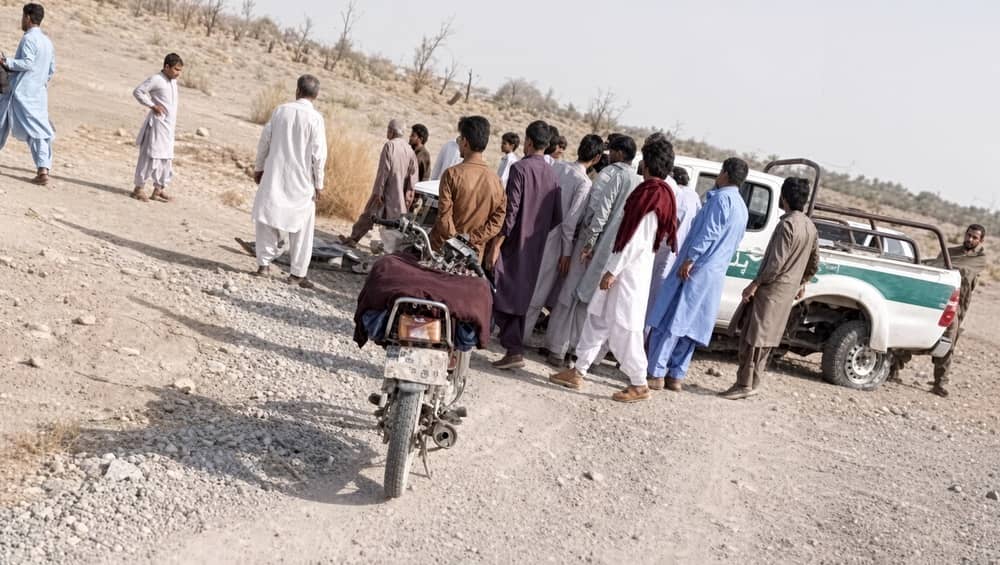
An armed group attacked a police patrol from the Nokju station on the Bampur-IranShahr road Monday morning, killing Second Lieutenant Amir-Hossein Ghasemi and First Sergeant Nezam Dast-Goshadeh and wounding a third officer. State media said security forces subsequently began searching the area for the attackers. The IRGC-run Tasnim later reported that Jaish al-Adl had issued a statement taking responsibility for the attack.
The incident extends the unusually concentrated series of armed confrontations and attacks seen across Sistan and Baluchestan over the past week—from Zahedan and Rask to IranShahr and now Bampur. Monday’s officially acknowledged casualties are therefore significant not only in themselves but because they add to a security environment that has required repeated deployments and operations across several districts.
The Rial Crisis Becomes an Information-Security Issue
In Tehran, meanwhile, authorities increasingly treated the currency crisis not just as a monetary problem but as an information-control issue.
The free-market dollar remained close to 270,000 tomans Monday. Iran’s Gold and Currency Information Network recorded it around 269,475 tomans at 5:34 p.m. Tehran time, after an intraday high above 271,000. The Central Bank’s official remittance dollar, by contrast, rose to only 176,281 tomans, leaving an enormous gulf between the administered and open markets.
Hours of fighting in Rask. An MOIS office attacked in Nokabad. A separate roadside bomb kills a regime-aligned fighter.
Meanwhile, the dollar reaches 263,000 tomans, factories warn of power and #financing crises, and regime figures clash over who had authority to negotiate.…
— NCRI-FAC (@iran_policy) October 2, 2026
That divergence persists despite the Central Bank’s multibillion-dollar intervention and the launch of individual cash-dollar sales through banks. But Monday brought a revealing additional response. Economic Security Police chief Hossein Rahimi announced that judicial and police action would begin against websites publishing what authorities call “false,” “inflated” or “bubble” exchange rates. He said the action followed instructions from the Tehran prosecutor and criticized domestic platforms for reproducing prices circulating on foreign-based channels.
Earlier in the day, Rahimi had also criticized the continuous publication of currency and commodity prices, arguing that such reporting could influence public expectations and the economic environment.
The progression is noteworthy. Authorities have already arrested currency traders, frozen accounts and targeted online channels. Now, while the market rate remains near record territory, the reporting of the price itself is becoming subject to police scrutiny. That does not resolve the underlying gap between official and free-market values; it instead makes information about that gap another arena of enforcement.
The internal argument over monetary policy is also intensifying. Lawmakers have repeatedly challenged Central Bank Governor Abdolnasser Hemmati over the currency intervention, including the decision to make as much as $10,000 available to individual buyers. One MP warned Sunday that scarce foreign exchange was effectively being distributed at a time when officials themselves acknowledge pressure on reserves.
Iran’s #economy is breaking at the household level. The dollar jumped from ~60,000 to ~258,000 tomans in two years. @IMFNews sees ~69% inflation in 2026 and a contracting economy. Bread, meat, oil, and medicine have surged far faster than wages—so families buy half a loaf and…
— NCRI-FAC (@iran_policy) October 2, 2026
World Teachers’ Day Under Detention and Prison
October 5 was also World Teachers’ Day, but a reports offered a stark picture of the situation facing Iranian educators.
According to a local human rights group, at least 47 serving or retired teachers are now imprisoned, detained or serving sentences of exile: 13 are serving prison terms, 32 remain in detention and two are in exile. The cases span 19 provinces, with the exact detention location or charges remain unclear in some cases.
The significance goes beyond the total. Punishments including long prison terms, dismissal from education, flogging, exile and occupational restrictions, while one case involves a double death sentence that has been upheld.
That repression coincides with a broader crisis in the profession. Recent domestic reporting has described teachers resigning over salaries that no longer cover basic living costs, while the Education Ministry has responded by portraying discussion of widespread resignations as part of a “cognitive” and cultural campaign against the system.
Iran’s dollar hit 268,500 tomans despite fresh Central Bank intervention.
A senior MP says people are dying because #medicine and treatment are unaffordable, alleges insurers are effectively bankrupt, and says $100 billion in trustee funds has not returned.
Meanwhile, gas…
— NCRI-FAC (@iran_policy) October 3, 2026
The pressures on education are mirrored by increasingly severe problems in healthcare. In a video circulating in recent days, Ruhollah Miri, head of the Cancer Institute at Tehran’s Imam Khomeini Hospital, described patients who had exhausted their assets paying for treatment and then begged doctors to end their lives, saying he had personally witnessed desperate patients attempting to throw themselves in front of vehicles outside the hospital. His account adds a human dimension to the wider evidence of rising out-of-pocket medical costs and failing insurance coverage.
The most revealing feature of October 5 is therefore not another exchange-rate number or another security incident. It is the erosion of confidence in the mechanisms through which a society normally absorbs pressure. Markets require credible prices, workers require institutions that make professional life sustainable, patients require insurance and healthcare they can actually access, and citizens require channels through which grievances can be expressed without detention.
When those mechanisms weaken simultaneously, economic hardship ceases to be merely a question of reduced consumption. It becomes a problem of institutional trust. And when authorities increasingly answer that loss of trust by policing information, cracking down on professional dissent and expanding security responses, the risk is that uncertainty itself becomes self-reinforcing.