

Three-minute read
As of March 2026, one truth stands out with brutal clarity: the Iranian regime fears its own people more than it fears any foreign enemy. A government that truly believed its own propaganda about national unity and “rallying around the flag” would try, at the very least, to ease domestic repression in order to preserve internal cohesion. But the ruling clerical dictatorship has done the opposite. It has continued killing political prisoners and protesters even while the country is under constant foreign bombardment. That choice is an admission of weakness, not strength. It reveals a regime that knows the greatest threat to its survival is not a foreign attack. It is a nationwide revolt.
The death penalty in Iran has never been functioning as a system of criminal justice. It is a weapon of political repression. It is the state’s most extreme tool for intimidating society, crushing dissent, and preventing organized resistance. No one should dignify these executions by treating them as ordinary capital punishment. They are state-sanctioned killings carried out by a regime that has turned courts into instruments of fear and prisons into factories of coerced confessions.
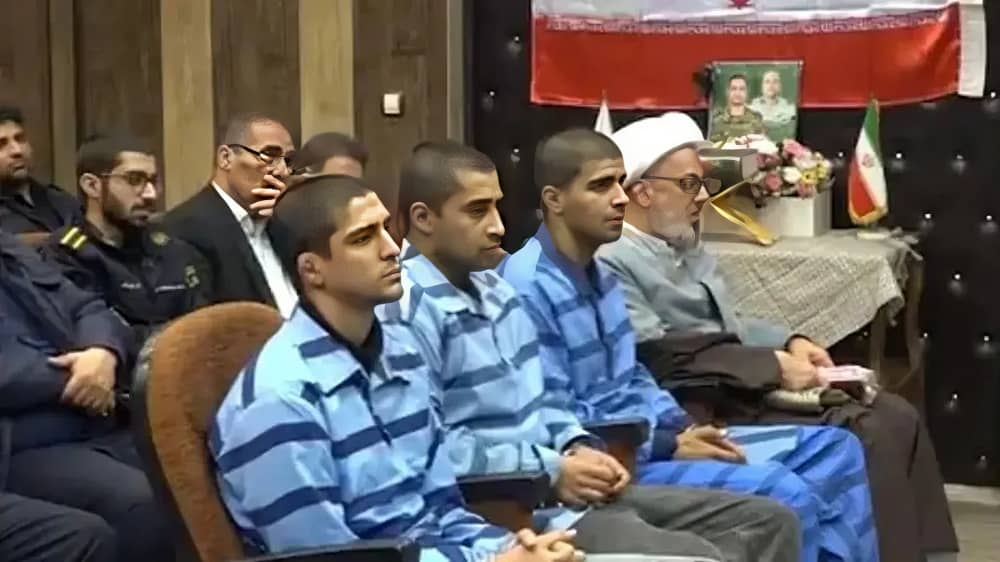
The execution of three young men in Qom on March 19, 2026, exposed this reality in its most naked form. On the eve of Nowruz and Eid al-Fitr, when millions of Iranians should have been preparing for renewal, family, and celebration, the regime chose the spectacle of death. Saleh Mohammadi, only 19 years old, a national wrestling champion and bronze medalist at the 2024 Saitiev Cup in Russia, was hanged in public. Saeed Davoudi, 21, was executed just two days before his 22nd birthday. Mehdi Ghasemi was killed alongside them after a trial reportedly lasting only minutes. All three had been arrested during the January 2026 uprising. The charges against them involved the killing of two police officers, but the men and human rights defenders maintained that the so-called confessions used to convict them were extracted under severe torture.
NCRI Statement: #Iran Marks More than 2,200 Executions in 2025, Unprecedented High in Khamenei's 37-Year Criminal Rulehttps://t.co/hPkFuWp9jN pic.twitter.com/4ALu0I17Oj
— NCRI-FAC (@iran_policy) December 31, 2025
This was not justice. It was political murder staged as law. It was meant to send a message far beyond Qom: if you rise up, if you join the streets, if you become a symbol of defiance, the state will make an example of you. The public hanging of a teenage athlete was not incidental. It was deliberate theater. The regime understands that visible executions create fear not only among activists, but among families, classmates, workers, and young people who see their own future in the face of the condemned. The point is not merely to kill three men. The point is to terrorize a nation.
The broader context makes the regime’s fear even more obvious. Following the January 2026 uprising, estimates suggest that more than 50,000 people were detained. That is not policing. That is mass political intimidation. It reflects a government trying to overwhelm society through arrests, torture, disappearance, denial of medical care, and death sentences. And it is doing so while facing regional conflict and wartime instability.
NCRI Statement: Champion Boxer Mohammad Javad Vafaei's Death Sentence Upheld, Forwarded for Implementationhttps://t.co/na8G4AASFc
— NCRI-FAC (@iran_policy) December 16, 2025
What makes this machinery of terror even clearer is the regime’s targeting of PMOI-linked political prisoners now facing the gallows. Among those named in the material are Vahid Bani-Amerian, Seyyed Mohammad Taghavi Sang-Dehi, Babak Alipour, Pouya Ghobadi, Akbar (Shahrokh) Daneshvarkar, Abolhassan Montazer, Ehsan Faridi, Manouchehr Fallah, Mohammad Javad Vafaei Sani, Zahra Shahbaz Tabari, and Karim Khojasteh.
That is the real face of this regime’s “justice”: it is using death sentences to decapitate resistance, terrorize dissident networks, and send a warning to every politically conscious Iranian that even belief, loyalty, or kinship can become a capital offense. In a moment of war and bombardment, Tehran is not uniting the country; it is tightening the noose around its most defiant prisoners because it knows the danger it fears most is not abroad, but at home.
But even inside the prison system, the regime has failed to extinguish resistance. Prisoners involved in the “No to Execution Tuesdays” campaign, now reportedly active in 56 prisons, continue to organize weekly hunger strikes against the execution spree. Their resistance matters because it shows that fear has not achieved total submission. Even from cells, even under death sentences, political prisoners are refusing the moral legitimacy of the state that seeks to kill them.
Maryam Akbari Monfared: The Unyielding Voice of #Iran’s Political Prisoners, 15 Years of Unjust Captivityhttps://t.co/idFu1qjeVO
— NCRI-FAC (@iran_policy) October 14, 2024
Every execution proves that this dictatorship survives not through consent or national legitimacy, but through naked terror. It understands that any retreat under foreign pressure would signal weakness to its own supporters and to a restive population waiting for its moment, so it will press on with repression and war rather than risk appearing vulnerable.
For that reason, the illusion that this threat can be contained through outside pressure alone is dangerously false. The only way to end the menace of this Islamic fundamentalist regime is to strengthen the one force it fears above all others: the people of Iran and their organized resistance.