

Three-minute read
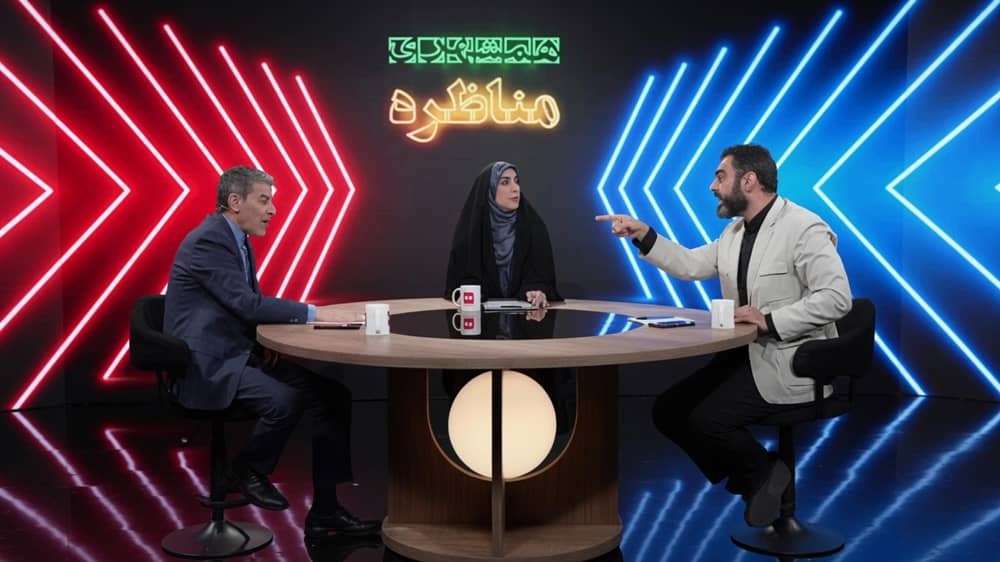
There is a kind of political theater that appears only when a system stops believing in its own future. Hamshahri TV appeared to stage this discussion to project an image of a strong, united regime: two deputies of the clerical regime’s parliament — Mohammad-Mehdi Shahriari of the National Security and Foreign Policy Committee and Amir-Hossein Sabeti from the Paydari Front — sat down to discuss war and negotiations and spent two hours dismantling each other, and with each other, the regime. Yet the two-hour program produced precisely the opposite effect. Instead of demonstrating unity and strength, the two men tore apart each other’s arguments and, in the process, exposed the deep divisions at the heart of the regime and the severe weakness those divisions reveal.
Some people in Western capitals will want the familiar script: a “pragmatic” camp against a “hardline” one, with the lesson that the first must be rewarded. That reading is a fabrication. Nothing here resembles the loyal disagreement of a democracy, where rivals contest policy and still share a floor. The cameras captured two factions of one apparatus accusing each other of treason, of foreign money, of destroying the state — men fighting over wreckage each suspect will not survive the next war.
The regime’s internal rift has now reached the very office on which the entire system rests. In a televised program— something once unthinkable — even the authority of the Supreme Leader was openly called into question. Sabeti had publicly claimed that the Islamabad accord was “imposed” on him. Shahriari immediately described the statement as “an open insult to the Leadership”. Yet Sabeti refused to retreat: “It is something I have said, and I am saying it again now. It is not an insult; it is the truth.” In a system built on the supposedly absolute authority of the velayat-e faqih, a parliamentary deputy can now declare on television that the Supreme Leader was overruled. What was once an untouchable taboo has become part of the regime’s public infighting — a striking measure of how far its internal divisions and erosion of authority have advanced.
"As internal factions wage intense political warfare over tactical #MoU concessions and hereditary succession, the fundamental crises driving the historic wave of popular uprisings since 2017 remain entirely unaddressed," writes Dr, @MasumehBolurchi. https://t.co/L5sGY8fPAp
— NCRI-FAC (@iran_policy) June 16, 2026
Shahriari insisted the Foreign Minister was the leader’s personal pick: “Mr. Araghchi was chosen by the Leader himself, and the next day Mr. Araghchi told me the Leader had summoned him.” Sabeti’s answer was a shrug at the throne: “Suppose the Leader whispered in your ear to make Araghchi minister… my legal duty is to oppose any minister.” Shahriari, defending the leader’s authority, ended up confessing its emptiness: “The Leader has said in a hundred places, ‘I say my view and you do as you please.'”
Then there is what Sabeti wants. He does not want leverage; he wants the war continued. Negotiation, he says, is “a necessary evil” at best, and if the enemy will not deal, “then you must fight, obviously.” He faults the regime for reopening the Strait of Hormuz and wants it shut again, with Bab al-Mandab, to break global supply chains: “The Strait of Hormuz is my strategic instrument.”
His revenge list extends past Israel and the United States to Arab neighbors: “the leaders and the palaces of the senior officials of every single Arab country” that hosted American forces “must be targeted.” Asked whether power should mean license, he answered plainly: “If we have power, we must do it — I am thinking realistically.” Shahriari’s retort was the most honest sentence of the night: “God forbid America’s power ever fell into your hands.”
"In recent weeks a severe political #crisis has erupted within Iran’s ruling establishment as the state #television network, the IRIB, systematically censors top state figures while airing calls to prosecute sitting leaders," writes Farid Mahoutchi.https://t.co/BKxtIYHkAP
— NCRI-FAC (@iran_policy) July 25, 2026
Shahriari’s own admissions are just as damaging. Recalling nuclear diplomacy in Europe, he let slip who guarded the Foreign Minister: Zarif’s detail “were Revolutionary Guard boys who did not share his views,” listening at the door until two in the morning. Diplomatic missions, by his own account, are IRGC operations with a diplomat inside. He then asked Sabeti whether dissenters in Iran are permitted to speak — “Don’t you arrest them?” — and, describing his years as a provincial governor, asked who his real overseers were: “Those who used to fabricate false case files — who were they?” He added that Hassan Rouhani cannot get airtime to answer his accusers. This is an insider testifying to censorship, surveillance and manufactured prosecutions.
The numbers they traded describe a state in liquidation: a country run on thirty billion dollars a year; wartime damage Shahriari puts at $270–300 billion, “ten years of our budget”; twenty villages in his own district without water and no five hundred billion tomans to fix it; a parliament shuttered for five months; a president Sabeti says is “sitting in a chair that is not his at all.”
"A brewing #diplomatic settlement between Tehran and Washington has ignited an unprecedented domestic crisis within the Iranian regime, exposing severe structural fractures at the highest levels of the clerical establishment," @HakamianMahmoud writes.https://t.co/FNT4uPeG5t
— NCRI-FAC (@iran_policy) June 15, 2026
And they know the street, where regime loyal but demoralized base is supposed to show force, is shrinking day by day. Shahriari, to Sabeti’s face: “You burned the mascot of our officials in the streets, and the people came to hate you — every night the crowd in the square gets smaller.” Then the dare no regime official makes about a healthy society: “Do you dare hold a referendum?”
The programme was clearly intended to project an image of a strong and united regime. Instead, two hours of televised knife-work, exposed the exact opposite: the economy broken, the leader bypassed, the parliament closed, diplomacy run by the Guard, dissent jailed — and the squares emptying. Far from demonstrating confidence or cohesion, the debate revealed a system weakened by deep internal fractures. This was not a debate about strategy. It was an argument about who to blame when the structure falls. And those who resent both factions, are watching.