

THIS PAGE WILL BE UPDATED WITH THE LATEST NEWS
UPDATE: 8:30 PM CEST
Iran, the Call from Rome: “Neither Shah nor Ayatollah—Only Freedom”

In support of Iran, Rome became the voice of the Resistance. Over two days of conferences, dozens of parliamentarians, former heads of state, and international diplomatic figures gathered in the Italian capital to send a clear message: the hope for a free Iran exists—and it is embodied by the organized Resistance.
The heart of Italy’s institutions and the capital’s convention center were transformed into a tribute to the Iranian people’s struggle. Two major international events placed at their core the stifled cries of political prisoners, the faces of those martyred in the uprisings, and the vision for a democratic future led by Maryam Rajavi, the President-elect of the National Council of Resistance of Iran (NCRI).
On July 30, the conference “Iran After the War – Prospects for Change and the Role of the Organized Resistance” was held in the Sala Regina of the Chamber of Deputies. The following day, at the Palazzo dei Congressi, the call grew even louder with the Free Iran World Summit.
Ayatollah Calls the Shots on Killings, Iranian Exiles Charge

In the Iranian regime’s intricate worldwide network for terror, the orders on terrorist acts and killings almost always come directly from the very top: the supreme leader himself, Ayatollah Ali Khamenei. “Not a single act of terrorism occurs without the order, approval, or supervision of Khamenei,” said Ali Safavi, spokesman for the National Council of Resistance of Iran, the leading opposition group to the regime.
The NCRI’s charge came barely 36 hours before reports that five death row prisoners in the Evin Prison — all convicted of opposing Khameni — were transferred to the Ghezel Hesar Prison, where executions are routinely carried out. Specifically, the five were sentenced to death on charges of membership in anti-Khomeni groups as well as assembly and collusion against national security and armed rebellion against the state.
Reza Pahlavi Does Not Represent the Iranian People

On July 25 and 26, Reza Pahlavi hosted a conference in Munich titled “National Cooperation to Save Iran.” He seeks to present himself as an exiled opposition leader. But who exactly is Reza Pahlavi—and why does he face such deep skepticism among Iranians, both inside and outside the country? Reza Pahlavi is the son of Mohammad Reza Pahlavi, Iran’s last Shah, who was overthrown in 1979 after a broad popular revolution. His regime was notorious for severe human rights abuses, systematic suppression of political opposition, strict censorship, and widespread corruption.
As early as 1976, Amnesty International documented how the Shah’s intelligence service, SAVAK, engaged in torture, imprisonment without trial, and extensive surveillance. One report concluded that “The Shah’s regime was one of the worst human rights violators in the world.”
UPDATE: 12:30 PM CEST
A view from Mark Isherwood – Welsh Conservative North Wales Member of the Senedd

I recently met with the Iranian Academics Association for an update on the rapidly evolving situation in Iran, the need to support efforts to protect lives and amplify the voices of those fighting for freedom at this critical time, and the need for a democratic alternative. Last year I sponsored and chaired a roundtable meeting in the Senedd with the Association, at which we also discussed ongoing developments in Iran and the Middle East war, and Iran’s theocratic regime.
At the meeting in 2024, we heard that at that point 120,000 lives had been lost, killed or under torture, that 30,000 had been arrested and 2,200 publicly hanged since the current uprising began, and that the ruthless theocratic Tehran regime is now a clear threat to global peace.
Maryam Rajavi, president-elect of the National Council of Resistance of Iran (NCRI), has offered a peaceful vision for change: no war, no appeasement. The path forward, she argues, lies in allowing Iranians to rise up and change their Government themselves. This approach requires no foreign boots on the ground, nor military or financial support — only recognition of their right to resist tyranny.
UPDATE: 7:30 AM CEST
She Died for Dreaming of Freedom. She Wasn’t the Last

In Connecticut, those of us in the Iranian-American community carry a sorrow that never really fades. We’ve lost family. We’ve lost friends. I lost my childhood friend, young, vibrant, and pregnant executed in an Iranian prison simply for believing in freedom.
Her murder wasn’t a random act of cruelty. It was part of a calculated massacre that unfolded in the 1980s, especially in the summer of 1988. Over 30,000 political prisoners, mostly members and supporters of the MEK (Mojahedin-e-Khalq) were systematically executed in prisons across Iran. Most had already been sentenced and were serving their time. But that summer, “death commissions” formed by clerics and regime officials asked them one question: “Do you still believe in the MEK?” Those who said yes were sent to the gallows. They were buried in unmarked mass graves, their families never notified.
Among those who signed off on this crime against humanity was Ebrahim Raisi, who later rose to the presidency. His role is no secret. His face is etched in survivors’ memories, and his name appears in UN reports and testimonies. Yet instead of a trial, he got a title. Instead of justice, he got power.
Blackouts, Bitcoin, And A Regime on Edge: Iran’s Summer of Power Cuts and Public Fury

On August 6, 2025, residents of Rasht rallied in Sabzeh-Meydan against water shortages and blackouts, facing a violent crackdown. The same day, locals in Benlar and Zivdar blocked the Khorramabad–Poldokhtar road over cuts to water and electricity. Nightly chants of “death to the dictator” and “death to Khamenei” have echoed from the darkness in Karaj, while even regime media carried citizens’ complaints of four to six hours without power in summer heat. By August 6, authorities shuttered the country except for three provinces—an extraordinary move that domestic outlets tied to environmental and infrastructure crises.
Political Prisoner Fatemeh Ziaee, 68, Arrested for the 7th Time

On Wednesday morning, August 6, 2025, Iranian security forces raided the home of Fatemeh Ziaee Azad (Houri), a former political prisoner and supporter of the People’s Mojahedin Organization of Iran (PMOI/MEK), arresting her and confiscating all her communication devices. This marks the seventh time Fatemeh Ziaee has been arrested over the past four decades.
Fatemeh Ziaee, now 68 years old, is a survivor of Iran’s notorious political prison system of the 1980s. She has spent over 13 years in prisons and torture centers under the clerical regime. Ziaee suffers from advanced multiple sclerosis (MS), and her health is reported to be in a fragile and deteriorating condition.
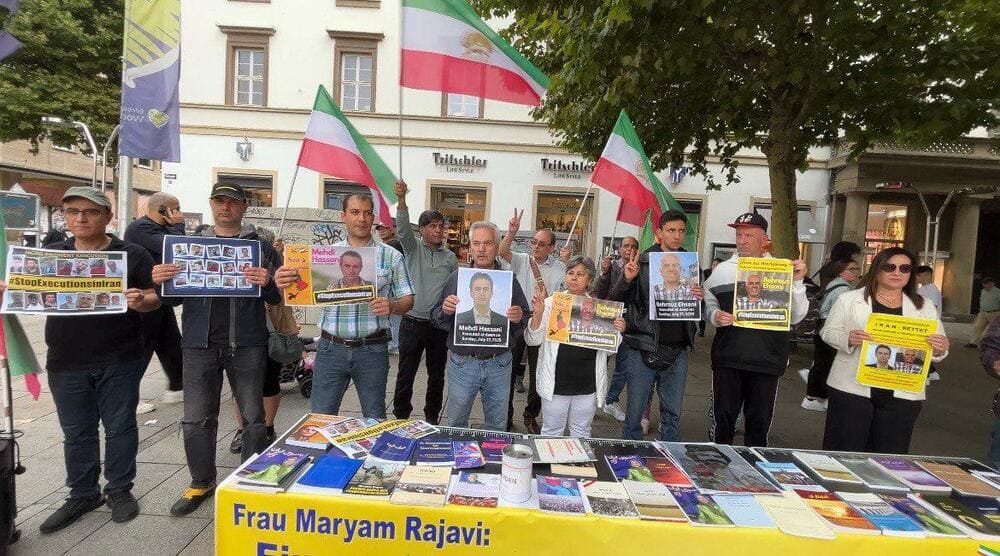
Brussels Book Stall Condemns Iran’s Executions and Promotes Free Iran Grand Rally on September 6

Brussels, Belgium – August 6, 2025 – A book stall organized by supporters of the People’s Mojahedin Organization of Iran (PMOI/MEK) in Brussels condemned the execution of Iranian political prisoners and called on Iranians and human rights advocates to join the Free Iran Grand Rally on September 6, 2025. The rally will unite voices from across Europe to demand justice, human rights, and a democratic Iran.
Manchester Exhibition Highlights Executions in Iran and Calls for Release of Political Prisoners

Manchester, UK – August 7, 2025 – The Academics in Exile Association, in support of the People’s Mojahedin Organization of Iran (PMOI/MEK), hosted a public photo exhibition and bookstall in Manchester to condemn the execution of Iranian political prisoners by the regime of Iran’s ruling clerics. The event specifically condemned the recent state-sanctioned executions of Mehdi Hassani and Behrouz Ehsani, both members of the PMOI.
Sudden Return of Over 600 Prisoners to Evin Prison

On Friday, August 8, 2025, over 600 political, security related, and financial prisoners, were suddenly and without prior notice to families returned from Greater Tehran penitentiary (Fashafouyeh) back to Evin Prison. This forced return occurred while several sections of Evin Prison remained unrepaired following the missile strike of June 23, 2025. Relocating prisoners to notoriously overcrowded and unsanitary wards; such as Ward 7 of Evin Prison; amounts to a clear case of gross human rights violations and a total disregard for the dignity and safety of detainees.
Evidence and reports confirm that the return of more than 600 prisoners to Evin Prison took place without adequate infrastructure or basic necessities in place. Far from being a sign of improved conditions, the move appears to be a hasty and opaque attempt at external crisis management following the exposure of inhumane conditions in temporary prisons. In practice, prisoners were returned to an environment already plagued by health, security, and overcrowding crises.
Extreme Heat Puts Lives of Iran’s Oil Industry Workers at Risk

Several labor-focused media outlets have criticized the extremely harsh conditions faced by workers in Iran’s oil industry amid soaring temperatures and have warned that their lives are at risk.
Oil industry workers are operating in extreme heat of 60°C (140°F) under critical water and electricity shortages and without any facilities or support, while contractors are failing to pay their wages and benefits.
A recent video showing a heat-stricken worker at the Kangan Petrochemical Complex has sparked strong criticism of the dangerous working conditions in the South Pars sites and other operational oil zones.
Iran’s Deepening Livelihood Crisis: Voices from the Streets
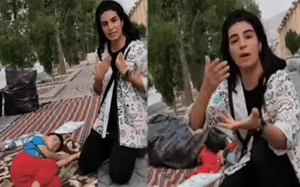
Power outages, food spoilage and soaring poverty drive Iranians to the streets, documenting daily collapse of basic services. The crisis of poverty, unemployment, and economic hardship in Iran has reached breaking point. From city centers to rural farmlands, citizens are speaking out — often in desperation — against conditions that have stripped them of stability, dignity, and hope. One such voice comes from a woman street vendor in Shiraz. In the sweltering heat of summer, she lays her child on the stone pavement near Hafezieh and speaks with raw frustration:
“It’s not fair that some live as billionaires, drowning in wealth and comfort, while others struggle to afford bread for the night.”
Iran Regime’s Media Push Unity Amid Rising Foreign Policy Pressures
State-controlled outlets rally behind Supreme Leader’s authority, warn of sanctions snapback, and attack dissenting voices within the regime. A review of Iran’s state-run press this week reveals a coordinated campaign to frame the country’s foreign policy challenges as a matter of national survival, demanding total unity behind the Supreme Leader’s directives. Several newspapers, including Ham Mihan, have sounded alarms over the potential activation of the UN’s “snapback” mechanism, warning that the return of international sanctions could have “serious consequences for the entire nation.” Drawing parallels to Mahmoud Ahmadinejad’s dismissive stance on sanctions as “worthless scraps of paper,” they insist that all political, diplomatic, economic, and military officials must work to prevent such a scenario.