

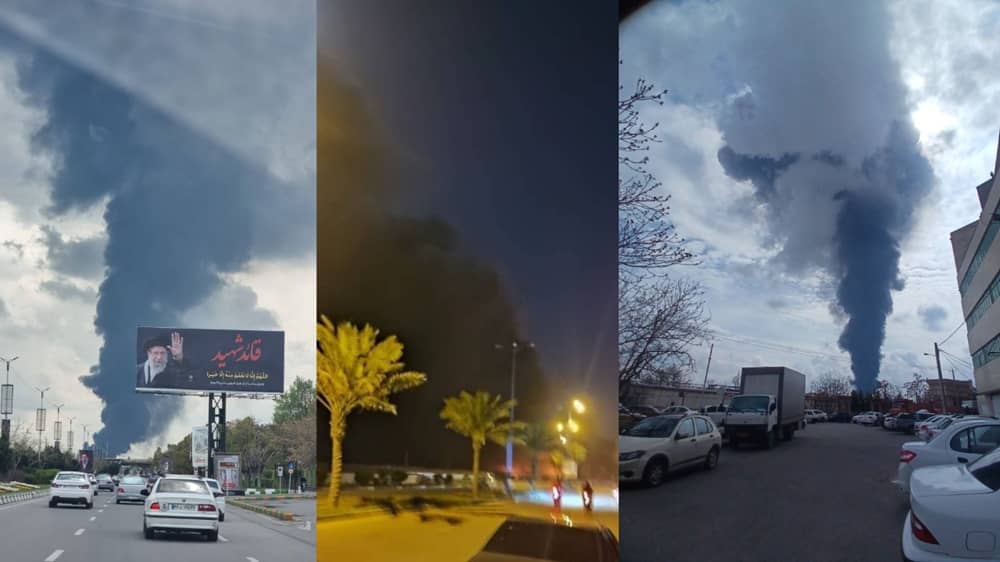
THIS PAGE WILL BE UPDATED WITH THE LATEST NEWS
UPDATE: 11:30 PM CEST
Senior Commanders Killed, Iranian Industrial and Military Sites Hit Nationwide, and Strait of Hormuz Crisis Deepens
The past 24 hours of the Iran war were defined by sustained strikes across Iranian military and industrial infrastructure, the continued killing of senior Iranian-linked personnel, and a sharp escalation in regional and economic warfare centered on the Strait of Hormuz. The regime in Iran responded with renewed missile attacks on Israel and Gulf states, but with limited tactical effect. At the same time, the near-total disruption of maritime traffic, rising global oil prices, and worsening humanitarian conditions inside Iran underscored the widening strategic impact of the conflict.
Regime Losses: Targets, Infrastructure, and Personnel
A sustained and coordinated wave of strikes over the past 24 hours targeted Iran’s military-industrial base across multiple regions, with a clear emphasis on degrading production capacity, logistics networks, and command infrastructure. In Tehran, approximately 20 weapons production sites and associated research facilities were struck, alongside infrastructure linked to paramilitary mobilization and internal security functions. Mehrabad International Airport and facilities connected to regime-linked forces remained under repeated pressure, indicating continued targeting cycles rather than isolated strikes.
⚠️ Update: It's now day 34 of #Iran's internet blackout as the nation-scale censorship measure continues past 792 hours in its second month.
Friends and family remain largely cut off from the outside world amid growing anxiety over wartime casualties, arrests, and executions. pic.twitter.com/rYkCV3vTuz
— NetBlocks (@netblocks) April 2, 2026
Industrial losses intensified significantly during this period. Major steel production facilities—including the Mobarakeh Steel Complex in Isfahan and key plants in Ahvaz—were struck again, with multiple sites reported rendered inoperable following repeated attacks. These facilities are central to Iran’s industrial output, and their continued targeting reflects a systematic effort to disrupt heavy industry rather than limited tactical strikes. Additional logistics and support infrastructure in Ahvaz and other cities was also hit, further constraining distribution and supply chains tied to both civilian industry and military production.
Strikes extended nationwide, with confirmed activity in Shiraz, Kermanshah, Sirjan, and Iran’s Kurdistan region, underscoring the geographic breadth of the campaign. The pattern of targeting—spanning weapons production, industrial manufacturing, and logistics—indicates an integrated approach aimed at degrading Iran’s ability to sustain prolonged operations.
Personnel losses within this 24-hour window included Mahdi Vafaei, a senior engineering commander within the Quds Force structure, killed in Mahallat. His role in overseeing underground weapons infrastructure projects made him a high-value operational figure.
Beyond Iran’s borders, Israeli strikes in southern Beirut targeted senior Iranian-linked and Hezbollah personnel. Among those killed was Hajj Youssef Ismail Hashem, a senior Hezbollah commander responsible for coordinating rocket and drone operations. His death, along with additional operatives killed in the same strike, represents a continued erosion of Iran’s regional command network within the same reporting period.
President Trump's threat to bomb Iran 'back to the Stone Age' raised tensions in the fifth week of the conflict, pushing oil prices higher and unsettling investors seeking a swift resolution https://t.co/PudDUbpetB pic.twitter.com/Ec9jRlfjOw
— Reuters (@Reuters) April 2, 2026
Iranian Retaliation and Its Effectiveness
The regime in Iran launched renewed missile attacks on April 2 targeting both Israel and Gulf states, demonstrating continued offensive capability despite sustained losses.
Ballistic missile launches toward Israel triggered air defense responses, with most projectiles intercepted and no major casualties reported. The limited impact of these strikes continues a pattern seen in recent days, where scale has not translated into effectiveness.
Iran also expanded its targeting profile regionally, firing toward Gulf countries and continuing coordinated attacks through aligned groups. Hezbollah launched heavy rocket fire into northern Israel during the same period, including barrages that struck civilian areas but caused no reported fatalities.
The war in Iran is dealing a heavy blow to Iraq’s economy. Iraq relies on oil revenues for roughly 90% of its budget. Most of its oil is exported through the Strait of Hormuz, which has been effectively closed since the conflict started. https://t.co/dsn2IyiFgy
— The Associated Press (@AP) April 2, 2026
Regional Spillover: Gulf, Shipping, and Strategic Infrastructure
The most consequential developments in the past 24 hours occurred in the maritime and economic domain. The clerical regime has effectively maintained a near-total disruption of the Strait of Hormuz, reducing shipping traffic by approximately 94% compared to normal levels and halting most commercial transit.
Iranian forces have continued targeting commercial shipping, with attacks affecting multiple vessels and forcing global rerouting of energy supplies. Oil exports are increasingly being diverted through alternative routes, including overland and pipeline systems, as regional states attempt to bypass the strait.
The global economic impact intensified sharply. Oil prices surged dramatically, with U.S. crude rising over 11% and Brent crude nearly 8% in a single day, driven by fears of prolonged disruption to energy flows.
International diplomatic efforts accelerated, with more than 40 countries engaging in talks to reopen the waterway. However, no resolution has been reached, and Tehran continues to signal it will use control of the strait as strategic leverage.
The United Nations warned that the situation places the global economy and regional stability at severe risk, describing the conflict as being on the edge of wider escalation.
The tallest bridge in the Middle East was partially destroyed in an airstrike hours after Donald Trump threatened to bomb Iran “back to the Stone Age”.
The B1 bridge in Karaj, which was still under construction, was set to form part of a major highway connecting the region with… pic.twitter.com/ikkyBQUzx1
— The Telegraph (@Telegraph) April 2, 2026
Internal Conditions Inside Iran
Inside Iran, humanitarian conditions deteriorated further over the past 24 hours. Medical needs have surged sharply due to continued strikes, with aid organizations warning that supplies are critically low and may soon be exhausted.
Power outages, communication disruptions, and logistical breakdowns continue to hinder relief operations. Civilians are increasingly unable or unwilling to access medical care due to ongoing strikes and security concerns.
At the same time, internal control measures remain severe. Communication remains heavily restricted, and the environment is tightly controlled as authorities attempt to manage internal stability during sustained external pressure.
French President Emmanuel Macron hit back at Donald Trump on Thursday after the US president mocked Macron’s relationship with his wife as he chided France for refusing to join the US-Israeli offensive against Iran. https://t.co/hzTaD1wot4
— CNN (@CNN) April 2, 2026
UPDATE: 10:30 PM CEST
Argentina Expels Iran’s Charge D’affaires
BUENOS AIRES, April 2 (Reuters) – Argentina’s government declared Iran’s charge d’affaires, Mohsen Tehrani, “persona non grata” and expelled him from the country, Argentina’s Foreign Minister said in a statement on Thursday.
The measure orders Tehrani to leave the country within 48 hours.
The decision comes in response to a statement released on Wednesday by Iran’s Ministry of Foreign Affairs, which accused Argentina’s president Javier Milei, an ally of U.S. president Donald Trump, and his foreign minister Pablo Quirno, of being complicit in military attacks on its territory.
UPDATE: 08:00 PM CEST
Iran Reportedly Executing Political Prisoners as War with Israel and U.S. Rages on

Iran executed four members of the political opposition this week in a move critics contend is the theocratic regime’s attempt to stifle and intimidate potential opposition, according to a new report. In the last week, four members of the People’s Mojahedin Organization of Iran (PMOI) were executed, the New York Post detailed. The regime said the men were convicted of crimes committed during protests in January.
“They were chivalrous men who did not bow to any torture or pressure and stood firm on their pledge and covenant until the very end,” Maryam Rajavi, president-elect of the Paris-based National Council of Resistance of Iran, said in a statement to Reuters.
Two Iranian Dissidents Facing Imminent Execution After ‘Grossly Unfair’ Trial, Human Rights Group Warn

Two Iranian political dissidents face execution as human rights organisations warn that time is running out. Vahid Bani Amerian, 34, and Abolhassan Montazer, 68, are at risk of being killed according to rights groups including Oslo-based NGO Iran Human Rights and Amnesty International. It follows the execution of teenager Amirhossein Hatami on Thursday after he took part in the January protests in Iran. Hatami was found guilty of entering a restricted military site in Tehran where he allegedly damaged and set fire to the facility.
Amerian, Montazer and their co-defendants Alipour, Ghabadi, Akbar, Daneshvarkar and Sangdehi were sentenced to death by an Iranian Revolutionary Court in Tehran in October 2024 after being convicted of “armed rebellion against the state” (baghi). They alleged that the men were affiliated with banned opposition group the People’s Mojahedin Organisation of Iran (PMOI).
UPDATE: 01:30 PM CEST
“The Enemy Is in Tehran!”

In these dramatic days of war, the bloodstained regime of the theocratic dictatorship still in power in Iran has hanged four members of the People’s Mojahedin: Mohammad Taghavi, in his fifties, and Akbar Daneshvar, in his sixties, executed on March 30; Puya Ghobadi, aged thirty-three, and Babak Alipour, aged thirty-four, on March 31.
As early as 1980, Ayatollah Khomeini, the founder of the regime, had declared that “the enemy is here, in Tehran,” identifying the People’s Mojahedin as the most serious threat to his reactionary regime. That logic of the “primary enemy” has never changed. Those who do not pretend otherwise know full well that the real opponent of the mullahs’ regime is the Iranian people and their organized resistance. The regime, even in its decline, cannot afford to ignore this, because it represents its very negation.
If the regime’s actions and behavior, together with decades of appeasement policies, have contributed to igniting the war in Iran, the arrival of a spring of revolution remains inevitable; it will come.
UPDATE: 09:30 AM CEST
We Seek Not Power, But the Transfer of Power to the Iranian People
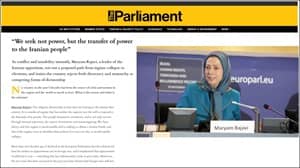
As conflict and instability intensify, Maryam Rajavi, a leader of the Iranian opposition, sets out a proposed path from regime collapse to elections, and insists the country rejects both theocracy and monarchy as competing forms of dictatorship. No country in the past 5 decades has been the source of crisis and tension in the region and the world as much as Iran. What is the reason and what is the solution?
Maryam Rajavi: The religious dictatorship in Iran does not belong to the twenty-first century. It is a medieval regime that has neither the capacity nor the will to respond to the demands of its people. The people demand its overthrow, and it can only survive through internal repression, the export of terrorism, and warmongering. We have always said this regime is unreformable and is seeking to obtain a nuclear bomb, and that if this regime were to abandon these policies for even one day, it would rapidly collapse.
Iran’s Regime Upholds Death Sentence for Political Prisoner Charged with PMOI Membership
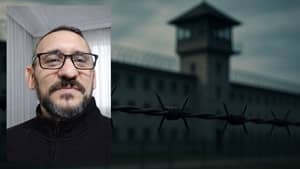
In tandem with a brutal wave of political executions, the Iranian regime’s Supreme Court has upheld the death sentence of political prisoner Mansour Jamali. The 55-year-old from Urmia now faces an imminent risk of execution on fabricated charges of “Moharebeh” (waging war against God) on charges of “membership in the People’s Mojahedin Organization of Iran (PMOI/MEK).”
Jamali’s confirmation follows a bloody 48-hour period on March 30 and 31, 2026, during which the regime hanged four PMOI members. While Tehran attempts to project power through the physical elimination of its organized opposition, these state-sanctioned murders are actually a symptom of profound, terminal weakness. Terrified by recent nationwide uprisings and the sudden loss of its supreme leader, the regime is using the domestic chaos to conduct a desperate purge. This unyielding bloodthirst makes the immediate intervention of the international community an imperative.
Iranian Regime Launches Execution Spree Over Growing Fears of Another Uprising: ‘Existential Threat’

Iran has unleashed several new executions — with many more expected to come — over fears of another citizen-led uprising as the embattled regime fights for survival in its war against the US and Israel. At least four members from the anti-regime organization, the People’s Mojahedin Organization of Iran, were executed in the last 48 hours, according to The National Council of Resistance of Iran.
Mohammad Mohaddessin, NCRI’s Foreign Affairs Committee chair, said the four executions were a message from the theocratic, and highly repressive, regime in an effort to “intimidate” and “exert control,” the Daily Mail reported.
“The execution of four PMOI members, amid an external war is a clear admission by the regime that it views the Iranian people and the organized Resistance as its principal enemy and an existential threat,” Mohaddessin said in a briefing Wednesday.
“I Will Not Bow Down”: The Letters of PMOI Martyr Babak Alipour

On the morning of March 31, 2026, the Iranian regime executed 34-year-old law graduate and political prisoner Babak Alipour, alongside his fellow inmate Pouya Ghobadi. Their hangings came just 24 hours after the executions of two other members of the People’s Mojahedin Organization of Iran (PMOI/MEK) from the exact same case. Yet, while the ruling clerics used the gallows to physically eliminate Babak, newly released handwritten letters penned during his imprisonment prove that the regime completely failed to crush his spirit.
Babak’s writings from inside the Greater Tehran and Ghezel Hesar prisons offer a profound glimpse into the mind of a young, educated Iranian who knowingly sacrificed his life for a free, democratic, and secular Iran. His words stand as a powerful testament to the resilience of the Iranian Resistance and a direct defiance of the mullahs’ dictatorship.
Resistance Units Commemorate PMOI Martyrs, Defy Regime’s Wave of Executions
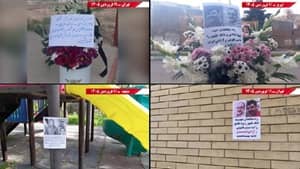
In a brutal escalation of state-sanctioned murder, the Iranian regime executed four political prisoners and members of the People’s Mojahedin Organization of Iran (PMOI/MEK) over a bloody two-day period. However, the ruling establishment’s desperate attempt to terrorize a restless society has completely backfired. Rather than instilling fear, the executions have only deepened the resolve of PMOI Resistance Units across Iran.
On March 31, 2026, Resistance Units openly commemorated the executed martyrs—Mohammad Taghavi, Ali Akbar (Shahrokh) Daneshvarkar, Babak Alipour, and Pouya Ghobadi. Activists laid flowers, held placards, and installed posters in public spaces across major cities, including Tehran, Tabriz, Karaj, Isfahan, and Mashhad. Defying the regime’s security apparatus, they left messages honoring the victims who “stood heroically and kissed the executioner’s noose.” In Tehran, messages placed on vehicles read, “We swear on the blood of our comrades Akbar Daneshvarkar and Mohammad Taghavi that we will stand till the end and continue their path until victory.”
Iran’s Internet Blackout Enters 33th Day Amid Deepening Economic Strain
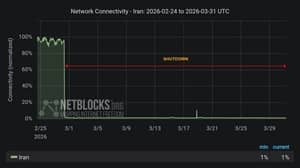
Iran’s sweeping internet blackout has entered its twentieth consecutive day, marking the longest disruption of online access ever recorded in the country and intensifying concerns over its far-reaching economic and social consequences.
According to the internet monitoring group NetBlocks, public access to the internet in Iran has been restricted for more than 744 hours. This unprecedented duration surpasses previous shutdowns, including the blackout imposed during nationwide protests in late 2023, which ended just before reaching the 20-day threshold.
At the time, Iran regime’s Minister of Communications, Sattar Hashemi, had acknowledged that approximately 20 days represents the upper limit of resilience for internet-based businesses. He warned that prolonged disruptions could severely damage the digital economy, placing the livelihoods of nearly 10 million people—directly and indirectly employed in the sector—at serious risk.
Global Reactions to Execution of Four PMOI Members in Iran
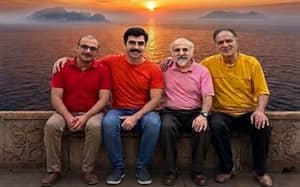
Following the execution of four political prisoners affiliated with the People’s Mojahedin Organization of Iran (PMOI/MEK), a broad wave of international reactions and condemnations has emerged, all warning against this action.
On Monday, March 30, Mohammad Taghavi and Akbar Daneshvarkar were executed, followed on the morning of Tuesday, March 31, by two other political prisoners, Babak Alipour and Pouya Ghobadi. The event has intensified concerns about the escalation of repression in Iran.
At the same time, political figures and human rights organizations, pointing to the risk facing other political prisoners, have called for urgent action by the international community to stop this trend.
Reuters reported that two prisoners were executed on Tuesday on charges of ties to the PMOI/MEK, noting that two similar executions had also taken place on Monday.
Iran: Executions, Mass Arrests, and Intensified Judicial Pressure in Late February and March 2026
In late February and March 2026, a set of field data, identified cases, recorded statistics, and official statements indicates that repression in Iran has continued simultaneously across multiple dimensions, including executions, widespread arrests, pressure on prisoners, restrictions on access to legal counsel, and judicial and economic measures against individuals. Severe restrictions on information and the lack of official disclosure regarding many cases have made it difficult to fully assess the scope of these developments.
Ahmadreza Radan, Commander-in-Chief of the Law Enforcement Forces, stated in a live interview on state television on March 10, 2026: “If someone takes to the streets at the behest of the enemy, we do not consider them a protester or anything of that sort. We consider them an enemy, and we deal with them as we deal with an enemy. All our forces are ready, with fingers on the trigger, to defend the revolution and support the people and the country.”
MEK Supporters Rally in Berlin and Hamburg to Condemn Latest Executions of Political Prisoners

March 31, 2026 — Supporters of the People’s Mojahedin Organization of Iran (PMOI/MEK) held rallies in Berlin and Hamburg to condemn the execution of political prisoners by the Iranian regime.

In Berlin, demonstrators gathered at the Brandenburg Gate, while a parallel protest took place in Hamburg, as participants honored Babak Alipour and Pouya Ghobadi, executed on Tuesday, March 31. The rallies also commemorated Mohammad Taghavi and Akbar Daneshvarkar, who were executed a day earlier, highlighting a rapid escalation in executions targeting MEK political prisoners.
Renewed Protests in Washington and Across U.S. Condemn Latest Executions of MEK Political Prisoners
March 31, 2026 — Iranian-American communities and supporters of the Iranian Resistance staged renewed protests across the United States following the execution of two additional political prisoners affiliated with the People’s Mojahedin Organization of Iran (PMOI/MEK).
Renewed Protests in Washington and Across U.S. Condemn Latest Executions of MEK Political Prisoners #StopExecutionsInIran #NoImpunity4Mullahs https://t.co/V1tZ7LUqIU
— Iran Freedom (@4FreedominIran) April 1, 2026
MEK Supporters Rally in Ottawa and Toronto to Condemn Latest Executions of Political Prisoners
March 31, 2026 — Iranian communities in Canada held coordinated protests in Ottawa and Toronto to condemn the execution of political prisoners affiliated with the People’s Mojahedin Organization of Iran (PMOI/MEK).
1-MEK supporters rally in Ottawa on March 31 to honor #Babak_Alipour and #Pouya_Ghobad, executed by Iran’s regime. They warn rising executions show fear of resistance and urge global action to stop this brutality. #StopExecutionsInIran #NoImpunity4Mullahs pic.twitter.com/LvWnJ3eFeK
— Iran Freedom (@4FreedominIran) April 1, 2026
In both cities, demonstrators gathered to honor Babak Alipour, 34, and Pouya Ghobadi, 33, who were executed on Tuesday, March 31, by Iranian authorities. The rallies also commemorated the execution of two other PMOI members, Mohammad Taghavi, 59, and Akbar Daneshvarkar, 58, carried out the previous day, underscoring a sharp escalation in the regime’s use of capital punishment against political prisoners.