

THIS PAGE WILL BE UPDATED WITH THE LATEST NEWS
UPDATE: 10:00 PM CEST
Rep. Steube Introduces Limiting Extremist Travel to the U.N. Act
WASHINGTON — U.S. Representative Greg Steube (R-Fla.) introduced today the Limiting Extremist Travel to the United Nations Act. This bill codifies travel restrictions and requirements for foreign officials affiliated with certain hostile countries, terrorist organizations, and U.N. organizations when attending official meetings of the U.N. at its headquarters in New York City.
“No person who chants ‘Death to America’ should be allowed free rein when visiting the United States for U.N. meetings in New York. Not only does their presence pose a serious risk to our national security, but it sends the wrong message to the world,” said Rep. Steube. “My bill makes sure only American allies and good faith partners in the international community are permitted full freedom of movement within the U.S. when attending official proceedings of the U.N.”
No Armed Groups Allowed in Lebanon, President Tells Hezbollah’s Ally Iran
BEIRUT, Aug 13 (Reuters) – No group in Lebanon is permitted to bear arms or rely on foreign backing, its president told a visiting senior Iranian official on Wednesday after the cabinet approved the goals of a U.S.-backed roadmap to disarm the Iran-aligned Hezbollah group.
During a meeting in Beirut with Ali Larijani, secretary of Iran’s top security body, Joseph Aoun warned against foreign interference in Lebanon’s internal affairs, saying the country was open to cooperation with Iran but only within the bounds of national sovereignty and mutual respect.
No… Larijani Persona Non Grata

A diplomatic storm preceded the visit of Ali Larijani, Secretary of the Supreme National Security Council of the Islamic Republic of Iran, to Lebanon today, Wednesday. Larijani’s visit comes amid political discontent expressed by sovereignty-minded forces, who see it as a blatant violation of Lebanese sovereignty, interference in Lebanon’s internal affairs, and a treatment of the Lebanese state as if it were still part of the Iranian axis — with Lebanon cast as one of its arms.
The objections escalated to the point where voices were raised calling for the Iranian official not to be received. Normally, diplomatic visits are carried out by a foreign minister, whereas Larijani’s position in the Supreme National Security Council carries a distinctly security-oriented character, raising questions about the true purpose of his trip.
Two days ago, he landed in Iraq to address primarily the security file of the “Popular Mobilization Forces” (PMF), in light of the widespread anger and objections to the PMF’s role. Therefore, if the Beirut leg of his trip is also security-related and aimed at pressuring the government over the “exclusive possession of arms,” it becomes incumbent upon Lebanon’s ruling authorities to block him — and, in accordance with diplomatic tradition, to consider him persona non grata (an unwelcome person).
UPDATE: 3:30 PM CEST
“Negotiating with Iran or Going to War? There Is a Third Option”

U.S. top diplomat Robert G. Joseph was the architect of the 2003 Libyan disarmament deal. Today, he warns: Iran will never voluntarily give up nuclear weapons. In an interview with WELT, he explains what the goal of the West’s strategy toward Tehran must be.
Under President George W. Bush, Robert G. Joseph was a key figure in American security policy. In his role as U.S. Special Envoy, he played a central part in the secret negotiations with Libya that in 2003 led to the complete dismantling of its nuclear, chemical, and ballistic missile programs. Joseph was among the highest-ranking diplomats to negotiate with the regime of dictator Muammar al-Gaddafi over the country’s reintegration into the international community.
Today, the former diplomat is one of the staunchest critics of the Islamic Republic. In the WELT interview, he warns against relying on negotiations with Tehran — arguing that they have failed in the past and, in his view, will not succeed in the future.
UPDATE: 10:30 AM CEST
Iran Faces Renewed Sanctions If Nuclear Talks Don’t Resume ASAP

PARIS — Iran has less than three weeks to resume talks on its nuclear program or face the reimposition of sanctions, France, Germany and the U.K. said in a joint letter sent to the United Nations. The so-called E3 countries said they would trigger the “snapback mechanism should no satisfactory solution be reached by the end of August 2025,” in a letter sent last week and shared by French Foreign Minister Jean-Noël Barrot on Wednesday.
Snapback mechanisms were included in the 2015 Iran nuclear deal — which the U.S. unilaterally withdrew from three years later under Donald Trump’s first presidency. They allow for crippling sanctions against Tehran — which were lifted as part of the agreement — to be automatically reinstated if Iran violates key nuclear commitments.
UPDATE: 8:00 AM CEST
A Dictator’s Playbook: Iran Regime’s Denial of Political Prisoners Is a Carbon Copy of The Shah’s Tyranny

In a move that reeks of desperation and historical irony, the Iranian regime is doubling down on a lie as old as its predecessor’s tyranny: the complete denial of the existence of political prisoners. On Sunday, August 10, the judiciary chief, Gholam-Hossein Mohseni-Eje’i, brazenly declared, “We have absolutely no political prisoners… whatever there is, is security-related.” To make the farce even more absurd, an aide to regime president Masoud Pezeshkian, Elyas Hazrati, added that after asking journalists and intellectuals for names, they could only identify a total of five.
This claim comes amidst a fresh wave of savage repression. The regime recently executed political prisoners and PMOI members Behrouz Ehsani and Mehdi Hassani, and reports have emerged of the brutal beating and transfer of other political prisoners from Evin and Fashafuyeh to Ghezel Hesar prison, including five who are currently on death row. For the people of Iran, this sinister tactic of denying reality while inflicting it is all too familiar, a stark reminder of why their chants echo with, “Theocracy, Monarchy; One Hundred Years of Crime.”
Political Prisoner Raheleh Rahemipour Admitted to Intensive Care

On Tuesday, August 12, 2025, political prisoner Raheleh Rahemipour, a member of the 1980s justice-seeking families, was transferred from Qarchak Prison in Varamin to hospital after collapsing in prison. Doctors, suspecting internal bleeding, ordered her immediate transfer from Mofatteh Hospital in Varamin to Pakdasht Hospital, where she was admitted to the Intensive Care Unit (ICU).
In recent weeks, Rahemipour had suffered repeated fainting spells. According to her family, these episodes began sporadically but had intensified in recent months, sometimes occurring several times a week. Prison and judicial authorities took no action to provide her with treatment, insisting instead that she could only be taken to hospital if shackled in handcuffs and leg irons—a degrading and inhumane condition that caused dangerous delays in her emergency care.
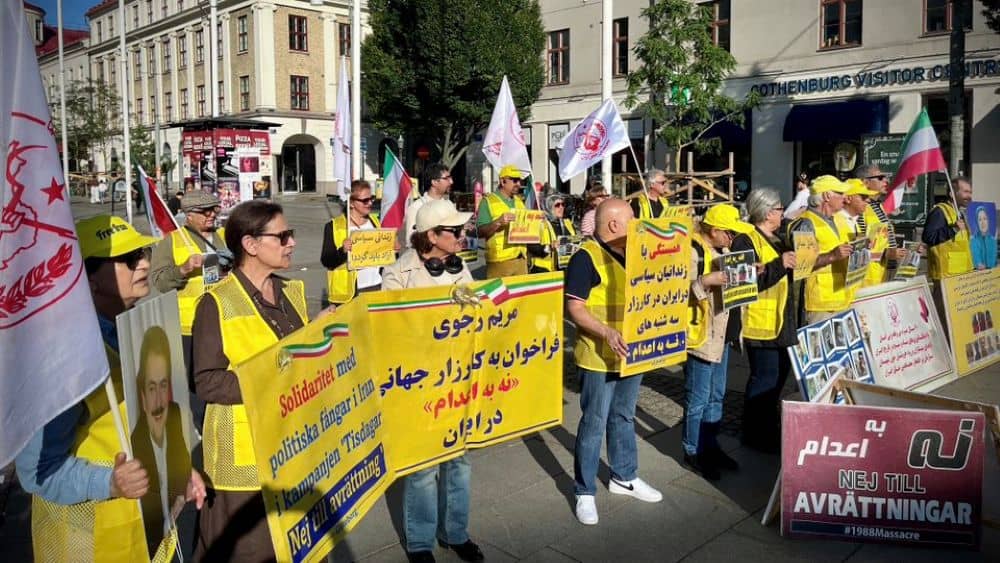
Gothenburg: Rally Against Executions in Iran, Marking 81st Week of “No to Execution Tuesdays” Campaign

Gothenburg, Sweden – August 12, 2025: Supporters of the People’s Mojahedin Organization of Iran (PMOI/MEK) gathered in Gothenburg to mark the 46th consecutive week of local participation in the global “No to Execution Tuesdays” campaign. The movement protests the Iranian regime’s escalating wave of executions and systematic repression.
MEK Supporters in Hamburg Rally Against Iran Executions, Demand Release of Political Prisoners

The rally also denounced the recent executions of PMOI members Mehdi Hassani and Behrouz Ehsani, exposing the Iranian regime’s intensifying crackdown. Protesters expressed strong solidarity with the PMOI Resistance Units active in Iran and reaffirmed their commitment to a democratic republic grounded in freedom, equality, and secular governance, rejecting both theocracy and monarchy.
Transfer of Arghavan Fallahi to the Infamous Qarchak Prison, Varamin

According to reports, Arghavan Fallahi, 24, a political prisoner, has been transferred to the political prisoners’ ward in Qarchak Prison, Varamin, after spending two months in solitary confinement in Fashafouyeh Prison and a period of transfer to an unknown location.
This transfer comes after she had previously spent more than six months under interrogation and subjected to physical and psychological torture, while her family remained unaware of her condition and whereabouts throughout this time. Arghavan Fallahi was arrested on January 26, 2025, in Tehran. The charges against her are “propaganda activities against the regime” and “supporting an opposition organization.” Her arrest and interrogations were conducted directly under the supervision of the IRGC Intelligence Organization and the Judiciary’s Intelligence Organization.
Return of the Massacre’s Shadow in Iran – No. 2
The ruling regime in Iran, fearing the resurgence of a nationwide uprising, is step by step preparing for another massacre of political prisoners. Signs that were evident before the bloody summer of 1988 have reappeared today: heightened security in prisons, classification and transfer of political prisoners to unknown locations, and widespread suppression of calls for justice in society.
In this context, Fars News Agency, affiliated with the Islamic Revolutionary Guard Corps (IRGC), recently published an unprecedented article titled “Why Should We Repeat the Experience of the 1988 Executions?!” implicitly urging the judiciary to adopt the same policy toward today’s political opponents. This stance, interpreted by international bodies as an explicit endorsement of executing political dissidents, has intensified concerns over large-scale human rights violations in Iran.
Land Subsidence Warnings in Tehran and the Critical Situation of 70% of Iran’s Plains

Isa Bozorgzadeh, spokesperson for Iran’s water industry, warned about the unprecedented severity of the water crisis, stating that 70% of Iran’s plains are in a “prohibited” or “critically prohibited” state and that more than 300 plains, including Tehran, face a serious risk of land subsidence.
Bozorgzadeh told the state-run Payam-e Ma magazine, “The water crisis in Iran has passed the 110th minute of the game.” He described land subsidence as a direct consequence of excessive groundwater extraction, saying that a significant part of this over-extraction has occurred due to “inefficient management, legal gaps, and a lack of coordination between responsible institutions.”
More Than 35,000 Pollution-Related Deaths Recorded In Iran in 2024

The deputy head of the Air Quality and Climate Change Research Center at Beheshti University of Medical Sciences announced that more than 35,000 deaths attributed to air pollution were recorded in the country during 2024.
The state-run ISNA news agency wrote on Wednesday, August 13, quoting Abbas Shahsavani, that statistics show the average number of deaths attributed to air pollution in 2024 was 35,540 people. In 2023, 30,690 deaths from air pollution were reported in Iran. Referring to the results of the most recent study conducted in Iran in 2024 on the health impacts and economic damages caused by air pollution, Shahsavani said: “A study on the health and economic effects of air pollution was conducted last year, in which 83 cities in the country with a population of more than 57 million people were examined.”
Iranian Regime Admits to 21,000 Arrests during the 12-Day War, Including Arbitrary Detentions and Forced Disappearances

Police spokesperson’s remarks reveal a sweeping crackdown, targeting political prisoners, activists, and ordinary citizens under vague “security” charges. In a rare admission of the scale of its domestic crackdown, Saeed Montazer al-Mahdi, spokesperson for Iran regime’s Law Enforcement Command (FARAJA), announced on Tuesday that 21,000 people were arrested within the 12-day war. The figures, provided during a media briefing, shed light on the regime’s widespread and systematic human rights violations — including arbitrary arrests, forced disappearances, and the violent suppression of dissent. Montazer al-Mahdi acknowledged that many arrests had no direct link to the conflict that served as a pretext for the crackdown, noting that “ironically, the situation reduced certain types of crime in Tehran.”