

THIS PAGE WILL BE UPDATED WITH THE LATEST NEWS
UPDATE: 9:00 AM CET
Veiled Assassins: The Unyielding Stand of Iran’s Exiled Defiant

The Istanbul morning clung like a shroud, heavy with the brine of the Bosphorus and the murmur of a city that never truly sleeps. In the passenger seat of a nondescript sedan slicing through the affluent Sariyar district streets, Hossein Abedini clutched his briefcase—a battered repository of resistance manifestos and encrypted dispatches—his pulse syncing with the wipers’ frantic swipe. At 67 now, but forged in the fires of 35 years past, Abedini was no stranger to the regime’s long shadow. Beside him, at the wheel, sat a trusted driver; behind, shadows of a fellow NCRI female member, bound for the airport and the thin air of exile’s reprieve. The mission that night wasn’t a daring extraction of dissidents on the brink of extradition—it was simpler, graver: survival itself. But Tehran had other plans. It struck like thunder from the dark—a savage rear-end collision that hurled the car forward, followed by a T-bone blocking escape by another assassin vehicle, its bulk crumpling metal and scattering glass like brittle stars. Time splintered into shards of chaos. Automatic weapons chattered, muzzle flashes stitching the gloom with lethal threads, the air acrid with cordite and terror.
Iran Withdraws from Deal to Let International Nuclear Inspections Resume

Iran said Thursday that it was withdrawing from an agreement to allow a resumption of international inspections of its nuclear sites. The decision came hours after a U.N. watchdog agency demanded information about the status of Iran’s enriched uranium stock and its nuclear sites that Israel bombed in June.
The International Atomic Energy Agency, or I.A.E.A., has been unable to inspect Iranian nuclear facilities ever since Israel launched a 12-day war, briefly joined by the United States, that battered Iran’s nuclear and military sites.
President Trump declared that Iran’s nuclear enrichment program was “obliterated” in the brief war. But regional officials and experts remain concerned that Iran may have developed a stronger interest in secretly developing an nuclear weapon since the attacks.
UPDATE: 8:00 AM CET
Milan Khajeii Held Incommunicado in Shiraz for Over a Week

More than a week after the arrest of Milan Khajeii in Shiraz, no official or credible information has been released regarding her whereabouts or health condition. Milan Khajeii (Fatemeh), 30, a native of Shiraz and a suspended history student at the University of Zahedan, was detained by security forces in Shiraz and has since remained in complete incommunicado detention. To date, no clear charges or reasons for Milan Khajeii’s arrest have been announced. Ms. Khajeii was previously sentenced on May 16, 2024, by Branch Two of the Zahedan Revolutionary Court to one year in prison on the charge of “propaganda against the state.”
Iranians in Bucharest Hold Exhibition Honoring 2019 Uprising Martyrs, Condemning Executions

Bucharest, Romania — November 17, 2025: An exhibition was held in Bucharest by supporters of the People’s Mojahedin Organization of Iran (PMOI/MEK) to honor the 1500 martyrs of the nationwide Iranian uprisings in November 2019 (Aban 98), the 2022 protests, and political prisoners—especially those executed by the mullahs’ regime this year and those still at risk of execution.
Iranians Rally in Copenhagen to Honor Iran’s November 2019 Uprising and Demand Regime Change

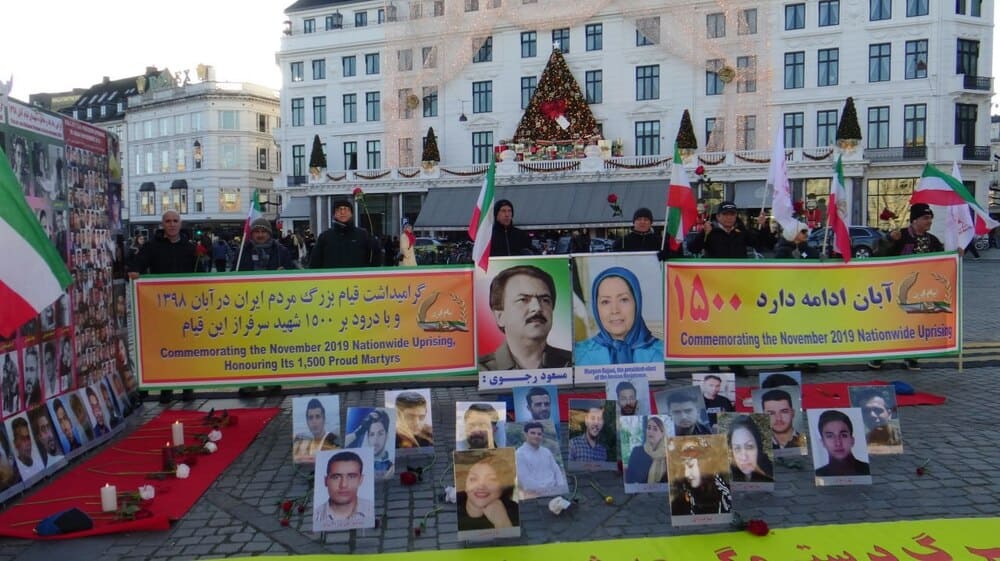
Copenhagen, Denmark — November 15, 2025: A rally and exhibition were held in Copenhagen by supporters of the People’s Mojahedin Organization of Iran (PMOI/MEK) to honor the 1500 martyrs of the nationwide November 2019 (Aban 98) uprising, the 2022 protests, and political prisoners—especially those executed this year or facing imminent execution.
Iranians Rally in Rome to Honor Iran’s November 2019 Uprising and Demand Regime Change

Rome, Italy — November 15, 2025: A rally was held in Rome by supporters of the People’s Mojahedin Organization of Iran (PMOI/MEK) to honor the 1500 martyrs of the nationwide November 2019 (Aban 98) uprising, the 2022 protests, and political prisoners—especially those executed this year or facing imminent execution.
Iranians Rally in Hamburg to Honor Iran’s November 2019 Uprising and Demand Regime Change

Hamburg, Germany — November 15, 2025: A rally and exhibition were held in Hamburg by supporters of the People’s Mojahedin Organization of Iran (PMOI/MEK) to honor the 1500 martyrs of the nationwide Iranian uprisings in November 2019 (Aban 98), the 2022 protests, and political prisoners—especially those executed by the mullahs’ regime this year and those still at risk of execution.
Suspicious Death of Farzad Khosh-Boresh in the Sari Intelligence Detention Center

Farzad Khosh-Boresh, a 31-year-old resident of Neka, died under suspicious circumstances only six days after his renewed arrest in the detention center of the Intelligence Office in Sari. Multiple bruises and bodily injuries observed on his body before being transferred to the forensic department reinforce the likelihood of torture and coercion for forced confessions, increasing serious concerns about violations of the right to life and violent treatment in security detention facilities. Farzad Khosh-Boresh had previously been arrested in Mordad 1404 (July–August 2025) on charges related to “posting critical and protest content,” and was released on bail after some time. Security pressures continued, and on 21 Aban 1404 (12 November 2025), he was arrested again by the Intelligence Office. During this second arrest, his family was kept completely uninformed about his condition.
Iran Regime’s Cyber-Kinetic Warfare: A Dangerous New Front Threatening Global Security

Amazon’s threat intelligence findings reveal how Iran-linked hackers merge digital espionage with real-world attacks, signaling a new era of state-backed hybrid warfare. A new report from Amazon’s security intelligence division, published via Hacker News, reveals something far more alarming than routine cyber intrusions: the merging of Iran-backed hacking operations with real-world military targeting. This is not merely hacking for disruption or espionage. It is cyber warfare explicitly designed to support physical attacks—what Amazon calls “cyber-enabled kinetic targeting.” For years, governments treated cyberspace and physical conflict as separate universes. But the report argues that this separation is now fiction. And if the findings are accurate, Iran’s intelligence services and affiliated militant groups have crossed a threshold that has serious implications for international security and commercial infrastructure.