


THIS PAGE WILL BE UPDATED WITH THE LATEST NEWS
UPDATE: 7:30 PM CEST
New US Sanctions Target 50 People, Companies and Ships for Allegedly Aiding Iran’s Oil and Gas Trade

WASHINGTON — WASHINGTON (AP) — The Trump administration on Thursday imposed sanctions on a group of 50 people, companies and ships largely out of the United Arab Emirates, Hong Kong and China, alleging they were facilitating the shipment of Iranian oil and sales of liquefied petroleum gas.
Included in the penalties are two dozen “shadow fleet” ships flagged across multiple nations, concealing the origin of Iranian oil and circumvents earlier sanctions; a China-based crude oil terminal; and a non-state-owned Chinese refinery. The Treasury Department said they are key to Iran’s ability to export petroleum and petroleum products.
The department said the entities and individuals cited enabled the export of billions of dollars worth of oil and gas products, aiding Iran’s government.
Turkey’s Gas Shift Threatens Russia and Iran’s Last Big European Market
ISTANBUL, Oct 8 (Reuters) – Turkey could meet more than half of its gas needs by the end of 2028 by ramping up production and increasing U.S. imports, in a shift that threatens to shrink the last major European market for Russian and Iranian suppliers.
Washington has publicly pressured allies, including NATO member Turkey, to cut energy ties with Moscow and Tehran. At their White House meeting on September 25, U.S. President Donald Trump pressed Turkish President Tayyip Erdogan to cut Russian energy purchases.
Diversifying supply would also strengthen Turkey’s energy security and support its ambitions to become a regional gas hub. Ankara aims to re-export imported liquefied natural gas and its own gas production to Europe while burning Russian and Iranian gas domestically, analysts said.
UPDATE: 3:30 PM CEST
Oil Trail from Iran to Berlin

A Berlin businesswoman is suspected of being deeply involved in the trade of Iranian oil, with profits allegedly funneled through subsidiary companies to Iran’s Ministry of Defense. It is an inconspicuous building in the middle of Berlin. In one of its apartments lives a businesswoman with her husband. From this flat, she is said to have conducted oil deals — involving tens of millions of liters of crude. The oil reportedly originates from Iran and is transported to China with the help of “shadow tankers” that operate under false flags or conceal their cargo.
The problem: the United States has placed Iran under sanctions, and anyone trading with the country — including shipping firms or banks — risks prosecution and could end up blacklisted by U.S. authorities.
Iranian Ship Sanctioned by Trump Docks in Santa Catarina

The Iranian vessel Delruba, sanctioned by the U.S. Office of Foreign Assets Control (OFAC), docked at the Santa Catarina Port Terminal (TESC) in the Brazilian state of the same name. The state government of Santa Catarina confirmed the information to Gazeta do Povo. The ship arrived on Saturday, October 4, and unloading was completed on Wednesday, October 8.
The ship delivered 60,000 tons of granulated urea, valued at US$24.4 million (approximately R$130.6 million), destined for fertilizer production. The supplier of the cargo, Pardis Petrochemical, is also listed under U.S. sanctions.
Amid ongoing tensions with the United States, Iran remains the world’s third-largest exporter of urea, producing around 4.8 million tons annually, or roughly 10% of global supply.
UPDATE: 9:30 AM CEST
U.S. Sanctions 29 Companies in China, Turkey, and UAE over Iran Military Support

The U.S. government announced on Wednesday a major expansion of its sanctions, adding 29 entries (26 entities and three addresses) to the Commerce Department’s Bureau of Industry and Security (BIS)’s restricted entity list. The sanctions target companies in China (15 firms), Turkey, and the UAE, which the U.S. accuses of providing illicit support to Iran’s military and its proxies.
Specifically, the action targets companies facilitating the purchase of American electronic components found in weaponized drones used by groups like the Houthi and Hamas militants.
The companies placed on the entity List, which include firms located in China and Hong Kong, are now restricted from receiving U.S. exports without specific government approval.
UPDATE: 8:00 AM CEST
Deleting Zeros from Iran’s Currency Won’t Hide the Regime’s Economic Bankruptcy

The Iranian regime’s parliament has approved a plan to remove four zeros from the national currency, the rial. Officials, such as the Central Bank governor, present this move as a remedy for the “decline of national pride” caused by a worthless currency. However, this is nothing more than a desperate political stunt—a shell game designed to create the illusion of economic stability while the terminal illness of corruption and mismanagement rages on. This policy is not an economic solution; it is a psychological tranquilizer meant to distract a suffering population. As state-affiliated economists have themselves admitted, it is merely a “show” and a “game with numbers” that will do nothing to address the root causes of Iran’s catastrophic economic collapse.
Raheleh Siavoshi: Murder of National Wushu Champion in Nahavand by Her Husband

In yet another tragic case of femicide in Iran, Raheleh Siavoshi, a national wushu champion and coach, was killed by her husband in the city of Nahavand, Hamedan province. On Thursday, October 2, 2025, the 26-year-old athlete — who was also the mother of a two-month-old infant — was brutally attacked by her husband and cousin, Homayoun Siavoshi, inside their home. She sustained multiple stab wounds to her head and body and succumbed to her injuries two days later in the hospital. Raheleh Siavoshi was among Iran’s most promising wushu athletes, having earned several national titles in recent years, including third place in the 2021 national championships.
Berlin Exhibition Highlights Iran’s Escalating Human Rights Violations

Berlin, Germany – October 7, 2025 – Supporters of the People’s Mojahedin Organization of Iran (PMOI/MEK) organized an exhibition to condemn the Iranian regime’s escalating human rights violations, particularly the rising number of death sentences against political prisoners.
Manchester Event by Academics in Exile Condemns Executions and Torture in Iran

Manchester, UK – October 7, 2025 – The Academics in Exile Association, supporters of the People’s Mojahedin Organization of Iran (PMOI/MEK), organized an exhibition and bookstall in Manchester to condemn the Iranian regime’s escalating executions of political prisoners. The event was held in solidarity with the international “No to Execution Tuesdays” campaign.
Executions in Iran: A Deadly Record in 2025
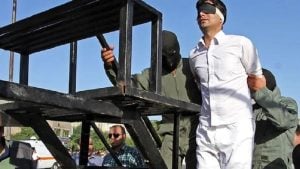
The World Day Against the Death Penalty is observed annually on 10 October, launched in 2003 by the World Coalition Against the Death Penalty with support from dozens of human-rights organizations. Its aim is to raise public awareness about the devastating consequences of capital punishment and to promote its universal abolitio. While more than two-thirds of the world’s countries have abolished or suspended executions, the ruling regime in Iran continues to use the death penalty as a tool of control and intimidation. In 2025, Iran once again topped the global ranking and surpassed all other nations in the number of executions. General international reports, including those of Amnesty International, confirmed in late September that the number of executions in Iran this year has exceeded one thousand.
Australian Government Introduces Bill to Designate IRGC As Terrorist Organization

The Australian government has introduced a bill to the House of Representatives that would allow the country to designate the Iranian regime’s Islamic Revolutionary Guard Corps (IRGC) as a terrorist organization. Australia’s Attorney General, Michelle Rowland, presented the bill to parliament on Wednesday morning, October 8. The move follows findings by the Australian Security Intelligence Organisation (ASIO) indicating that the IRGC was involved in at least two antisemitic attacks on Australian soil. Under the provisions of the bill, the government would also be able to include foreign state institutions on the list of terrorist organizations — something that was previously not legally possible.
Rising Poverty in Iran: Families Turn to Chicken Tails and Bread as Meat and Dairy Become Luxuries

A recent field report by the daily Ham-Mihan exposes a stark picture of collapsing purchasing power and worsening food insecurity in Iran’s capital. Surveying eight districts of Tehran — including regions 6, 10, 11, 12, 16, 17, 18, and 19 — the report found that residents are cutting back sharply on basic food items such as meat, dairy, legumes, and even eggs, while some butcher shops have closed altogether due to lack of customers. According to Ham-Mihan, the price surge has reshaped consumer habits in shocking ways. As meat prices soar, many now purchase chicken tails, one of the cheapest animal parts, while others buy half a chicken breast or drumstick to stretch their budgets. The paper notes that as of early October, beef reached 900,000 tomans per kilo, causing sales to drop by 30–40 percent.