

THIS PAGE WILL BE UPDATED WITH THE LATEST NEWS
UPDATE: 7:30 PM CEST
Don’t Fall For Tehran’s Talking Points About The Resistance

UPDATE: 3:00 PM CEST
Iran’s Security Apparatus Signals Fear of Renewed Nationwide Unrest
As Iran’s gasoline crisis deepens, living costs soar, and public protests spread, two of the regime’s most powerful security bodies—the Ministry of Intelligence and the IRGC Intelligence Organization—have issued separate statements. Behind their hollow displays of strength, the statements reveal growing fear of another nationwide uprising and a possible eruption of public anger.
Both agencies urged security forces to stay alert to “suspicious activities” and confront any action that could “disrupt public calm.”
In one statement, the Ministry of Intelligence announced the arrest of 30 people in Central Province, claiming they had taken part in the January 2026 uprising.
The ministry also urged the public to report suspicious activity to its intelligence reporting center as quickly as possible.
The IRGC Intelligence Organization also issued a lengthy statement claiming that the regime had moved beyond merely preserving its own survival and that of its regional proxy forces. At the same time, the statement reflected deep anxiety, repeatedly calling for action against anything that might disturb social stability.
UPDATE: 6:30 AM CEST
Message to the Germany Conference: Supporting a Democratic Solution in Iran
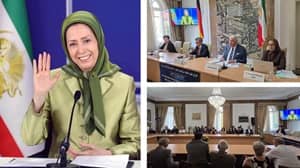
Mrs. Maryam Rajavi’s speech: “I am delighted that this conference is being held and to meet with you today. The landmark events of the past year have drawn global attention to the situation in Iran. The tensions and wider ramifications of these developments continue to unfold, sending ripples across the international political and economic landscape. Unsurprisingly, this has raised critical questions: What path will the Iranian regime ultimately take? And where does the Iranian people’s uprising stand as it confronts this regime? The current situation can be summarized in a single premise: although the fires of external war have for now quieted, the main conflict, namely, the conflict between the people of Iran and religious fascism continues unabated. On one side are the atrocities of the regime, hanging members of the PMOI and the rebellious youth who took part in the uprisings. On the other side are the unrelenting operations of Resistance Units and the ceaseless protests of a people pushed to the brink.
“For over four decades, massacres and killings have defined this regime. These days coincide with the 38th anniversary of the 1988 massacre of 30,000 political prisoners, over 90 percent of whom were members of the PMOI. Yet the flame of the struggle for freedom has never been extinguished. This conflict began on June 20, 1981, and has continued for over 45 years. In truth, the foreign war that began on February 28 was merely a parenthesis within the primary conflict between the Iranian people and the regime.”
The $6 Billion Scandal: Structural Corruption and the Harvest of Poverty on the Streets of Iran
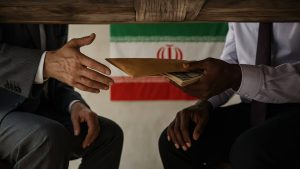
In totalitarian and authoritarian regimes, corruption is neither an incidental anomaly nor a localized administrative malfunction. Rather, it constitutes the foundational logic and primary mechanism for the reproduction of political power. In economies subjugated by closed autocratic structures, capital accumulation does not emerge from productive innovation, competitive markets, or entrepreneurial enterprise.
Instead, it operates through clientelism, systemic dispossession, and the redistribution of massive state rents to networks loyal to the regime’s core. In Iran, national assets, strategic resources, judicial oversight, and armed forces are consolidated under the unchecked authority of the supreme leader and his allied security-military apparatus. As a result, corruption becomes the very adhesive that binds the ruling oligarchy and sustains the machinery of repression.
From this structural perspective, recurring economic scandals are not isolated grievances. They are everyday clinical manifestations of an extractive state apparatus that offloads the cost of its survival and elite rent-seeking onto ordinary citizens through runaway inflation, healthcare collapse, mass unemployment, and infrastructural decay.
Situation of 5 Detained Women: Harsh Sentences and Limbo

The ongoing arrests and heavy sentences remain a primary pillar of the suppression of women, aimed at controlling society during critical times and instilling fear to prevent another uprising. In this context, fresh reports on the situation of 5 detained women reveal details regarding the prolonged detention and heavy sentences handed down by the Revolutionary Court to Leila Abolhassani, Najmeh Amini, Zahra Mousavi, Madineh Shahnavazi, and Fatemeh Gholami Moghadam in the prisons of Isfahan, Mashhad, and Kerman.
Leila Abolhassani, a 43-year-old mother of two teenage girls who was arrested during the nationwide protests in January 2026 in Shahin Shahr, Isfahan, has been sentenced to death for “enmity against God” after authorities accused her of helping set fire to a supermarket.
In April 2026, Branch 5 of the Isfahan Revolutionary Court, presided over by Judge Vahid Hemmat-Nejad, sentenced her to death on charges of “Moharebeh” (enmity against God). Her case is now before Supreme Court, and if her appeal fails, she could be executed.
Poverty Is Driving Children Into Iran’s Deadly Kolbari Trade
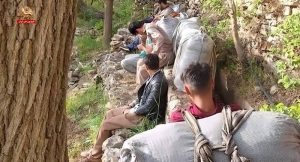
Iran’s deepening economic crisis is pushing an increasingly vulnerable population into dangerous forms of informal labor. In the country’s border regions, poverty and the absence of stable employment are reportedly forcing children and teenagers to join the ranks of kolbars—people who carry goods across mountainous border routes under extremely hazardous conditions.
The warning was raised on August 30 by labor activist Abdullah Balwasi in an interview with the state-run ILNA news agency. He said the economic pressures facing families in border areas are increasingly affecting children and adolescents as well.
“A teenager who goes down a path where there is a possibility of being shot, stepping on a landmine, or suffering an accident simply to help his family or pay for school and living expenses should be a serious warning to society,” Balwasi said. “A child should be sitting behind a school desk, not on a kolbari route.”
His remarks highlight a particularly grim dimension of Iran’s poverty crisis: children are being pulled into dangerous work not because of personal choice, but because families lack sufficient income to meet basic needs.
Rising Internet Taxi Fares Add to Iran’s Deepening Cost-of-Living Crisis

The cost of simply getting to work is becoming another burden for millions of Iranians as sharply higher fares for internet-based taxis coincide with fuel shortages, widespread GPS disruptions, and a decline in the number of active drivers.
Reports from Tehran and several other cities indicate that fares on Snapp and Tapsi have risen substantially in recent days, particularly during peak hours. A journey that cost around 300,000 tomans only a few weeks ago can now exceed 700,000 tomans at certain times.
For workers whose wages have not risen accordingly, the increase has quickly become unsustainable.
“Wages have not doubled, but commuting costs have more than doubled overnight,” one Tehran resident told local media. “If the daily round trip costs 500,000 to 600,000 tomans, a large part of the monthly salary goes simply toward getting to work.”
Public transportation offers little relief for many commuters because buses and the metro do not adequately cover every neighborhood and workplace.
From Street Anger to Organized Resistance: What Could Change Iran’s Uprising Equation?
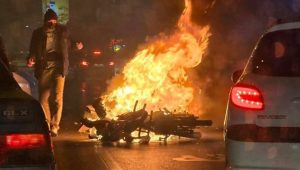
For years, Iran has experienced waves of nationwide protest driven by economic hardship, political repression, corruption, and a deepening rejection of the ruling system. From the 2009 protests to the nationwide uprisings of 2017–18, November 2019, and 2022, millions of Iranians have demonstrated that the regime’s claim to social legitimacy is increasingly hollow.
Yet a difficult question remains: Why have these uprisings, despite their scale and determination, not brought about the regime’s downfall? And what could make a future uprising different?
The answer lies partly in the asymmetry between mass anger and organized repression.
The Iranian regime possesses an extensive coercive apparatus, with the Islamic Revolutionary Guard Corps (IRGC), the Basij, intelligence agencies, police forces, and other security institutions forming the backbone of its survival strategy. A nationwide uprising may overwhelm the streets with numbers, but the regime can respond through coordinated arrests, killings, intimidation, internet shutdowns, surveillance, and the deployment of organized security forces.
Iranian Officials Warn of a Society “On the Edge” as Economic Crisis Deepens

The Iranian regime is facing a convergence of economic and social crises that is increasingly difficult to contain. As inflation, declining purchasing power, unemployment, and mounting economic pressures weigh on millions of people, senior officials have begun issuing unusually stark warnings about the consequences.
The language coming from the regime’s own leadership is revealing. On Friday, August 28, President Masoud Pezeshkian acknowledged the explosive potential of worsening economic conditions, warning that the population was already “on the edge.”
Speaking at a press conference, Pezeshkian said: “People are on the edge right now. If I put another pressure on them, they may fall off the edge. I must not do anything that makes them fall off.”
The statement is significant because it comes from the head of the executive branch itself. Rather than presenting the country as economically stable, Pezeshkian openly acknowledged that additional pressure could trigger a dangerous social reaction. His warning reflects a broader fear within the regime: that economic grievances are no longer merely producing dissatisfaction, but are accumulating into a potentially uncontrollable force.
Iran’s Housing Crisis: When a Home Is Reduced to a Hundredth of a Square Meter
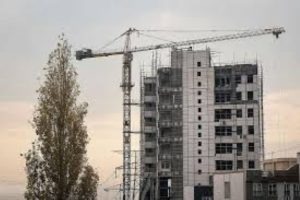
Housing, one of the most basic necessities of life and a fundamental component of a dignified existence, has become increasingly inaccessible to ordinary Iranians. Under the regime’s economic policies, a home is no longer primarily treated as a place for families to live. It has become a vehicle for speculation, rent-seeking, and preserving wealth for those with access to capital and political power.
For millions of Iranians, the dream of buying an apartment has already disappeared. Increasingly, even renting a modest home in the country’s major cities is becoming unaffordable.
The depth of the crisis is reflected in an extraordinary response from the authorities: instead of making housing affordable, institutions are promoting schemes that allow citizens to purchase tiny fractions of property. Tehran Municipality has unveiled a scheme known as “Khaneh-Riz”, in which people can effectively invest in housing projects in units as small as one-hundredth of a square meter.
The concept itself illustrates how far the housing crisis has deteriorated. A society that once aspired to own a home is now being offered the opportunity to buy a fraction of a square meter.
Iranian Regime Arms Shipment for Houthis Seized in the Red Sea

Forces of Yemen’s internationally recognized government seized an arms shipment sent by the Iranian regime to the Houthi militants in the Red Sea. The shipment contained equipment and components used to manufacture and upgrade suicide drones.
The “Yemeni National Resistance” forces, affiliated with the country’s internationally recognized government, said the shipment was intercepted and seized on August 24 after a smuggling network linked to the IRGC was identified and monitored. According to the published report, the equipment discovered included drone guidance and control systems, live video transmission equipment, precision electronic components, communications systems, antennas, and components used in drone fuel systems.
Yemeni officials also said that those detained in the operation had provided information about the smuggling network’s activities and its links to the IRGC, and that details of these confessions would be released.
Iranian Regime Reports Attacks on U.S. Bases in Response to Larak Strike

Following the U.S. attack on IRGC positions on Larak Island, which killed and wounded several IRGC personnel and local residents, the Iranian regime reported retaliatory attacks on U.S. positions in the region. The claims come amid continued tensions over the security of the Strait of Hormuz.
The Iranian regime’s Foreign Ministry, while confirming casualties from the U.S. attack on Larak Island, accused Washington of “military aggression” and claimed that the regime’s armed forces, acting in “legitimate self-defense,” had attacked a U.S. base in Jordan. Tehran also accused Jordan of cooperating in the U.S. attacks.
At the same time, the Iranian regime’s military claimed to have targeted the U.S. Al Minhad base in the United Arab Emirates with dozens of drones, attacking the locations where U.S. forces and helicopters were stationed.
The Strange Business of Real Estate Agents and Grave Sales in Iran
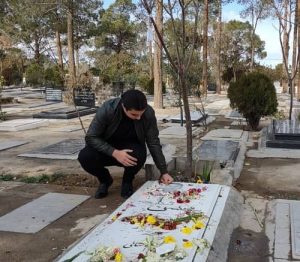
The state-run Hamshahri newspaper reported on the buying and selling of graves in Iran.
The report says that 460 million tomans (approximately $2,300) is the price ceiling set by the Endowments and Charity Organization for graves for those who, after their death, are buried in cemeteries adjacent to shrines and the tombs of descendants of prominent religious figures in the capital. However, despite the price ceiling set for graves in these cemeteries, in many cases the prices remain only on paper, and the owners and heirs of graves make substantial financial gains from selling them. The profits from these transactions can sometimes equal the prices of luxury homes in the capital and can even reach billions of tomans.
Hamshahri adds that in Shahr-e Rey, south of Tehran, prices go as high as 600 to 700 million tomans (approximately $3,000 to $3,500), but most of these graves have already been sold and have owners. Graves in the more distant rows cost 400 to 500 million tomans (approximately $2,000 to $2,500), while in the farthest rows or corners of the cemetery, graves can also be found for 300 million tomans (approximately $1,500).
Iran’s Regime Claims Reaching Agreement with Oman, but Strait of Hormuz Will Not Be Reopened

While the Iranian regime seeks to portray its control over the Strait of Hormuz as a sign of power and leverage against the United States, Kazem Gharibabadi, the regime’s deputy foreign minister, said the waterway remains closed and conditioned its reopening on the United States fulfilling its commitments.
On Saturday, August 29, Gharibabadi said the Iranian regime had reached an understanding with Oman on how vessels would pass through the Strait of Hormuz, but “the strait will not be reopened until the United States fulfills its commitments.”
According to the regime official, these commitments relate to the Islamabad memorandum of understanding between the two sides, which includes an end to military attacks against Iran and the lifting of the naval blockade.
U.S. Attacks IRGC Positions on Larak Island
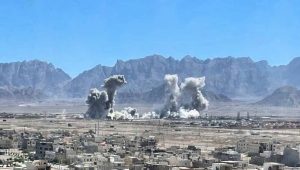
Reports indicate that U.S. forces attacked two launch platforms belonging to Iran’s Islamic Revolutionary Guard Corps (IRGC) on Larak Island, near the Strait of Hormuz. The IRGC also reported that several people were killed and wounded in the attack.
According to Reuters, Al Jazeera, and Axios, U.S. forces targeted two IRGC launch platforms on Larak Island on Sunday, August 30. U.S. officials said IRGC forces were preparing to launch rockets carrying naval mines into the Strait of Hormuz.
The IRGC confirmed the attack several hours later, saying the operation resulted in the deaths and injuries of several of its personnel and local residents. Tasnim, a state-run news agency, also reported that two people were killed and two others wounded.
The U.S. Central Command (CENTCOM) has not yet officially commented on the attack.
Iran’s President Calls US Memorandum a ‘Source of Pride’ as Hardliners Push Back
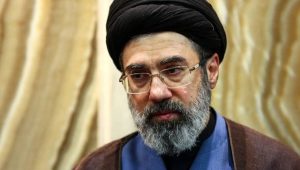
Pezeshkian says the agreement was backed by nearly all members of Iran’s Supreme National Security Council, while Kayhan argues that the memorandum has lost its credibility.
Iranian President Masoud Pezeshkian has defended a memorandum with the United States as an achievement for the Islamic Republic, prompting criticism from conservative figures and media as a public dispute inside Iran over negotiations and how to confront the conflict with Washington has widened.
At a government event, Pezeshkian described the recent memorandum as “a source of pride for the Islamic Republic of Iran” and said nearly all members of the Supreme National Security Council had supported it.[1] According to the official presidential website, he said those who backed the agreement were concerned with Iran’s “dignity and pride” and were not people who had capitulated. (president.ir)
Pezeshkian also argued that war should not automatically be seen as the only option. “War is not always the solution,” he said, adding that Iran does not trust the other side but will try to navigate the crisis through “prudence and thought.”
Sydney Exhibition Condemns Executions in Iran and Calls for Release of Political Prisoners
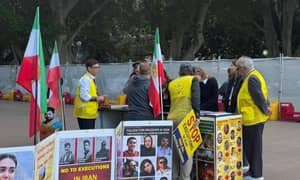
Sydney, Australia – August 29, 2026 – Supporters of the People’s Mojahedin Organization of Iran (PMOI/MEK) gathered in Sydney for an exhibition condemning the Iranian regime’s execution of PMOI political prisoners and protesters arrested during the January 2026 uprising, while honoring the victims’ memory.
The event also called for the immediate and unconditional release of all political prisoners in Iran. Participants denounced the death penalty, political repression, and the regime’s impunity, demanding justice and accountability for human rights violations.
Demonstrators described the executions as a blatant violation of human rights and called for regime change in Iran. They also urged the Australian government and the international community to adopt a firm policy toward the ruling clerical regime, increase pressure to halt executions, and support the Iranian people’s struggle for freedom, democracy, and human rights.
PMOI Supporters Hold Exhibition in Alicante, Spain, to Condemn Executions in Iran
Alicante, Spain – August 29, 2026 – Supporters of the People’s Mojahedin Organization of Iran (PMOI/MEK) held a book table and photo exhibition in Alicante to condemn the Iranian regime’s execution of PMOI political prisoners and protesters arrested during the January 2026 uprising and to pay tribute to the victims.

The exhibition also commemorated thousands of political prisoners executed during the 1988 massacre and honored those who have lost their lives in Iran’s struggle for freedom and human rights. Participants called for justice for the victims and emphasized the importance of preserving the memory of those who died in pursuit of freedom and democracy.
PMOI Supporters in Heidelberg Condemn Executions and Call for Urgent Action to Save Lives
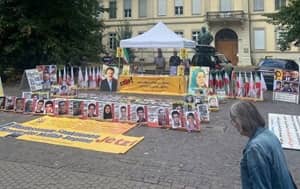
Heidelberg, Germany – August 29, 2026 – Supporters of the People’s Mojahedin Organization of Iran (PMOI/MEK) held a rally and photo exhibition in Heidelberg to protest the Iranian regime’s continued use of the death penalty and draw international attention to the plight of political prisoners and protesters facing execution.
Participants called for immediate and decisive international action to save the lives of political prisoners and protesters arrested during recent protests who are facing execution. They urged the international community to act swiftly to prevent further executions and to exert effective pressure on the Iranian regime to halt the use of the death penalty as an instrument of repression.
They called for the immediate and unconditional release of political prisoners and protesters sentenced to death, as well as the abolition of the death penalty in Iran.
Participants also called for senior Iranian regime officials responsible for systematic human rights violations and executions to be held accountable before an international tribunal for crimes against humanity.
The rally condemned the continued use of executions to silence dissent and intimidate those seeking political and social change, stressing that the international community must take swift and decisive action before more lives are lost.
Cologne Rally Condemns Executions in Iran and Supports Resistance Units’ Struggle for Freedom
Cologne – August 29, 2026: Supporters of the People’s Mojahedin Organization of Iran (PMOI/MEK) held a rally and photo exhibition condemning executions carried out by the mullahs’ regime and calling for an end to the death penalty. They urged the international community to take action to stop executions in Iran and condemned the execution of PMOI political prisoners, as well as protesters arrested in January 2026. The event also expressed solidarity with the “No to Executions” campaign.

Participants also voiced their support for the struggle of the PMOI’s Resistance Units inside Iran, which are working for the country’s freedom. They called for regime change in Iran and urged the German government to adopt a firmer stance against Tehran. Protesters emphasized the need for international accountability and stronger measures to address ongoing repression inside the country.