

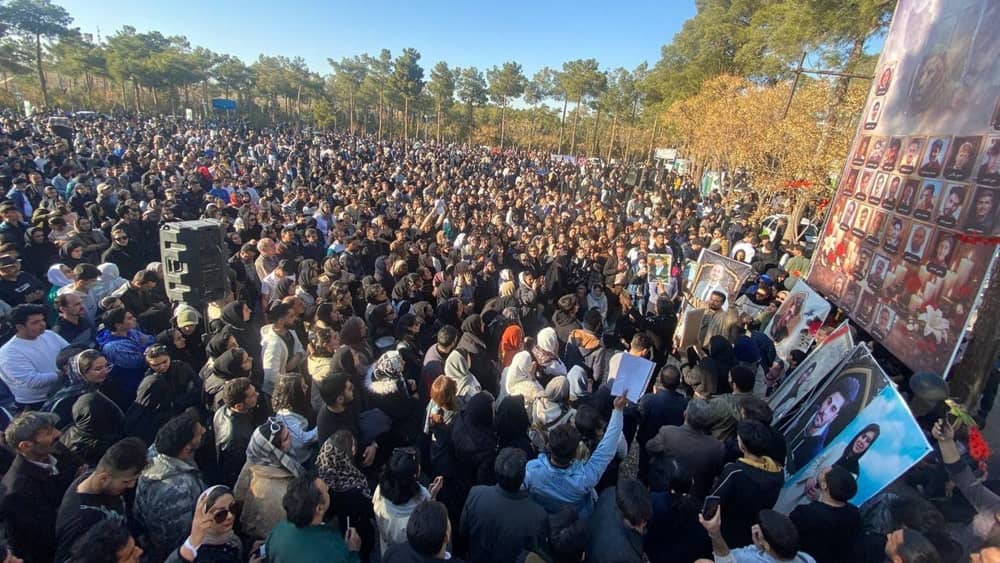
Forty days after a wave of unrest swept through Iran in January 2026, the traditional mourning period has transformed into a fresh catalyst for defiance. From the capital to the rugged provinces of the west, memorial services for those killed have evolved into a nationwide display of political volatility, leaving the regime struggling to contain a crisis of its own making.
Echoes from the Cemeteries
In the cemeteries of Hamadan, Malayer, and Asadabad, the air was thick with both grief and organized resistance. Mourners gathered to flower the graves of Nima Najafi and Mojtaba Rostaei, young men who have become symbols of the latest movement. Despite a suffocating security presence, the rhythmic chanting of “By the blood of our comrades, we stand until the end” signaled that the state’s attempt to move past the January uprising has failed.
The unrest was particularly acute in Tehran’s Behesht-e Zahra and the city of Mashhad. In the latter, security forces attempted to seal off major thoroughfares like Vakilabad Boulevard, only to be met by mobile groups of protesters who bypassed cordons to gather in front of local landmarks. In the western town of Abdanan, the situation reportedly turned lethal as security units opened fire on crowds, later using military hardware to physically block the entrance to the local burial grounds.
February 17—Hashtgerd, northern Iran
People rally to commemorate uprising martyr Mehran Salimi on the 40th day of his murder by regime security forces. Mourners chant anti-regime slogans, including "We swear on the blood of our comrades that we will stand till the end"… pic.twitter.com/PTbvErrz1J— People's Mojahedin Organization of Iran (PMOI/MEK) (@Mojahedineng) February 17, 2026
The “Lose-Lose” Admission
The depth of the internal crisis was perhaps most visible in the rhetoric coming from the Presidential Palace. Vice President Mohammad-Reza Aref, in a rare departure from the usual triumphalism of state media, described the winter’s events as a “lose-lose game” for the establishment.
While Aref leaned on the familiar trope of “foreign design” to explain the unrest, his admission that the uprising was a “tragic” event reflected a growing sense of paralysis within Masoud Pezeshkian’s administration. By labeling the situation a “lose-lose,” Aref inadvertently confirmed that the state’s traditional tools of control—a mix of minor “reformist” rhetoric and heavy-handed suppression—are no longer yielding stability.
As the executive branch grapples with its legitimacy crisis, the judiciary has moved to restore order through mass legal action. Asghar Jahangir, a spokesperson for the judiciary, revealed that the state has issued over 8,800 indictments related to the recent disturbances. More than 10,000 individuals have been summoned for trial, a massive caseload that underscores the scale of the January crackdown. The government continues to distinguish between “deceived” youth and “behind-the-scenes leaders,” the latter of whom are being threatened with the full weight of the state’s punitive apparatus.
40th-day memorials become the new frontline of Iran’s uprising against the regime https://t.co/muYKomcoDN
— People's Mojahedin Organization of Iran (PMOI/MEK) (@Mojahedineng) February 17, 2026
The Economic Foundation of Rage
The persistent nature of the protests is increasingly linked to a total collapse of the Iranian social contract. Economic data published in state-aligned outlets paints a picture of a nation trapped in a terminal ‘structural dead-end.’ With capital investment plunging into a negative 15 percent growth rate, the country has entered a period of systemic capital depletion. This catastrophic threshold signifies that the regime is no longer even replacing the infrastructure it consumes—essentially cannibalizing its own future to sustain a paralyzed present. This is not merely a recession; it is the physical and functional decay of a state.
This economic erosion has bridged the historical gap between the middle class and the urban poor, fusing them into a single, combustible demographic. No longer satisfied with piecemeal cultural concessions or hollow political rhetoric, this unified front views the state not as a governor, but as an obstacle to survival. This systemic failure is mirrored in the digital realm; despite aggressive internet filtering, the illegal market for VPNs has swelled to 30 trillion tomans annually. For the Iranian public, this figure serves as mathematical proof of a regime that has lost the ability to enforce its will even in the virtual world.
As the regime exhausts its remaining tools of suppression, it faces a society pushed beyond the point of no return. With investment in a state of suspension and a middle class in free-fall, the current atmosphere suggests that the January uprising was not a conclusion, but a prelude. In this state of total paralysis, where the authorities offer no solutions and the populace no longer fears the cost of defiance, the nation appears to be standing on the precipice of an inevitable, final reckoning.