

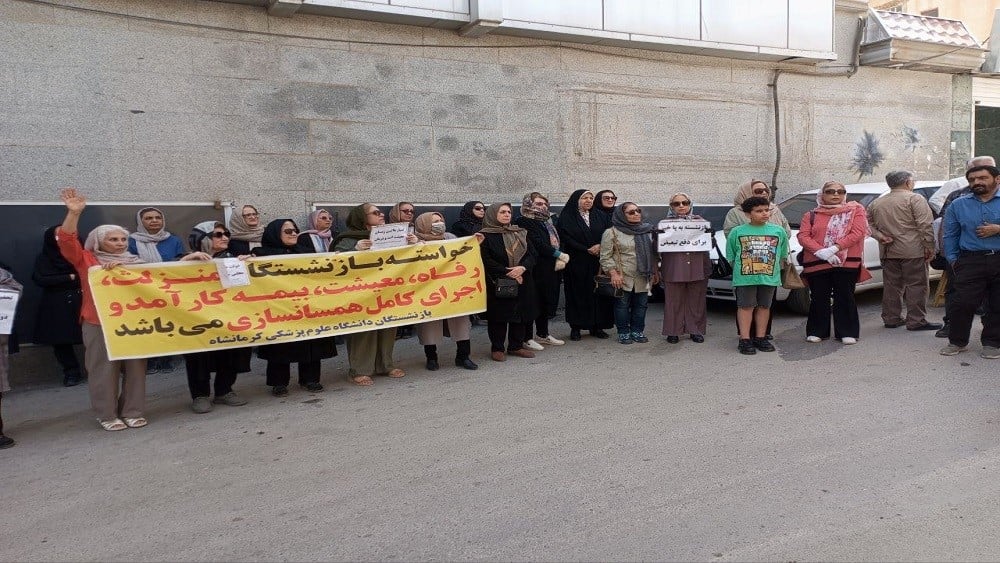
A dual crisis of economic failure and lethal state violence is gripping Iran, exposing the unchanged nature of the ruling theocracy. In recent days, nationwide protests by bakers against a disastrous state-run rationing system and furious demonstrations by investors at a collapsing stock market have coincided with the IRGC’s deliberate killing of civilian women in Sistan and Baluchistan, revealing a regime that answers desperation with negligence and dissent with bullets.
Bakers Revolt Against “Nanino” System
The epicenter of the economic unrest is the nation’s bakeries, where a state-imposed digital system known as “Nanino” has pushed thousands to the brink of collapse. In Mashhad, bakers rallied on July 8, their frustration palpable. “Who do we tell our pain to?” one baker asked, lamenting a promised 50% rate increase that never materialized after 50 days. Another spoke of his inability to pay workers or buy basic food for his family, stating, “I haven’t had any money in my account since the 27th [of last month].”
The protests are spreading rapidly. In Kangavar and Bojnurd, bakers have taken the dramatic step of returning their state-mandated card readers, officially ending their cooperation with a system they say is destroying their livelihoods.
At the heart of their grievances is “Nanino,” a so-called “smart” system introduced in 2022. Critics describe it as a flawed program that has created a bureaucratic nightmare. The system operates from a central command in Tehran, arbitrarily slashing bakeries’ monthly flour quotas for vague “violations.” One baker reported his daily quota was cut from 10 bags to just three, making it impossible to cover the costs of three workers, let alone rent, utilities, and supplies.
The system traps bakers in a no-win scenario. It uses unrealistic metrics, overestimating the number of loaves that can be produced from a bag of flour. If a baker produces a realistic amount, the system accuses them of selling flour on the black market; if they try to meet the system’s inflated target by reducing the size of the bread, they are accused of short-changing customers. Either path leads to fines and further quota cuts. Bakers are even penalized for circumstances beyond their control, such as frequent power outages or poor internet service in rural areas.
July 8—Mashhad, northeast Iran
Bakers hold rally in front of the provincial governorate, protesting the inefficiency of the state-run Nanino bread distribution system.
"We bake bread but can't make ends meet," protesters say.#IranProtestspic.twitter.com/HU93XTTiEz— People's Mojahedin Organization of Iran (PMOI/MEK) (@Mojahedineng) July 8, 2025
Investors Storm Stock Exchange
The economic turmoil is not confined to basic necessities. In Tehran, the crisis took a dramatic turn on July 9 as angry investors stormed the Stock Exchange building to protest the market’s continuous and severe collapse. The demonstrators vented their fury over massive financial losses triggered by what analysts call an “unsafe political and economic atmosphere” following the 12-day war.
The financial data paints a picture of a full-blown crash. On July 9 alone, the main index fell by over 21,000 points, with a staggering 90% of all traded stocks seeing their prices fall. This followed a 52,000-point drop the previous day. In total, the market has shed over 300,000 points since the conflict ended. The first trading day after the ceasefire, June 28, saw more than 99% of stocks plummet, creating a record-breaking 35 trillion toman sell-off queue as investors rushed to exit the market.
The regime’s attempts to halt the freefall have failed. Manipulating daily price fluctuation limits and announcing a 60 trillion toman injection of funds by the Central Bank have been dismissed by experts as temporary fixes, unable to restore confidence or stop the massive capital flight.
July 9—Tehran, Iran
Protest by defrauded investors in the stock market hold protest rally in front of the offices of the Securities and Exchange Organization.#IranProtestspic.twitter.com/AamzK7LSYm— People's Mojahedin Organization of Iran (PMOI/MEK) (@Mojahedineng) July 9, 2025
The Regime’s War on Women in Baluchistan
While bakers fight for economic survival, the regime’s security forces continue to deploy lethal force against civilians, particularly in minority regions. In Khash, Sistan and Baluchistan province, a military-style assault by the IRGC on the village of Guneich on July 1 resulted in the death of two women and left over ten others wounded.
Lali Bamri, a 40-year-old mother, was shot directly by IRGC forces during the raid. With both kidneys destroyed by the gunfire, she clung to life for three days on dialysis before succumbing to her injuries on July 4. Another woman, Khan-Bibi Bamri, was killed instantly in the same attack.
According to local witnesses, the IRGC raid was a deliberate operation targeting civilians. The forces used military vehicles, drones, and war weapons to attack residential homes, with a specific focus on women. The funeral for Lali Bamri on July 7 transformed into a scene of public anger, demonstrating how the regime’s brutality is only fueling further resistance.
Baluch women rise: ‘we neither forgive nor forget’ echoes after deadly regime raid https://t.co/uS3P95njn9
— People's Mojahedin Organization of Iran (PMOI/MEK) (@Mojahedineng) July 6, 2025
A Regime of Incompetence and Murder
These events—from the collapse of the stock market and the systemic failure of the Nanino system to the sheer brutality of the IRGC in Baluchistan—are not isolated incidents. They are faces of the same failing theocracy under Supreme Leader Ali Khamenei. The new presidential administration under Masoud Pezeshkian is merely a facade designed to distract from the unyielding reality of a system that destroys livelihoods with one hand and takes lives with the other.