

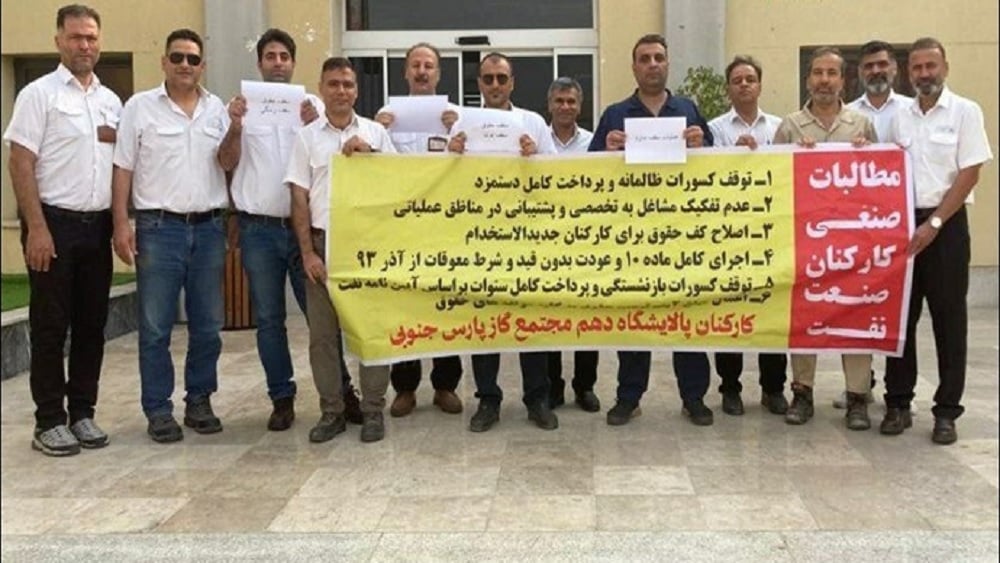
A powerful wave of protest is sweeping across Iran, demonstrating a unified national rejection of the ruling theocracy’s systemic failures. On August 3 and 4, 2025, coordinated strikes and demonstrations by oil workers, farmers, small business owners, and defrauded citizens erupted in multiple cities, revealing a regime that is not only corrupt but fundamentally incapable of governing. The protests, stretching from the country’s economic heart in the south to its agricultural centers and major cities, are not isolated incidents but a collective verdict on a state in an advanced stage of decay.
Oil Workers Strike
In a highly organized and strategic challenge, official employees of the state-run oil and gas industry launched simultaneous protests on August 4 across the critical South Pars energy hub. Workers in Asaluyeh (Site 1), the 10th, 11th, and 12th refineries, and across the 40 offshore platforms of the Pars Oil and Gas Company (POGC) walked out to protest stagnant wages and the regime’s failure to honor its contractual obligations.
August 4—Asaluyeh, southern Iran
Protest rally by employees of Pars Oil and Gas Company, protesting unpaid wages, unfair contracts, and poor working conditions. At the same time, protests are ongoing at other sites of Pars Oil.#IranProtestspic.twitter.com/tiJBoX7WPR— People's Mojahedin Organization of Iran (PMOI/MEK) (@Mojahedineng) August 4, 2025
In a potent display of defiance, the workers co-opted the regime’s long-standing nuclear slogan, chanting, “Enriching life is our undeniable right!” This chant transforms a call for nuclear development into a demand for basic human dignity and economic survival, highlighting the stark contrast between the regime’s costly ambitions and its neglect of the people. The workers are demanding the removal of arbitrary salary caps, an increase in base pay, and the full implementation of Article 10 of the State Civil Service Management Law.
Systemic Collapse Paralyzes the Country
The regime’s gross mismanagement has pushed essential services and vital economic sectors to the brink of collapse. In Zabol, on August 4, farmers gathered in front of the governor’s office to protest crippling cuts to their tractors’ fuel quotas at the absolute peak of the agricultural season. “With this small quota, we can’t even keep the tractor running for a few days,” one farmer lamented, as the region’s entire harvest faces ruin.
August 4—Zabol, southeast Iran
Farmers protest significant reduction in fuel subsidies, which are critical for operating agricultural machinery during the planting season, exacerbating existing challenges from drought and water scarcity.#IranProtestspic.twitter.com/2fQHSGDvtP— People's Mojahedin Organization of Iran (PMOI/MEK) (@Mojahedineng) August 4, 2025
This paralysis is mirrored in Iran’s urban centers. In Tabriz, chronic water and power outages have plunged commercial districts into darkness. A local shopkeeper described the despair: “What is left of a big city like Tabriz when its infrastructure goes out like a candle in the wind? This is not just a power outage, it is the blackout of a nation.”
Similarly, in Sanandaj, shopkeepers protested on August 3 after daily blackouts destroyed their businesses, warning the power cuts are a “final blow to the half-dead body of commerce in Kurdistan.”
State-Sanctioned Theft and Brutality
The protests also expose a system where state institutions actively participate in crime and oppression. On August 4, hundreds of victims of a massive, organized housing fraud in Robat Karim gathered outside the Justice Department in Tehran. They accused the judiciary of being “complicit in the crime” and shielding the perpetrators because “IRGC commanders and powerful figures” are involved, rendering any hope for justice impossible.
This institutional corruption is matched by brazen brutality. In Chabahar, Sistan and Baluchestan province, regime agents used bulldozers on August 1 to demolish the home of an impoverished Baluchi citizen without warning. This cruel act is a clear reflection of the regime’s systematic policy of oppressing Iran’s ethnic minorities and the nation’s most vulnerable.
August 3—Sanandaj, western Iran
Shopkeepers of Tanakoora market in Sanandaj protest frequent and prolonged power outages severely impacting their businesses during peak hours, leading to loss of customers and revenue.#IranProtestspic.twitter.com/mhL2FAgCOQ— People's Mojahedin Organization of Iran (PMOI/MEK) (@Mojahedineng) August 4, 2025
The events of recent days—from retirees in Rasht demanding “Water, Electricity, Life!” to the families of prisoners in Kermanshah protesting their inhumane conditions—paint a clear picture. The Iranian people are united in their suffering and their defiance. The breadth of these protests, cutting across every social class, industry, and region, delivers an irrefutable verdict on the regime’s absolute illegitimacy. Their coordinated actions and powerful messaging prove that the struggle for freedom is not only continuing but gaining strength.