

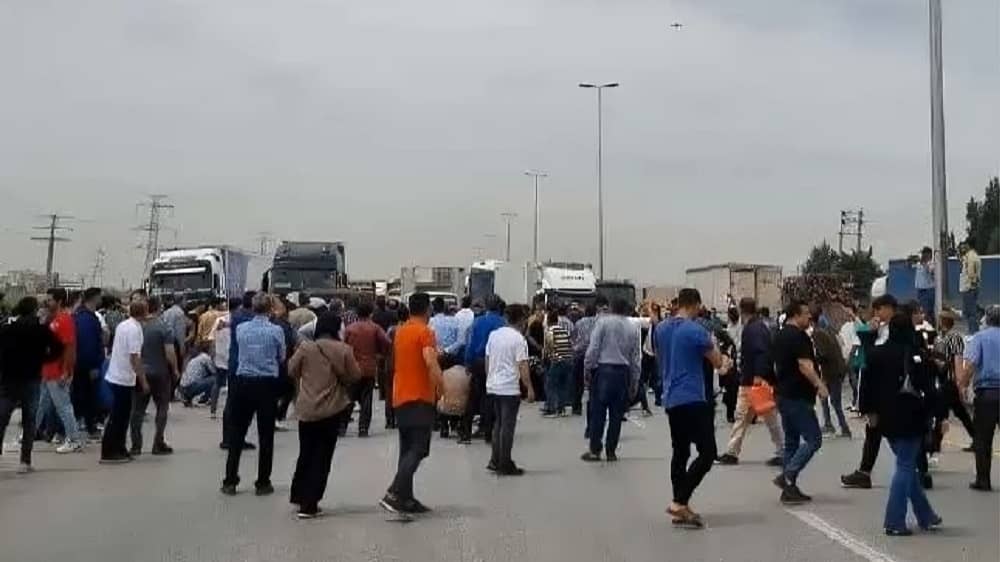
Iran witnessed a fresh wave of protests on Monday, with rallies erupting across multiple provinces and cities as retirees, students, workers, and ordinary citizens voiced grievances over corruption, economic hardship, and repression. The demonstrations, spanning Tehran, Isfahan, Kermanshah, Kurdistan, and beyond, were met with regime crackdowns and threats as the clerical dictatorship scrambles to contain growing dissent.
In Isfahan, central Iran, retirees from the Telecommunications Company of Iran (TCI) gathered on Chaharbagh-e Bala Street outside the provincial headquarters, condemning corruption by regime-linked entities like the Execution of Imam Khomeini’s Order and the IRGC’s Etemad Mobin consortium. Chanting slogans such as “Imam’s Executive Order has looted telecom” and “Etemad Mobin has stolen our rights,” they demanded immediate payment of overdue pensions and the implementation of the 2009 employment regulations.
In Tehran, dozens of retirees staged a protest outside the TCI headquarters on Sardar Jangal Street, demanding accountability from state-aligned shareholders. Meanwhile, students at Shahid Beheshti University protested prolonged water and electricity cuts in the women’s dormitory, chanting “The student dies but won’t accept humiliation.” Elsewhere in Tehran’s Pardis district, residents furious over repeated blackouts gathered, shouting “Death to Khamenei” and “Death to the dictator.”
May 5—Qazvin, northern Iran
Defrauded customers of the state-backed carmaker Reyhan Tak rally in front of the offices of the justice ministry to reiterate their demand for the delivery of their purchases based on the original contract. #IranProtestspic.twitter.com/5WRkt29bjc— People's Mojahedin Organization of Iran (PMOI/MEK) (@Mojahedineng) May 5, 2025
The electricity crisis extended to Rey, Baharestan, Soltanabad, and Shahriar (southern and western suburbs of Tehran), where residents protested hours-long outages, blocking roads and demanding answers. “We went to the governor’s office, they wouldn’t even open the door to listen,” a resident said, highlighting official indifference amid sweltering heat and disruptions to water and communications.
In Kermanshah, western Iran, retirees from the telecom sector held a protest outside the TCI office, chanting “The pensioner is awake, fed up with tyranny.” Their counterparts in Hamadan (west), Kurdistan (west), Zanjan (northwest), Gilan (north), and Chaharmahal and Bakhtiari (southwest) similarly gathered in their provincial capitals, protesting unpaid dues, poor insurance coverage, and corruption by regime-controlled shareholders.
Bandar Abbas, southern Iran, also witnessed protests by telecom retirees, while workers of the Iranian Offshore Oil Company in Lavan Island, southern Hormozgan province, rallied against wage injustice and poor labor conditions.
May 5—Iran
Defrauded customers of the Ghaffari car scam blocked the Qazvin-Karaj highway to raise awareness about the lack of justice to their financial losses caused by a state-backed carmaker.#IranProtestspic.twitter.com/qqp8ecZvdP— People's Mojahedin Organization of Iran (PMOI/MEK) (@Mojahedineng) May 5, 2025
In Tabriz, northwest Iran, residents of the Kujuvar neighborhood demonstrated outside a local refinery, protesting suffocating pollution that has damaged crops and endangered public health.
A major highway was blocked in Qazvin, northern Iran, where defrauded investors in the Ghaffari auto scandal staged a protest near the Qazvin-Karaj expressway, demanding restitution for years of unfulfilled promises. Similarly, investors in the Reyhan Tak project gathered outside the courthouse in the Punak district, chanting “We only want justice!” as years of legal stonewalling boiled into fury.
In Dezful (Khuzestan province, southwest Iran), the funeral of slain protester Azim Farrokhvand turned into an anti-regime demonstration. Farkhond was shot by regime forces outside Dezful’s Fajr prison after protesting the execution of a relative. Mourners honored him with banners calling him “The lion of bravery” and condemned the regime’s repression.
Meanwhile, students in the village of Makinah Salehah (Khuzestan province) protested deteriorating school conditions, holding handwritten signs about collapsing ceilings and lack of air conditioning amid scorching temperatures. Similar scenes unfolded in Abadan (Khuzestan), where elementary school girls protested power cuts as classroom temperatures soared above 42°C, endangering their health.
May 5—Isfahan, central Iran
Rally by retirees of the Telecommunications Company of Iran (TCI), demanding higher pensions and access to basic services and protesting corruption by government institutions managing the pension fund.#IranProtestspic.twitter.com/5wlqm6ArTV— People's Mojahedin Organization of Iran (PMOI/MEK) (@Mojahedineng) May 5, 2025
The day’s protests reflected deepening public anger over systemic corruption, economic ruin, and authoritarian repression. While security forces attempted to silence dissent, demonstrators in city after city challenged the regime’s narrative, calling out theft by entities linked to the regime’s Supreme Leader Ali Khamenei and demanding basic rights.
The breadth of Monday’s protests—from telecom retirees to oil workers, students to environmental activists—underscored the regime’s crumbling legitimacy across diverse sectors and regions. As crackdowns continue and grievances mount, Iran’s rulers face an increasingly emboldened citizenry unafraid to speak out despite brutal repression.
With demonstrations erupting from Tehran to Tabriz, from Lavan to Dezful, Monday’s protests signaled a regime under siege by its own people—a population demanding dignity, justice, and freedom in the face of tyranny.