

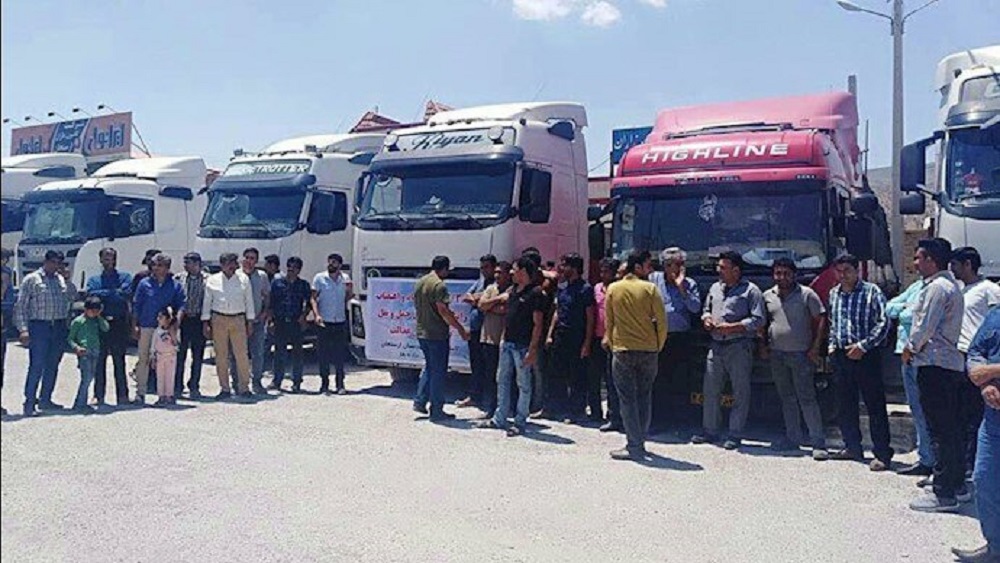
The clerical regime in Iran faced intensifying nationwide defiance on May 29th, as courageous truck drivers marked the eighth consecutive day of their crippling strike. This sustained action, protesting dire economic conditions and unaddressed grievances, has now spread to at least 140 cities across 30 provinces, including newly joined cities such as Marivan, Anzali, Asman Abadi (Ilam), and Kahak (Qom).
The strike has paralyzed transport arteries, with videos showing key transit highways—including Bandar Abbas–Shiraz, Mashhad, Arak, Qazvin, and Shahreza—completely deserted. This underscores the regime’s profound economic mismanagement and its increasingly desperate, repressive responses. The drivers’ stand is a stark testament to a populace pushed to its limits by systemic corruption and official indifference.
The protests sweeping Iran are not isolated incidents but direct consequences of the clerical regime’s catastrophic economic mismanagement and deeply entrenched corruption. The sheer diversity of sectors demonstrating previously, and the continued resolve of the truckers, underscore the systemic nature of this failure.
May 29—Iran
Eighth day of nationwide strikes by truck drivers, demanding fair commission rates, reduction in the exorbitant prices of spare parts, tires, and crucially, fuel.#IranProtestspic.twitter.com/wQigm49vi4— People's Mojahedin Organization of Iran (PMOI/MEK) (@Mojahedineng) May 29, 2025
Truck Drivers’ Strike – Day 8
On May 29th, the resilience of Iran’s truck drivers remained unbroken. In Isfahan, central Iran, the strike entered its eighth day, with drivers protesting crushing economic pressures including high insurance costs, soaring prices for parts and fuel, and freight rate adjustments that fail to meet their basic needs—all issues deliberately ignored by government authorities.
The strike’s impact was palpable in other regions as well. In Darab, southern Iran, drivers also marked their eighth day of action, parking their empty trucks to protest against the same unbearable costs. Similarly, in Bajestan, northeast Iran, truck drivers continued their strike, citing high fuel prices, unfair insurance policies, and relentless economic pressures.
The defiance was equally strong in Mahabad, northwest Iran, where strikes by truck drivers continued for the eighth day, leaving roads empty as truckers steadfastly refused to haul freight.
These drivers, responsible for over 90% of freight transport in the country, face a grim reality where operating costs, severely exacerbated by rampant inflation and inflated fuel prices on the open market, far exceed their earnings, turning daily survival into an arduous battle.
May 29—Isfahan, central Iran
8th day of a nationwide truck drivers' strike against high insurance costs, rising prices of parts and fuel, and inadequate freight rate adjustments, all unaddressed by government authorities.#IranProtestspic.twitter.com/9hvEqJ5cGx— People's Mojahedin Organization of Iran (PMOI/MEK) (@Mojahedineng) May 29, 2025
Regime’s Response: Threats, Intimidation, and Hollow Promises
Faced with the drivers’ unwavering resolve, the Iranian regime has predictably intensified its campaign of intimidation and repression. Fearing the expansion of the strike and escalating public dissatisfaction, the regime has even deployed a convoy of IRGC trucks under the title “Convoy for the Transport of Essential Goods for Tehran Province.”
Kamran Mirhaji, the notorious prosecutor of Fars Province, stated that those obstructing truck activity had been detained and charged, warning, “Serious action will be taken against those who cause disruption.” An audio clip of the same prosecutor further revealed the regime’s intentions: “As the public prosecutor of the county, I will definitely intervene—I will absolutely deal with their fuel cards, with the systematic and physical impoundment of their vehicles… I will not let them off the hook.”
This direct threat is consistent with the regime’s broader strategy of attempting to crush dissent. On May 27th, Shahab Darabi, a truck driver and blogger from Eslamabad-e Gharb, was violently arrested by security forces merely for expressing support for the nationwide strike.
May 29
Ehsan Salehi, prosecutor of Kazerun, threatens truck drivers: “Send them my regards. I will come for every one of them. As prosecutor, I will definitely intervene, I will interfere with their fuel cards, confiscate of their vehicles”#IranProtestspic.twitter.com/Ddtk2Lo3H9— People's Mojahedin Organization of Iran (PMOI/MEK) (@Mojahedineng) May 29, 2025
Further reports from May 29th indicate that truckers have reported several of their colleagues arrested in Isfahan, Hormozgan, Fars, Kermanshah (confirming earlier reports of 11 arrests on May 27th), Gilan-e Gharb, Ardabil, and Khuzestan, with demands for their immediate and unconditional release. The IRGC in Khuzestan also issued a statement announcing that individuals filming the truckers’ strike in Bandar Imam had been arrested.
Alongside these brutal tactics, the regime has resorted to deceptive maneuvers. While threatening drivers with confiscation and arrest, authorities in Hormozgan province on May 28th announced “incentive fuel” of 300 liters for trucks that continued to carry goods, a clear attempt to undermine the strike. This was coupled with disinformation campaigns, such as a report by the state-run “Eghtesad Online” on May 28th.
However, the truckers firmly rejected such ploys, including promises made by government officials—such as Reza Rostami, head of the Transportation, Transit, and Logistics Commission of the Chamber of Commerce, Industries, Mines and Agriculture, and the head of the parliamentary construction committee—to review freight rates and issues of insurance and fuel by the end of Khordad (June 21).
Adding to the pressure, the General Directorate of Roads and Road Transport of Yazd Province issued a notice threatening that all transport fleet vehicles in Yazd must report to the terminal at 10:00 AM on Saturday, May 31, for loading, or their services would be suspended.
May 29—Darab, southern Iran
Eighth day of a nationwide truck drivers' strikes. Drivers have halted empty trucks to protest against soaring insurance costs, tire prices, and unfair freight rates.#IranProtestspic.twitter.com/KP8xm6SPSa— People's Mojahedin Organization of Iran (PMOI/MEK) (@Mojahedineng) May 29, 2025
A Nation Demands Change Amidst Economic Ruin
The regime’s policies, characterized by plundering national wealth and prioritizing ideological ambitions over public welfare, have created an economic abyss. The striking truckers are not alone in their suffering.
The previous day, May 28th, saw protests from various other sectors: construction workers in Nikshahr (southeast Iran) struck over two months of unpaid wages; thousands of wheat farmers in Ahvaz (Khuzestan province) protested egregious payment delays; boat operators and fishermen in Bushehr demonstrated against restrictions on their fishing rights; and bakers in Qom continued to protest soaring operational costs.
This widespread discontent is further inflamed by the regime’s denial of reality. Regime Supreme Leader Ali Khamenei recently claimed that assertions of “systemic corruption” in Iran’s regime are “a lie.” This stands in stark contrast to the daily struggles of ordinary Iranians and the regime’s own desperate attempts to manage an economy it has driven into the ground. Even the regime’s spokesperson, Fatemeh Mohajerani, stated on May 28th, echoing the hollow confessions of the Shah’s regime in its final days: “A report on the truckers’ strike was presented… and it was emphasized that the government has a duty to respond to the needs of all citizens. The voices of all citizens will be heard, and their needs will be addressed.”
The regime’s fear of organized labor and popular dissent is palpable in these heavy-handed responses and transparently false narratives. The state-run Donya-ye-Eqtesad newspaper admitted on May 29, 2025: “The truckers’ strike is not just a stoppage by a single trade group, but a warning bell for the entire road-based supply chain—the main artery of Iran’s economy. For an economy where over 90% of goods are transported via road freight, the truckers’ strike is not merely a professional dispute, but a symptom of institutional dysfunction. If the wheels of transportation stop, the wheels of industry will also come to a halt. For us, transportation is not just a route, but the lifeblood of production.”
May 29—Bajestan, northeast Iran
Truck drivers in Bajestan continue their strike, protesting against high fuel prices, unfair insurance policies, and economic pressures.#IranProtestspic.twitter.com/GkERnaKNj6— People's Mojahedin Organization of Iran (PMOI/MEK) (@Mojahedineng) May 29, 2025
Despite the threats and arrests, the Union of Truckers’ Associations emphasized that such measures “will not create the slightest disruption in their will but will make the drivers more determined in their strike.” The expanding solidarity, with reports of pickup truck drivers in Neyshabur joining on May 28th and even some rideshare (Snapp) drivers joining the protests, highlights a growing national consensus against the regime’s failures. Furthermore, retirees, teachers, oil workers, women, nurses, child rights advocates, and anti-execution activists have issued statements of support, demonstrating that the truckers’ strike echoes the legitimate demands of millions of workers and toilers.
A Determined People on the Path to Reclaiming Sovereignty
The sustained and courageous nationwide strike by Iranian truck drivers, now in its eighth day, sends an unequivocal message: the Iranian people are no longer willing to endure the economic devastation and systemic oppression inflicted by the clerical regime.
The government’s consistent failure to address legitimate grievances, coupled with its brutal crackdown on dissent and reliance on deceitful propaganda, only serves to galvanize further resistance. These actions are not merely cries for economic relief; they are increasingly manifesting as a profound demand for fundamental political change.
The determination witnessed on the roads and in the cities of Iran signals a populace striving to reclaim its usurped sovereignty from a corrupt and incompetent dictatorship, inching ever closer to a future where their dignity, rights, and national wealth are restored. The regime’s attempts to extinguish these flames of protest with repression and lies are proving futile against the unyielding spirit of a nation determined to be free.