

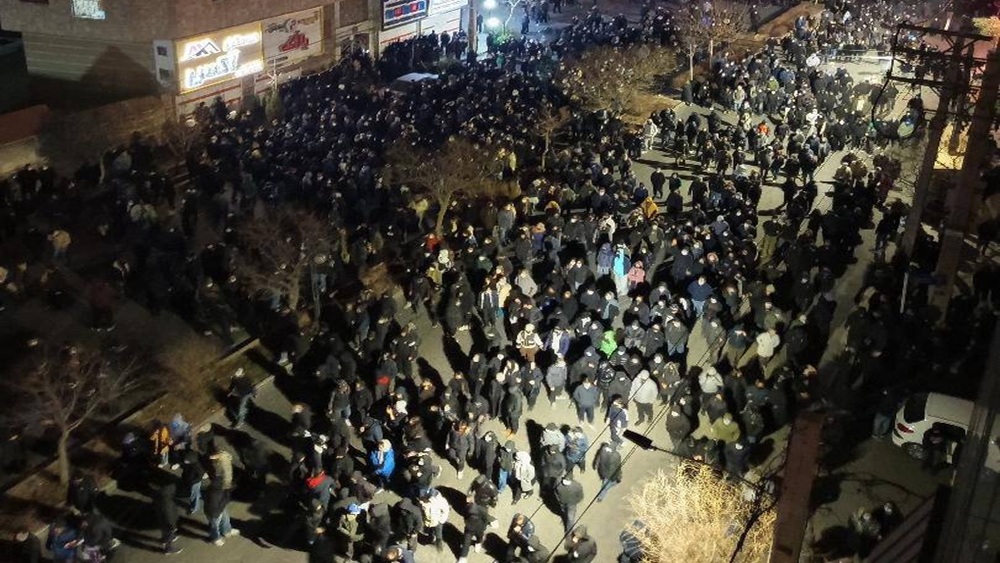
Two weeks into the nationwide uprising, the clerical regime in Iran has deployed its ultimate suppression tactics—a total internet blackout and the use of live ammunition against unarmed civilians—yet the unrest has only intensified. As the sun set on Saturday, January 10, 2026, marking the fourteenth consecutive day of protests, the scope of the rebellion widened to encompass at least 190 cities. The events of this weekend demonstrate a qualitative shift in the uprising, characterized by organized resistance, a rejection of all forms of dictatorship, and the failure of the state’s monopoly on violence.

The Failure of the Digital and Physical Siege
The regime’s primary strategy to quell the uprising relies on isolating the population and inflicting maximum terror. NetBlocks, the global internet monitor, confirmed that Iran has been subject to a near-total internet blackout for 48 hours. This “digital kill-switch” is intended to hide the extent of the crackdown from the international community and sever coordination among protesters. However, reports from the ground indicate that the information blockade has failed to stem the tide of unrest.
In western Iran, the courage displayed by the residents of Kermanshah highlights the diminishing returns of the regime’s brutality. In the Dareh Deraz district, security forces have utilized live fire and heavy-handed tactics over the past few days. Yet, on Saturday, residents returned to the streets in large numbers, chanting “Down with Khamenei.”
⚠️ Update: #Iran has now been offline for 48 hours, as telemetry shows the nationwide internet blackout remains firmly in place.
Meanwhile, regime leaders have continued to post their version of events online while their kill-switch silences the voices of 90 million Iranians 😶 pic.twitter.com/TubjIy4f0g
— NetBlocks (@netblocks) January 10, 2026
Similarly, in Kazerun, southern Iran, security forces resorted to collective punishment, wantonly firing at shops and residential houses to terrorize the population. Despite these measures, the protests have not only continued but have evolved into more direct confrontations.
From Protest to Organized Resistance
The uprising is rapidly shifting from peaceful demonstrations to active self-defense and organized resistance, particularly among the youth. The reports emerging from Friday night and Saturday morning depict a population willing to dismantle the regime’s suppression machinery.
In Izeh, Khuzestan province, the situation escalated into what observers described as a “full-scale battle.” Rebellious youth successfully took over the local Red Crescent building, which reports indicate had been commandeered by the regime to serve as a depot for suppression equipment and a gathering point for security forces. The youth set fire to the building and the regime vehicles stationed there. Furthermore, Basij bases, the local seminary (a symbol of the clerical establishment), and state-owned banks were targeted and damaged.
January 9—Tehran, Iran
At Tehranpars, a vehicle belonging to security forces who were dispatched to quell protests was set on fire after protesters forced the regime's agents to abandon their car and flee.#IranProtests pic.twitter.com/xdj5q0zzRx— People's Mojahedin Organization of Iran (PMOI/MEK) (@Mojahedineng) January 10, 2026
In Mashhad, northeast Iran, rebellious youth in the Toos, Tabarsi, and Vakilabad districts launched coordinated actions against police stations. They destroyed surveillance cameras—critical tools for the regime’s identification and arrest of protesters—and set fire to buses used to transport special anti-riot units.
Political Maturity: A Rejection of Past and Present Dictatorships
The slogans echoing across Iran’s cities reveal a politically astute movement that rejects the regime’s attempts to sow ethnic division or promote a return to monarchical rule. The regime has long relied on a “divide and conquer” strategy, but the protesters are actively dismantling this narrative.
January 10—Tabriz, northwest Iran
Large crowd rallied for another night of anti-regime protests. Demonstrators are chanting, "Turk and Fars will unite to free the country!"#IranProtests pic.twitter.com/CQMRl24j2k— People's Mojahedin Organization of Iran (PMOI/MEK) (@Mojahedineng) January 10, 2026
In Tabriz, the heart of Iranian Azerbaijan, demonstrators clashed with security forces while chanting, “Turk and Fars will unite to free the country.” Another slogan, “Azerbaijan has found its way, rejected Velayat (clerical rule) and Monarchy,” explicitly outlines the protesters’ vision for a democratic future free from any form of autocracy.
This sentiment was mirrored in Karaj and other central cities, where the chant “Down with the oppressor, be it the Shah or the Leader [Khamenei]” has become a core slogan of the uprising. By drawing an equivalence between the current theocracy and the former dictatorship, Iranians are signaling that their goal is forward-looking popular sovereignty, not a regression to the past.
January 10—Tehran, Iran
Large protest at Heravi despite internet blackouts and repressive measures by the regime. Protesters are chanting, "We won't have a country until the mullahs are gone!"#IranProtests2026 pic.twitter.com/g0C9HVFToG— People's Mojahedin Organization of Iran (PMOI/MEK) (@Mojahedineng) January 10, 2026
In Tehran, the rejection of the clerical establishment is total. In districts such as Jannat Aabad, Heravi, and Sattarkhan, nightly protests featured chants like “Mullahs must get lost!” and “We won’t have a country until the mullahs are gone!”
Tehran and Major Urban Centers in Turmoil
Despite the massive security presence, the capital remains a volatile hub of dissent. By Saturday evening, protests had resumed in numerous districts including Saadat Abad, Ekbatan, Punak, and Shahrara. In some areas, such as Maaliabad in Shiraz and parts of Tehran, security forces attacked crowds with tear gas and live ammunition, yet the gatherings persisted.
January 10—Tehran, Iran
Large crowd at Ekbatan rallied for anti-regime protests and chanted, "Down with Khamenei!"#IranProtests pic.twitter.com/VifZms8LbW— People's Mojahedin Organization of Iran (PMOI/MEK) (@Mojahedineng) January 10, 2026
The unrest has also permeated the academic sector. On Saturday morning, students at the Iran University of Science and Technology in Tehran and Yazd University held demonstrations, aligning the country’s intellectual centers with the streets.
The Regime’s Panic and the Price of Freedom
The regime’s response has been one of panic coupled with lethal force. On Saturday, the regime’s Prosecutor General explicitly threatened protesters with charges of “Moharebeh” (waging war against God), a charge that carries the death penalty. He demanded that courts issue indictments “without wasting time” and show “no mercy,” attempting to use the judiciary as a tool of terror.
The cost of this freedom struggle is rising. The PMOI/MEK released the names of 10 additional martyrs from Chenaran and Lordegan, bringing the number of identified protesters killed by direct fire over the past two weeks to 54.
Mrs. Maryam Rajavi, President-elect of the NCRI, stated that the “young and rebellious forces” have “shaken Khamenei’s regime to its core.” She noted that by defending protesters at the cost of their own lives, the youth have ensured the uprising cannot be silenced.
Salute to the young and rebellious forces of the uprising across our homeland, who today complete the second week of a great uprising.
These brave souls have spread the uprising to 190 cities and shaken Khamenei’s regime to its core.
By defending protesters, at the cost of their… pic.twitter.com/fVcp3DYXpn— Maryam Rajavi (@Maryam_Rajavi) January 10, 2026
As the uprising enters its third week, the Iranian people have proven that their resolve to overthrow the dictatorship is stronger than the regime’s capacity to suppress it. The “kill switch” has failed; the voice of Iran is louder than ever.