

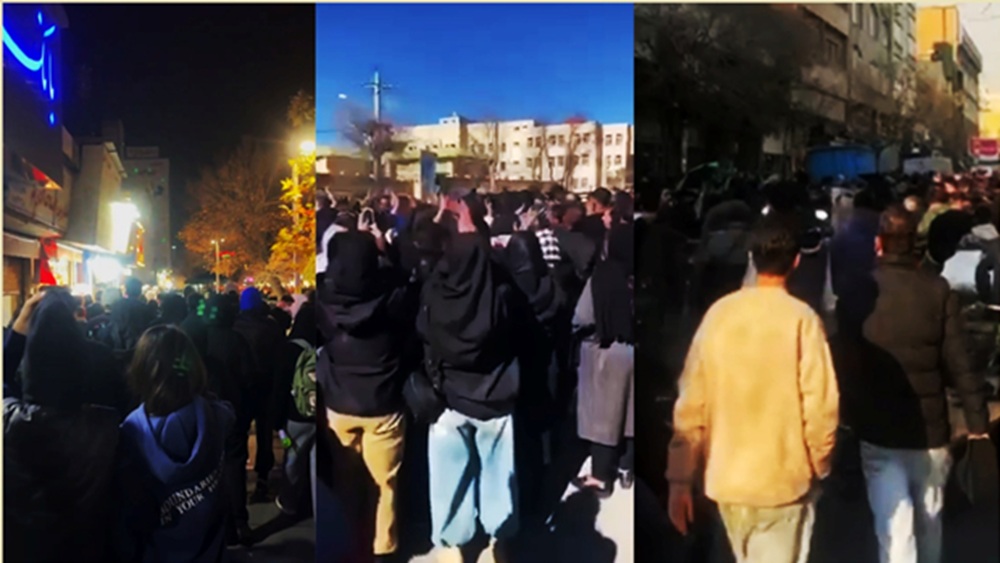
On Monday, January 5, 2026, the nationwide uprising against the ruling theocracy in Iran entered its ninth consecutive day. What began as scattered economic grievances has rapidly coalesced into a formidable political movement seeking the overthrow of the regime. According to the Secretariat of the National Council of Resistance of Iran (NCRI), the unrest has now expanded to at least 107 cities across the country. Despite a militarized crackdown, internet blackouts, and documented war crimes—specifically the targeting of medical facilities in Ilam—the resolve of the Iranian street appears to be hardening.
The dynamic of the protests has shifted significantly over the past few days. While daytime hours see strikes in commercial centers, nightfall has brought intense, widespread confrontations. From the capital of Tehran to the western provinces, the barrier of fear is visibly eroding as citizens move from passive resistance to active self-defense against security forces.

The Battle for Tehran: Economic Hub Turned War Zone
The regime has identified Tehran’s Grand Bazaar as a critical threat, turning the historic economic hub into a militarized zone. On Monday, reports confirmed a total internet blackout in the Bazaar district and surrounding kilometers, coupled with severe disruptions to mobile signals intended to stifle the flow of information.
However, the information blockade failed to prevent physical confrontation. Clashes erupted in the Cheragh-Bargh area, where video footage confirmed direct skirmishes between protesters and suppressive forces. In the Ahangaran Market and Kalantari Alley, regime agents launched brutal attacks on shopkeepers and civilians. Security forces utilized tear gas and pellet guns against merchants on Saadi and Hafez streets, only for defiant youth to respond by setting fire to trash bins to create roadblocks and hamper the movement of police vehicles.
January 5—Tehran, Iran
Citizens start to gather for then 9th night of protest rallies in Tehransar.#IranProtests #IranRevolution pic.twitter.com/LQZeb98Tve— People's Mojahedin Organization of Iran (PMOI/MEK) (@Mojahedineng) January 5, 2026
As night fell, the unrest spilled out of the commercial districts into residential areas. In the Narmak (Haft Hoz) and Tehransar districts, citizens defied threats of a crackdown to hold rallies. In Haft Hoz and Naziabad, the chants were explicitly political and existential for the regime: “This year is the year of blood, Khamenei will be overthrown.”
“Crimes Against Humanity”: The Ilam Hospital Raid
The crackdown took a particularly dark turn in the western province of Ilam. On Sunday, January 4, forces belonging to the Revolutionary Guards (IRGC) stormed the Khomeini Hospital in Ilam city. Their objective was to abduct wounded protesters who had been hospitalized following clashes in Malekshahi the previous day.
Crime Against Humanity in Ilam.
On Sunday, Jan 4—one day after security forces opened fire on protesters in #Malekshahi—regime security forces raided the Imam Khomeini Hospital in Ilam to abduct the survivors.
The @iran_policy has officially condemned this raid as a "crime… pic.twitter.com/rD6Mlf9tQb— SIMAY AZADI TV (@en_simayazadi) January 5, 2026
Witnesses report that suppressive forces fired tear gas inside the hospital wards, a violation of international humanitarian norms. Medical staff, alongside ordinary citizens, attempted to block the agents from entering patient wards, locking doors to protect the injured. Following the raid, the regime launched a campaign of mass arbitrary arrests. In Ilam city alone, approximately 40 teenagers and young people were arrested on Monday, with families reporting 10 youths missing. This followed a coordinated raid the previous night where at least 200 people were detained and bussed to unknown locations.
An assault by Khamenei’s agents on a hospital in Ilam, using tear gas to arrest and abduct wounded protesters and seize defenseless civilians, is an unforgivable crime. This attack came just one day after the horrific massacre in Malekshahi, Ilam.
Desperate to confront the…— Maryam Rajavi (@Maryam_Rajavi) January 5, 2026
Mrs. Maryam Rajavi, President-elect of the NCRI, condemned the hospital attack as an “unforgivable crime” and a desperate attempt by Supreme Leader Ali Khamenei to quell the uprising through “extreme brutality.” She called on the youth of neighboring Lorestan and Kurdistan provinces to rise in support of Ilam.
Escalation in the Provinces: Self-Defense and Armed Clashes
Beyond the capital, the uprising has seen a sharp escalation in the intensity of confrontations. In the western and central provinces, protesters are increasingly engaging in self-defense and direct action against the Basij and security forces.
In Sonqor, Kermanshah province, security forces opened fire on Monday to disperse crowds. Reports indicate that despite the live ammunition, the people stood their ground and continued their rally late into the night. In Nurabad Mamasani, Fars province, demonstrations escalated into armed confrontations with regime agents, with hit-and-run clashes reported in the streets.
January 5—Sari, northern Iran
Protesters in Sari rushed security forces who wanted to abduct one of the demonstrators. The demonstrators was saved and the security forces were forced to flee.#IranProtests #IranRevolution pic.twitter.com/Nh4jCA3zdI— People's Mojahedin Organization of Iran (PMOI/MEK) (@Mojahedineng) January 5, 2026
Specific anecdotes of resistance highlight the shifting morale. In Mardabad, Yazd, rebellious youth attacked a Basij base that had been dispatching agents to crack down on demonstrations. In Sari, northern Iran, demonstrators physically rushed security forces who were attempting to abduct a protester, successfully rescuing the detainee and forcing the agents to flee.
University students continue to act as a vanguard. At Birjand University, students rallied against the concept of neutrality, chanting, “I will avenge my brother’s killer.” Similarly, students at Tarbiat Modares in Tehran chanted, “Basiji, IRGC, you are our ISIS,” drawing a direct parallel between the regime’s security apparatus and the terrorist group.
Socio-Political Messaging: Defining the Enemy
The slogans echoing across Iran’s cities provide a clear window into the motivations of the uprising. The protests have moved far beyond specific economic demands to a total rejection of the regime’s ideological and strategic pillars.
In Sonqor and other cities, the chant “Neither Gaza, nor Lebanon, my life for Iran” was heard repeatedly. This slogan represents a direct repudiation of the regime’s costly regional proxy wars, which the population views as a drain on national resources.
January 5—Sonqor, western Iran
Security forces are trying to disperse protesters by opening fire. Protesters stand their ground and continue their protests.#IranProtests pic.twitter.com/zne0McLK7e— People's Mojahedin Organization of Iran (PMOI/MEK) (@Mojahedineng) January 5, 2026
Simultaneously, the class divide created by state corruption is being highlighted with visceral clarity. In Isfahan, crowds chanted, “The people live like beggars, the leader lives like a god!” In Yasuj, southwest Iran, families of detained protesters gathered at the governorate. Their chant exposed the hypocrisy of the ruling elite: “Their children are in Canada, our children are in prison!” referring to the children of regime officials living in luxury abroad while Iranian youth face incarceration and death.
International Implications and Conclusion
As the death toll rises and the regime intensifies its crackdown, the international community has begun to take note. U.S. President Donald Trump addressed the situation, warning the Iranian regime that if it continues “killing people like they have in the past,” it will face severe consequences from the United States.
However, on the ground, the cycle of violence has not deterred the population. Funerals for those killed in recent days have transformed into mass protests. In Kuhdasht, the funeral procession chanted, “It’s time for war.”
Entering its tenth day, the uprising shows no signs of abating. The regime’s reliance on lethal force, from the hospital corridors to streets in cities across Iran, has thus far failed to break the will of a population that appears to have nothing left to lose.