

Three-minute read
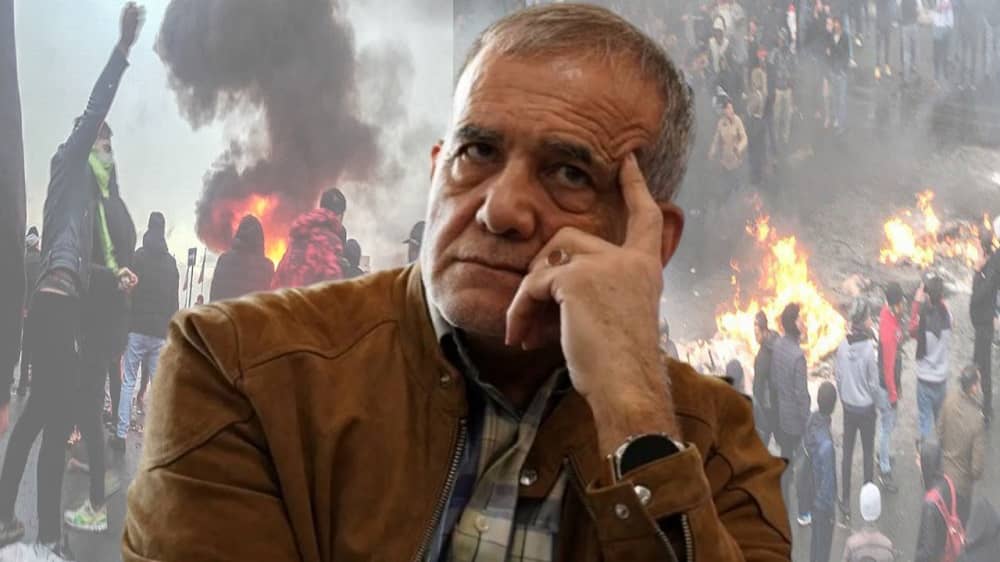
A wave of televised warnings and parliamentary speeches by Iranian officials in recent days has revealed growing anxiety within the regime over deepening social unrest and fears of a potential nationwide uprising. From the president to provincial clerics and MPs, officials have echoed a common theme: the regime is losing control over a disillusioned society, especially among the youth.
On April 18, 2025, Masoud Pezeshkian, the regime’s president, spoke on state television in unusually blunt terms. “People are angry,” he said, referring to the growing frustration with economic hardship and systemic inequality. “We caused these problems. We didn’t solve them. People are not to blame.” Acknowledging the dangerous build-up of public rage, he added: “You want to fix tensions? Should we send the police to the streets to arrest people? That’s not a solution.” Pezeshkian warned that the regime has failed to build trust and warned his colleagues to act before “things explode.”
In a separate statement on April 19, Ahmadreza Radan, commander of Iran’s State Security Forces, emphasized growing concerns about ideological erosion among students. “The enemy has targeted the minds of our students,” he said, signaling the regime’s inability to maintain control over the younger generation’s worldview. While he avoided naming specific groups, the phrase “enemy” is frequently used in official discourse to refer to foreign influence, opposition groups, or dissident networks inside the country.
#Iran’s Regime Officials Express Growing Despair Amid Rising Threat of Uprising https://t.co/aZ0rUG07xZ
— NCRI-FAC (@iran_policy) January 5, 2025
Echoing these fears, Mohammad-Mehdi Hosseini Hamedani, the Friday Prayer Leader in Alborz Province, called on regime loyalists to prepare for unrest. “We must be ready as if war will begin tomorrow,” he said during a sermon aired on provincial TV. “The enemy is not always visible on the battlefield. We may suddenly find ourselves under attack.” He stressed the need for “social and security preparedness,” noting that unrest can erupt from within. “We must fortify ourselves at every level — ideologically, economically, and militarily.”
In Gilan Province, Friday Prayer Leader Rasoul Fallahati voiced similar concerns. “We must be alert. A society that is distracted or deceived can easily be manipulated,” he said, cautioning against complacency and “media warfare.” His remarks emphasized the importance of preventing what he called “social shocks” — a term often used in regime discourse to describe uprisings.
In parliament on April 20, MP Mohammad-Reza Sabaghian Bafqi voiced concern over the erosion of Iran’s Islamic identity, warning that the country is losing ground in a “confrontation with Western culture.” He said, “Every day, in one way or another, our religious and Islamic culture is falling behind,” citing the role of “social media and media outlets” in shaping public opinion.
#Iranian Officials Fear Uprising and Regime Downfall on Anniversary of 2009 and 2017 Protestshttps://t.co/6w44RIVFHK
— NCRI-FAC (@iran_policy) December 31, 2024
Also speaking in parliament today, MP Ezzatollah Habibzadeh delivered a stark warning about the depth of public frustration. “People are sick and tired,” he said, emphasizing that economic pressure, mismanagement, and unfulfilled promises have left society at a breaking point. “The people no longer accept empty words… This pain will not remain confined. It will spill over.” He criticized the government for failing to address inflation, youth unemployment, and the paralysis of small businesses, adding: “People feel abandoned… They no longer feel they are being heard.” His remarks reflected a mounting fear within the regime that unchecked grievances could soon ignite broader unrest.
Together, these statements — made by high-level political, clerical, and security figures — reflect a leadership increasingly preoccupied not with foreign threats, but with the potential for internal revolt. While no single official used the term “uprising” explicitly, their collective warnings about “explosions,” “shocks,” and “cultural infiltration” signal the regime’s heightened awareness of growing unrest across Iran.
The tone across these remarks is no longer defensive but anticipatory. For a regime that has long relied on repression to maintain power, these admissions reveal cracks in its sense of control — and a fear that time may not be on its side.