

Four-minute read
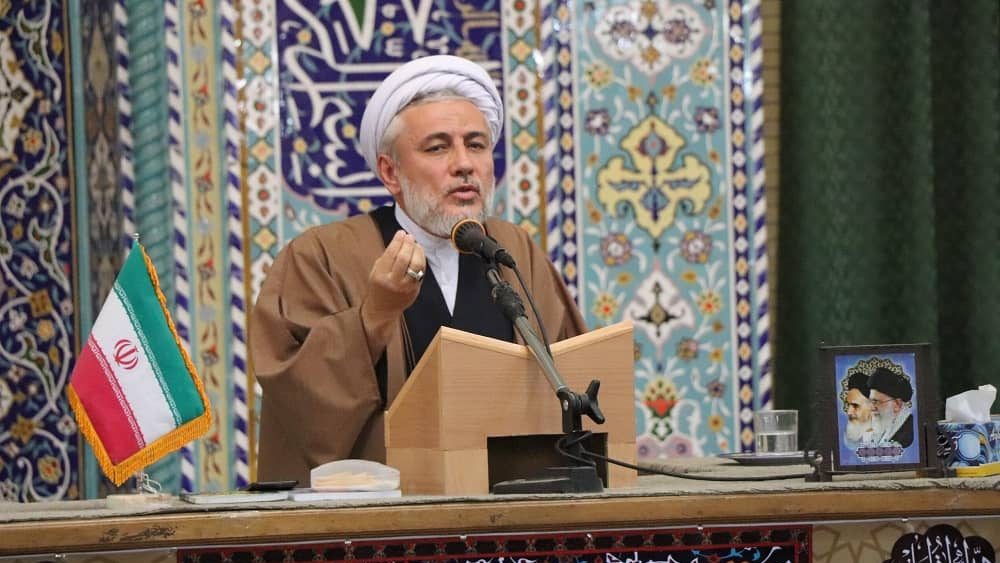
In a revealing series of statements over recent days, top Iranian regime officials have issued a coordinated warning of internal collapse, foreign conspiracy, and social fragmentation. The language—charged, defensive, and apocalyptic—paints a regime deeply fearful of an impending uprising. From Tehran to provincial capitals, Friday prayer leaders and high-ranking clerics are openly invoking the specter of Libya and Syria, warning of Western plots and internal disintegration, while the state intensifies violent crackdowns on civilians, particularly in marginalized regions.
A “Libya Model” for Iran?
Perhaps the clearest expression of the regime’s anxiety came from Allahnour Karimi-Tabar, the Friday Prayer Leader of Ilam Province, who used his May 30, 2025, sermon to warn that the West, led by the United States, is preparing to destabilize Iran using a “step-by-step satanic strategy” modeled on Libya’s collapse.
“They want to step in, create expectations among the people and among the officials… slow down or stop economic progress… and ultimately carry out the same program they did in Libya in our country,” Karimi-Tabar declared. “Libya was a Muslim country with nuclear capabilities. They forced it to dismantle its own program, and once the technology and missiles were taken, the country descended into chaos.”
Watch and judge how #IranRevolution has terrified this #Iranian state official. pic.twitter.com/HWXo3Ne8KN
— NCRI-FAC (@iran_policy) October 23, 2023
Invoking both Syria and Libya, he accused foreign powers—especially the U.S.—of manipulating diplomatic overtures as pretexts for infiltration and regime change.
“They told Bashar al-Assad to cut ties with the Islamic Republic, promising billions in aid. As soon as he distanced himself, they overthrew him in just eleven days. The same fate awaits us if we trust them.”
Youth, Resistance, and the Battle for Minds
Alongside foreign threats, regime officials are increasingly preoccupied with internal ideological erosion—especially among youth. Abdollah Hajji Sadeghi, the Supreme Leader’s representative in the IRGC, warned during his sermon on May 26, 2025, that the real “Khorramshahr”—symbol of resistance in the Iran-Iraq war—is now the “hearts and minds” of young Iranians.
Watch and judge why this insider is warning that the regime is destined for a collapse or #IranRevolution pic.twitter.com/Ysu6LbOhnz
— NCRI-FAC (@iran_policy) January 1, 2024
“Our Khorramshahr is the minds of our youth, their hearts. We must protect them… lest someone plants the idea that resistance is not the only path to victory,” he said on Channel 2 State TV.
Such statements suggest a crisis of legitimacy. The regime no longer takes for granted that the narrative of resistance will suffice for the post-war generation. This cultural insecurity coincides with growing economic hardship and mounting protests over issues like inflation and labor rights.
“With All Our Might, We Must Defend This Regime”
In Tehran, Ahmad Khatami, a senior cleric and member of the Assembly of Experts, reinforced the idea that defending the clerical dictatorship is not merely a political imperative but a religious one.
“The late Imam [Khomeini] said preserving the regime is the most essential of all obligations. The Supreme Leader has affirmed: this is more important than anything else,” Khatami declared during Friday prayers on May 30.
Watch and judge how this former #Iranian official (who happens to be the son of former regime's president Akbar Hashemi Rafsanjani) warns the state's leadership against #IranRevolution pic.twitter.com/dAS7ewKL8M
— NCRI-FAC (@iran_policy) December 28, 2023
He insisted that the country’s nuclear program—though not intended for weapons—remains a non-negotiable symbol of sovereignty:
“They said we couldn’t have even one centrifuge. We enriched uranium. They said one percent enrichment was too much—nonsense! To spite them, we enriched, we are enriching, and we will enrich.”
His repeated use of crowd chants such as “Death to America” and “Death to the enemies of the Supreme Leader” served to fuse national identity, religion, and regime survival into one indivisible construct.
Watch and judge how this insider is warning that #IranRevolution is at the regime's doorsteps. pic.twitter.com/C8ywVnrVJN
— NCRI-FAC (@iran_policy) November 3, 2023
Acknowledging Crisis: “Don’t Let People Be Forced to Protest”
Amid these ideological defenses, some officials are voicing concern over public discontent that could spiral out of control. Reza Nouri, the Friday Prayer Leader of Bojnourd, warned on May 30 that economic pressures risk triggering unrest.
“Do not let it reach a point where people are forced to protest,” he urged, citing tensions among bakers, truckers, and other working-class sectors. “The enemies are lying in wait, looking for even the smallest internal dispute to blow up into mass chaos.”
His comments came after the fifth round of indirect nuclear talks with the United States, which he described as marked by American duplicity. “They won’t put anything in writing. They want all the concessions, without giving anything back,” he said.
“MEK Is the Undeniable Core of Iran Revolution,” State Media Warnhttps://t.co/fx3cJqaThY
— NCRI-FAC (@iran_policy) April 25, 2023
“Hypocrites,” Black Markets, and Social Erosion
In the northwestern city of Bonab, Naser Asghari, the interim Friday Prayer Leader, echoed warnings of internal subversion, explicitly invoking the regime’s longstanding enemy: the People’s Mojahedin Organization of Iran (PMOI/MEK). In his May 30 sermon, Asghari warned that “hypocrites and infiltrating currents, posing as devout Muslims, are actively working to damage the system.”
The term “hypocrites” is a common euphemism used by Iranian officials to refer to the PMOI. Asghari claimed these groups exploit religious imagery to conceal their agenda, adding: “Virtual platforms and certain media outlets are sowing psychological insecurity in society through black propaganda.”
He acknowledged growing public frustration over living costs: “Prices for basic goods such as bread, fruit, and saffron have risen sharply. Fuel smuggling is inflicting billions in damages and must be addressed.”
This convergence of ideological warning and socioeconomic anxiety reflects the regime’s intensifying fear that the PMOI — its most reviled opposition group — continues to exert ideological influence within Iranian society, particularly among disaffected youth.

Crackdown and Bloodshed
As officials call for vigilance, the regime’s security forces have intensified crackdowns on already-repressed communities. In the restive province of Sistan and Baluchestan, three separate incidents in recent days have escalated tensions:
- On May 28, security forces in Hirmand shot and killed a Baluch farmer in his field without warning. He died en route to the hospital, having been shot in the head. Officers fled the scene.
- On May 29, heavily armed units raided Bandar Kargan in Hormozgan province, torching property and clashing with residents under the pretext of suppressing fuel smuggling. Several civilians were wounded.
- On the same day, military forces stormed Birdaf village in Konarak, arresting at least 12 Baluch fishermen and smashing windows in their homes.
Sources report widespread fear and silence following the operations, which appear designed to pre-empt any local resistance through collective punishment.

A Regime on Edge
As Karimi-Tabar put it bluntly: “This is the tragedy of the Islamic world today. May God save Islam from rulers who are slaves of the enemy.”