

A groundswell of protest activity swept across Iran on May 31, 2025, vividly illustrating the deepening chasm between the ruling regime and a populace pushed to its limits by economic hardship and official indifference.
The 10th consecutive day of a nationwide strike by truck drivers, which has now paralyzed transport in 152 cities, stood as the most prominent manifestation of this unrest. Concurrently, workers, parents, and local residents in various regions staged their own demonstrations, collectively painting a stark picture of a nation simmering with discontent over the regime’s pervasive corruption and gross mismanagement of the country’s resources.
May 31—Iran
10th day of strikes by truck drivers, protesting high insurance costs, rising prices of parts and fuel, and inadequate freight rate adjustments, all unaddressed by government authorities.#IranProtestspic.twitter.com/xHREfJmY8w— People's Mojahedin Organization of Iran (PMOI/MEK) (@Mojahedineng) May 31, 2025
Truck Drivers’ Unprecedented 10-Day Strike
The nationwide strike by Iran’s truck drivers, a critical artery of the nation’s economy, entered its tenth day on May 31, 2025, demonstrating remarkable resilience and expanding its reach to an unprecedented 152 cities.
From Isfahan and Kermanshah to Ahvaz, Sanandaj, Shiraz, Yasuj, and Bandar Abbas, drivers refused to load cargo or operate their vehicles, transforming highways and transport hubs into scenes of civil disobedience. Reports from Chermahin Lanjan indicated all trucks were parked in the city’s four parking lots.
In Sanandaj, a complete strike was observed. The usually bustling road to Bandar Abbas was notably empty of trucks, and similar conditions were reported on the road from Abbas Abad towards Bandar Abbas. Drivers in Shiraz noted that the Sadatshahr police checkpoint, typically congested, was devoid of heavy vehicles. The strike’s momentum was further bolstered as minibus drivers in Isfahan joined their protesting colleagues.
More footage of 10th day of truckers' strikes in Iran, which has now spread to 152 cities across the country.#IranProtestspic.twitter.com/GE1UegA99x
— People's Mojahedin Organization of Iran (PMOI/MEK) (@Mojahedineng) May 31, 2025
The drivers’ grievances are rooted in severe economic pressures: exorbitant insurance costs, the relentlessly rising prices of essential spare parts and fuel, and freight rate adjustments that fail to keep pace with rampant inflation. These critical issues, they state, have been consistently ignored by government authorities.
The regime’s response has been a predictable mix of threats, attempts at suppression, and hollow promises. While a government spokesperson, Fatemeh Mohajerani, claimed on May 30, 2025, that the government feels “obliged to respond to the demands of the truck drivers” and suggested that some regulations are not “properly considered,” and the Deputy Minister of Roads and Urban Development, Mehran Qorbani, promised prompt payment of freight charges, these assurances have rung hollow. Simultaneously, authorities have resorted to intimidation, arresting drivers in cities like Hamedan and Bijar under the pretext of being “security disruptors.”
May 31—Isfahan, central Iran
Minibus in Isfahan join the nationwide strike by truck drivers, protesting high insurance costs, rising prices of parts and fuel, and inadequate freight rate adjustments.#IranProtestspic.twitter.com/QWFZFCyhPB— People's Mojahedin Organization of Iran (PMOI/MEK) (@Mojahedineng) May 31, 2025
Despite this, the striking drivers have remained defiant. The Union of Truck Drivers and Transporters of Iran issued a powerful statement: “We proudly announce that the great and historic strike of drivers, backed by your unity and awareness, has now spread to 152 cities… Our response is one word: resistance until we achieve our basic human and legal rights! These threats only prove that our voice has reached a point where it has shaken the foundations of injustice… We stand firm until our rightful demands are met.”
This strike is not just a professional protest, but part of the national struggle against the ruling religious dictatorship and the cry for justice and rights of the Iranian people. Echoing this sentiment, protesters have been heard chanting slogans such as “Death to the oppressor, be it Shah or Leader,” a clear denunciation of the entire ruling structure.
May 31—Ilam, western Iran
Workers of Puya Nakh hold protest rally outside the provincial governor's office to demand the resumption of factory operations, payment of overdue wages, and prevention of layoffs.#IranProtestpic.twitter.com/dIk9KZvhal— People's Mojahedin Organization of Iran (PMOI/MEK) (@Mojahedineng) May 31, 2025
Other Protests Erupt on May 31st
The truck drivers’ action was far from an isolated incident. On May 31, 2025, other sectors of Iranian society voiced their grievances:
- In Ilam, western Iran, workers from the Puya Nakh factory held a protest rally outside the provincial governor’s office. Their demands were clear: the resumption of factory operations, payment of long overdue wages, and an end to threatened layoffs. Reports indicate these workers have not received wages for several months and have been unemployed for three months.
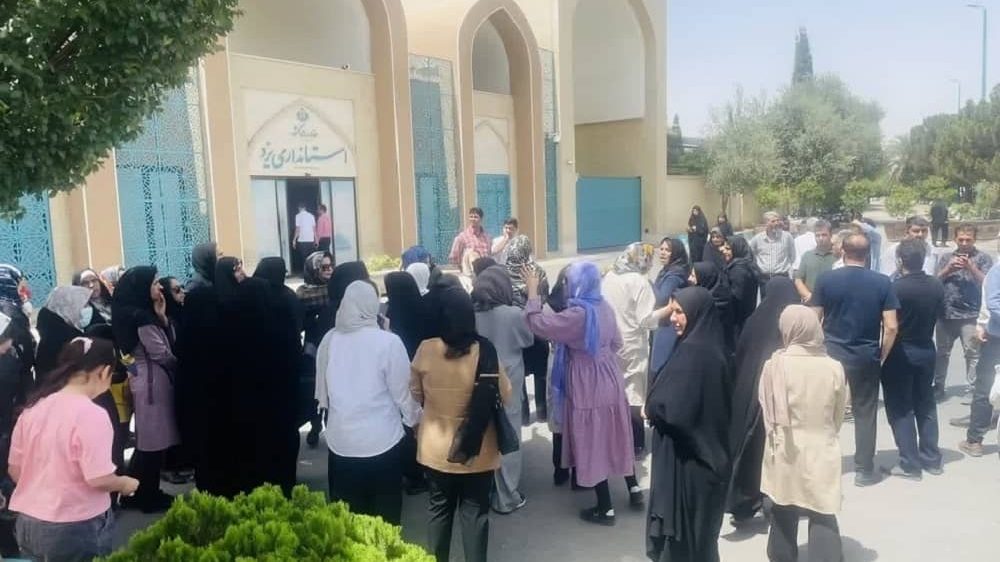
- In Yazd, central Iran, parents of students gathered outside the Yazd governor’s office to protest a sudden and exorbitant 370-million-rial tuition hike at the Seyed Al-Shohada School.
- In Lordegan, western Iran, residents protested the abrupt halt of a crucial water supply project. They decried the mismanagement of natural resources in a region ironically rich with water sources yet plagued by scarcity due to poor governance and neglect.
May 31—Lordegan, western Iran
Residents protest the halt of a water supply project that is and mismanagement of natural resources in a region rich with water sources yet facing water scarcity due to poor governance.#IranProtestspic.twitter.com/cyF8g5w5ml— People's Mojahedin Organization of Iran (PMOI/MEK) (@Mojahedineng) May 31, 2025
Regime’s Incompetence Fuels Nationwide Anger
These diverse protests, erupting simultaneously, are not disparate events but symptoms of a profound and systemic economic crisis engendered by the clerical regime’s decades of corruption, incompetence, and prioritization of ideological agendas over national welfare.
The skyrocketing costs faced by truck drivers, the crippling tuition increases burdening parents in Yazd, the non-payment of wages to workers in Ilam, and the failure to complete essential infrastructure like the water project in Lordegan all point to an economy in severe distress.
These are direct consequences of policies that have led to rampant inflation, widespread unemployment, and the decay of public services, while regime-affiliated entities continue to plunder the nation’s wealth. The government’s acknowledgement, via its spokesperson on May 30, 2025, that “some laws and regulations that are enacted are not properly considered” is a tacit admission of its own failings, yet offers no tangible solutions to the suffering of the Iranian people.
May 31—Yazd, central Iran
Parents of students rally outside the Yazd governor's office protesting a sudden 370-million-rial tuition hike at Seyed Al-Shohada School.#IranProtests pic.twitter.com/hGljEa89bR— People's Mojahedin Organization of Iran (PMOI/MEK) (@Mojahedineng) May 31, 2025
Regime’s Fear and Panic
The growing scale and intensity of these protests have not gone unnoticed by the regime’s inner circles, betraying a palpable sense of anxiety. On May 30, 2025, Reza Nouri, Khamenei’s representative and Friday prayer leader in Bojnourd, voiced these concerns publicly. “There is the issue of truck drivers, there is the issue of bakeries,” he lamented, adding, “Our enemies are lurking; they are looking to create chaos… We know our enemies are in ambush, looking to create a big issue, a big chaos out of a small dispute or difference that might arise within the system.” Such statements reveal not a willingness to address legitimate grievances, but a deep-seated fear of popular uprising and an attempt to deflect blame onto external “enemies” rather than acknowledging internal failures.
The People’s Will Versus a Failing Dictatorship
The events of May 31, 2025, particularly the sustained and widespread strike by Iran’s truck drivers, serve as a powerful testament to the Iranian people’s escalating frustration and their courage in the face of a repressive regime. The diverse protests across multiple sectors underscore a unified rejection of the economic devastation and systemic corruption that have become hallmarks of the clerical establishment.
While the regime responds with a mixture of empty promises, intimidation, and paranoid accusations against perceived enemies, it demonstrably fails to address the fundamental grievances of its citizens: the right to a dignified livelihood, access to basic services, and an end to the squandering of national wealth.
The unity displayed by workers, parents, drivers, and ordinary citizens across Iran signals a growing and potent grassroots movement. This collective outcry is not merely about economic hardship; it is a profound demand for fundamental change and the restoration of the people’s sovereignty.
The regime’s inability to quell this dissent, despite its vast repressive apparatus, highlights its increasing isolation and the Iranian people’s unyielding determination to reclaim their rights and their nation’s future. The path forward, as consistently articulated by the Iranian Resistance, lies in empowering this popular will to overcome tyranny and establish a democratic and accountable government