

Three-minute read
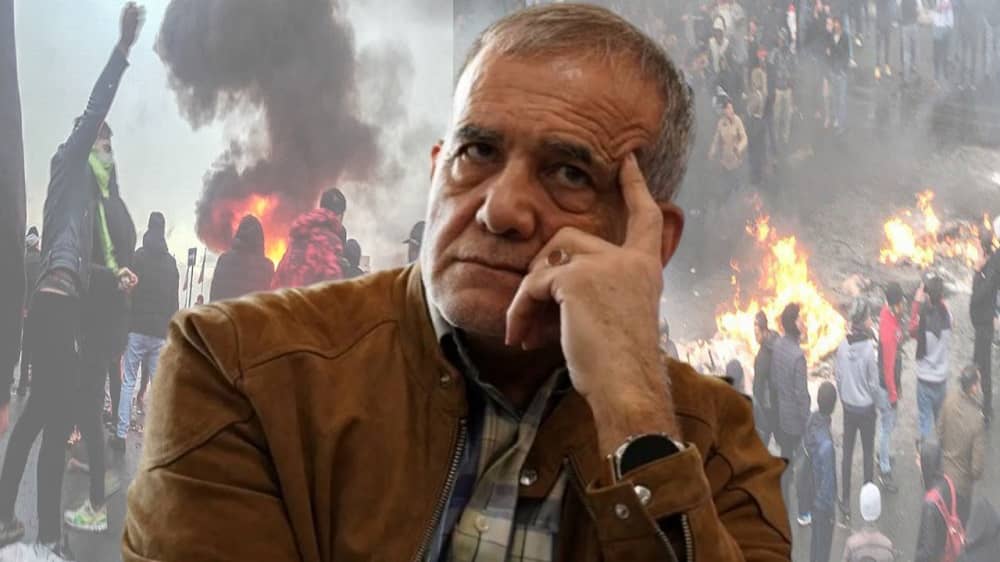
Iran’s clerical establishment is openly signaling fear that the next wave of unrest could move beyond protest and threaten the survival of the system itself. In recent days, senior officials, Revolutionary Guard–aligned media, and state economic figures have described a state that is broke, volatile, and “at war,” while security forces roll out new neighborhood-level control structures designed to manage “social incidents” without outside support. The message is clear: the regime no longer trusts its ability to absorb another nationwide shock.
“Do you want me to lie so you feel good?”
On October 25, 2025, the regime’s president Masoud Pezeshkian told officials in West Azerbaijan that the state is effectively insolvent. He said there are roughly “six million billion tomans” (about six quadrillion tomans) of unfinished projects “and no money,” adding that even if the government launched nothing new and focused only on the backlog, “we would still need 15 years of work.” Confronting local demands, he asked: “Do you want me to lie so you feel good? Let me tell the truth and you get angry.”
Pezeshkian called this “the worst credit situation,” citing oil budget assumptions blown apart by prices closer to $51 a barrel versus $70 on paper, leaving “a $10 billion shortfall.” He admitted the state is pushing basic services onto citizens—“we built the schools with the people’s money; we have no money”—and framed the moment bluntly: “The reality is we are in a war and under sanctions,” while refusing “to give too much detail” lest it be “exploited.”
#Khamenei and his squad try to say “the unrest is under control”.
Other state officials offer indications that "more riots lie ahead".
Watch and judge the signs of #IranRevolution2023 pic.twitter.com/UTiTXxHakN— NCRI-FAC (@iran_policy) January 5, 2023
Neighborhood control, block by block
On October 23, Isfahan’s provincial security chief Mojtaba Fada unveiled a “neighborhood-based command center” — a Basij-led grid to manage crises locally. Each base, he said, must maintain a “file” on its neighborhood’s people, services, and equipment so that “in times of crises such as war or social incidents [it] can manage the scene without relying on outside institutions.” He called the project a “strategic necessity for the state’s future” and warned that “any voice” sowing division among society or state “is an echo of the enemy.” This is not conventional policing; it is pre-emptive urban control architecture built for unrest.
On the same day, the state-alligned daily Jahan-e Sanʿat described an “explosive” social landscape. Long-term youth joblessness, it warned, breeds “despair” and “social harm,” conditions that “can fuel riots and social unrest.” The younger generation, it wrote, blames the economic and educational systems for blocking their future, creating a “deep rift full of resentment between generations.” The paper called the coexistence of labor shortages and mass youth unemployment “a serious alarm bell for national security.” When state media speaks this way, it reflects an internal assessment that stability is at risk.
#Iran News in Brief
IRGC Chief: "The #internet acts as a weapon of mass destruction. The enemy wants to mobilize the youth to serve their own goals, and to lead them to #protests and riots." #IranRevoIution https://t.co/TeoECUEZsC pic.twitter.com/5wgmP5PFtP— NCRI-FAC (@iran_policy) November 2, 2022
Hunger politics and the math of collapse
Economic stress is intensifying. On October 23, former labor minister Hossein Kamali told the state outlet Eqtesad News that nearly 60 percent of Social Security retirees live below the poverty line even by the government’s own (contested) benchmark of 6,128,739 tomans per person—which would put a four-person household’s threshold near 24 million tomans against a ~12 million minimum pension. He criticized “number-fixing” that masks, rather than solves, poverty.
The same week, Reza Kangari, the head of the food wholesalers’ union said the halt in Pakistani rice imports has tripled wholesale prices to 175,000–185,000 tomans per kilo—a direct hit to household staples. And on October 22, Khabar Online summarized international forecasts: consumer prices above 40 percent this year and next, and potentially 50–60 percent in 2026, alongside negative growth. The combination—shrinking output with accelerating prices—is a classic spark for street anger.
Meanwhile, Pezeshkian’s unusually blunt language—“we are sitting on oil and gas but we are hungry”—has enraged hardliners. The IRGC-aligned daily Javan scolded him, urging the president to stop repeating the “word hunger” and instead “strengthen distributive justice” while using the bully pulpit to project “strength, self-belief, and forward-looking confidence.” The critique reveals the security current’s priority: control the narrative, not the prices. Acknowledging deprivation is treated as a security breach.
Oct 8- Acknowledging the exhaustion of the regime’s oppressive forces, Mohsen Mansouri, the governor of Tehran, said: “During the riots, some police forces did not go home for several days.”
He added: "They launched a full-scale war in the country.”
4/9https://t.co/o8bkPV0mXk pic.twitter.com/FxnjIFJFVe— NCRI-FAC (@iran_policy) October 9, 2022
Preparing for what they expect
Put together, the week’s signals show a system preparing for an uprising it deems plausible. The president tells provincial elites the treasury is empty and decades of promises are undeliverable. Provincial commanders build autonomous Basij hubs to suppress “social incidents” without waiting for orders. State media and officials warn of youth-driven “riots.” Former senior officials concede that most retirees are under the poverty line. And official reporting now normalizes medium-term scenarios of 50–60 percent inflation with no growth to ease the pain.
The regime is not acting like it can defuse public anger through policy. It is acting like it must outlast a confrontation—street by street, mosque by mosque—because the next shock could move from protest to regime-threatening challenge.