
Three-minute read
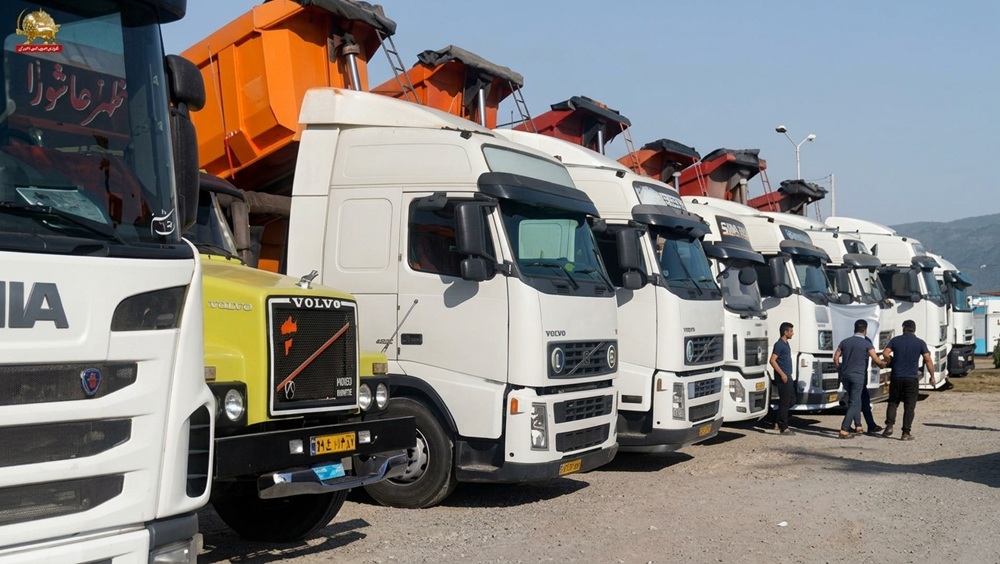
Truck drivers continued their strike Monday for a second consecutive day, with reports of stoppages in Shiraz, Tehran, Qazvin, Bam, Sirjan, Dezful, Bandar Abbas, Isfahan, Chabahar and Divandareh. Drivers in Gachsaran and Jiroft reportedly joined the protest, alongside pickup-truck operators.
The drivers are protesting inadequate freight rates, fuel shortages and soaring operating costs. Some report tire prices reaching 350 million tomans and spare-part costs quadrupling.
In an unusually frank assessment, the state-affiliated newspaper Jahan-e Sanat acknowledged Monday that the government’s recent 22.6% freight-rate increase falls far short of rising expenses.
Transport industry representatives described a sector crippled by costly vehicles, inadequate freight payments, diesel shortages and lengthy delays at border crossings.
Yet Road Maintenance Organization chief Reza Akbari insisted Monday that no strike had occurred and freight operations were normal.
Iran, Nov. 18: New restrictions on subsidized bread purchases spark anger as food prices soar. Reports say 5 protesters remain detained after #Abdanan's anti-regime demonstrations. Workers protest unpaid wages, patients shoulder nearly 70% of healthcare costs, and pollution shuts…
— NCRI-FAC (@iran_policy) November 18, 2026
He simultaneously acknowledged unresolved grievances involving insurance, tires and engine oil, promising that authorities were addressing them.
The contradiction is particularly revealing: while the government denies the protests, its own newspapers document the grievances driving them.
Protests Spread Across Several Social Sectors
Monday also saw demonstrations by telecommunications retirees in Isfahan, Kermanshah and Kurdistan over unpaid benefits, inadequate pensions and deteriorating living conditions.
In Tehran, approximately 200 Jahan Pars workers reportedly protested employment-related grievances, while investors in Momtaz Iranian demonstrated over unresolved financial claims.
Welfare Organization employees in Khorasan Razavi also protested, demanding improved working conditions and payment of outstanding entitlements.
These developments followed Sunday’s demonstrations by pensioners in Tehran, Isfahan and Shush, reflecting the persistence of labor and livelihood protests across different provinces.
"A society can endure for years without accepting the conditions imposed on it—but when accumulated anger finally breaks through, the result may be sudden, nationwide and far harder to contain," @MansoreGolestan writes.https://t.co/BYM0Pzydhe
— NCRI-FAC (@iran_policy) November 15, 2026
Meanwhile, student councils representing 31 universities, including Sharif, Amirkabir, Tarbiat Modares and Shahid Beheshti, issued a joint statement condemning disciplinary proceedings against elected student representatives.
They demanded an end to retaliatory punishments and the reversal of suspensions, including a four-semester suspension imposed on a former student council secretary.
Producer Inflation Reaches 15-Year High
Iran’s Statistical Center disclosed that producer prices rose 120.9% year-on-year during the summer, the highest rate recorded since 2011.
Industrial producer inflation reached an even steeper 147.3%, while prices in petroleum refining surged approximately 199%.
The figures, examined in Monday’s Jahan-e Sanat, reveal mounting pressure on manufacturers already facing energy shortages, currency restrictions and declining demand.
The newspaper noted that producer prices had nearly doubled over three consecutive quarters, creating further pressure likely to reach consumers.
In a separate analysis, state-aligned economist Hossein Raghfar criticized the government’s economic priorities, warning that poor policymaking and the allocation of scarce foreign currency to nonessential imports were compounding public hardship.
"The logic of Tehran’s political #economy: protect the institutions that defend the ruling order, preserve the regional and military projects the state considers strategic, and make households absorb a greater share of the cost of economic failure," writes @shahriarkia…
— NCRI-FAC (@iran_policy) November 16, 2026
The newspaper Ebtekar meanwhile reported estimates that approximately 1.5 million workers had lost their jobs amid the economic downturn and wartime disruptions.
Housing Becomes Increasingly Unaffordable
According to Monday’s Donya-e Eqtesad, Iran’s oil blockade and economic disruption have severely affected production and growth.
Another report in the newspaper bulletin placed the average advertised price of apartments in Tehran at 277 million tomans per square meter in November, up 12% from October.
Actual transaction prices averaged approximately 236 million tomans per square meter, while only around 2,560 apartments changed hands during the month.
Real estate agents said even apartments in southern Tehran could cost at least 10 billion tomans, placing homeownership increasingly beyond the reach of ordinary wage earners.
Iran, Nov. 17: Mourning for 13 oil workers killed in a bus crash turns into anti-regime #IranProtests in Abdanan. Officials admit 25% of roads are deteriorating, an IRGC commander acknowledges intelligence penetration, and the Central Bank reveals severe monetary expansion.…
— NCRI-FAC (@iran_policy) November 17, 2026
Fuel Shortages Contradict Official Assurances
Acting Oil Minister Hamid Bord announced Monday that gasoline production and consumption had reached equilibrium, claiming the government could manage winter energy needs through a 20% reduction in gas consumption.
His assurances contrast with recent citizen reports of lengthy gasoline queues and station closures, including incidents in Tehran, Ahvaz and Bushehr.
Separately, electricity authorities have warned that worsening power-station fuel shortages could force restrictions on residential and commercial supplies.
The establishment newspaper Setareh Sobh directly linked the energy crisis to mismanagement, confrontational foreign policy, sanctions and war, warning that ordinary Iranians wanted normal lives rather than further conflict.
Factional Conflict Extends to Internet Restrictions
A new dispute emerged after the Guardian Council declared the Pezeshkian administration’s special internet-management committee religiously unlawful.
The committee, chaired by Vice President Mohammad-Reza Aref, had been established to address internet restrictions and potentially reopen blocked foreign platforms.
Pezeshkian keeps publicly warning of winter energy crises, oil-sale blockages & #IranProtests. Hardliners (and Mojtaba Khamenei) want him to stop “advertising weakness.” He might be more worried about an unprepared population exploding than about signaling vulnerability abroad.…
— NCRI-FAC (@iran_policy) November 21, 2026
The decision, reported by Khabar Online, threatens another government initiative and underscores the continuing influence of factions determined to preserve tight control over online communications.
The dispute follows Sunday’s extraordinary parliamentary disruption over imprisoned hardline lawmaker Hamid Rasaee, whose disabled parliamentary access triggered protests by fellow lawmakers and forced the cancellation of a legislative session.
Military Threats Continue Despite Diplomatic Contacts
While the regime’s president Masoud Pezeshkian has pressed for an end to the country’s damaging “neither war nor peace” situation, senior regime figures continue emphasizing military confrontation.
Parliament Speaker Mohammad Bagher Ghalibaf argued that only strengthened military deterrence could remove the threat of war.
Meanwhile, Deputy Foreign Minister Kazem Gharibabadi confirmed contacts with Qatari mediators, including a recent visit by a Qatari delegation, but said formal negotiations had not begun.
The contrasting positions reflect the regime’s unresolved divisions over how to escape the economic and military pressures threatening its survival.
Iran, Nov. 21: Bread controls now operate in seven provinces as bakers protest and fuel queues persist. Workers, students and consumers demonstrate, while #Abdanan arrests rise to 12. Tehran faces renewed blackout fears, and Pezeshkian acknowledges failing enterprises and…
— NCRI-FAC (@iran_policy) November 21, 2026
With industrial prices surging, livelihoods collapsing and competing factions obstructing one another, the regime faces mounting pressures it cannot resolve through rhetoric or repression.
The expanding protests suggest that the gap between official assurances and everyday reality is becoming a political danger in its own right.