Six-minute read
Saeed Kamali Dehghan built a high-profile career interpreting Iran for Western audiences. A closer examination of his Guardian record shows a sustained pattern of hostile framing of the People’s Mojahedin Organization of Iran (PMOI/MEK) and the National Council of Resistance of Iran (NCRI). His 2026 return to Iran, and reports reproducing his own social-media admission that a prominent 2010 human-rights interview was fabricated, now make the provenance and editorial impact of that record impossible to treat as a minor question.
Saeed Kamali Dehghan is an Iranian-British journalist and former Guardian Iran correspondent whose byline gave him unusual authority to explain Iran to Western audiences. He began contributing to the Guardian from Tehran in 2006, built an award-winning profile during the 2009 protests, and later became a staff journalist in London. That credibility is central to this story. Between 2010 and 2018, he repeatedly used the Guardian’s platform to describe the MEK and NCRI as unrepresentative, unpopular, fringe, shadowy, cult-like or extreme, while often presenting change within the Islamic Republic as the more realistic political path. The Iranian regime has long treated media, information and intelligence as overlapping arenas. Iran ranks 177th of 180 countries in Reporters Without Borders’ 2026 World Press Freedom Index, and RSF describes a media environment marked by state control, arrests, surveillance and pressure on journalists. In a 2017 interview, former Intelligence Minister Ali Fallahian was recorded describing the need for occupational cover in intelligence collection and naming journalism among the professions that could provide such cover. That statement does not establish that any particular journalist is an intelligence officer. It does establish that scrutiny of source relationships, access and information flows is not an artificial concern in the Iranian context.
The MEK has, meanwhile, been treated by Tehran as an intelligence and security target, not merely a political adversary. In a U.S. federal case, Ahmadreza Mohammadi-Doostdar and Majid Ghorbani pleaded guilty in connection with work on behalf of Iran that included photographing MEK members and supporters at rallies, collecting identifying information and transmitting it towards Iran. The U.S. Department of Justice said Doostdar admitted that money used to pay Ghorbani had come from his Government of Iran handler. In Europe, a 2018 bomb plot targeted the NCRI’s annual gathering near Paris; France later formally attributed the plot to Iran’s Ministry of Intelligence. The reputational campaign against the same movement therefore unfolded alongside documented surveillance and physical-security threats.
periodic reminder on role of Iran's embassies from Ali Fallahian, regime’s former Intel Minister@eu_eeas @JosepBorrellF how long do you plan to allow the Iranian regime to carryout its terror plots abroad?#ShutDownIranTerrorEmbassiespic.twitter.com/nSTS6RS86i
— Zolal Habibi (@Ashrafi4ever) May 9, 2021
From Iran’s media system to the Guardian
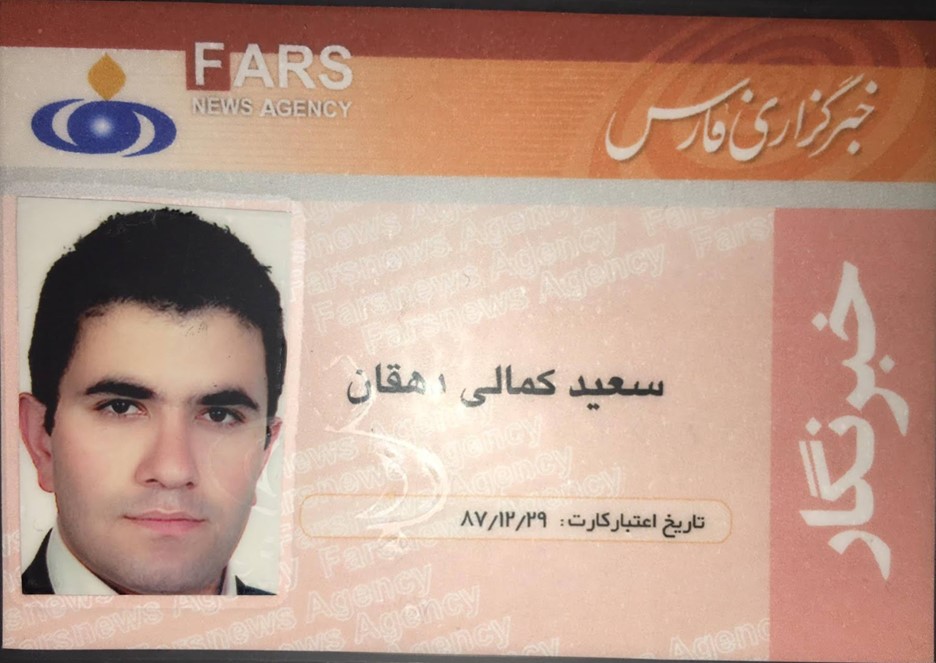
Dehghan’s professional trajectory began inside Iran’s tightly restricted media environment. He worked with reformist publications including Shargh, Etemaad and Shahrvand-e Emrooz and, according to IranWire’s account of his career, for a period with Fars News Agency. Years later, the U.S. Treasury designated Fars for being owned or controlled by, or acting on behalf of, the IRGC, describing it as closely affiliated with the Revolutionary Guards and as having provided special intelligence reports to senior IRGC figures. The chronology matters, but so does precision: later U.S. findings about Fars do not by themselves prove that Dehghan’s earlier work there was intelligence activity. What they do make reasonable is a closer audit of how a journalist who moved from Iran’s controlled media sphere into a highly trusted Western institution sourced and framed politically sensitive reporting.
The 2009 uprising accelerated Dehghan’s rise. With foreign reporters expelled or constrained, his access from inside Iran made him valuable to international outlets. He later moved to London, became a Guardian staff journalist focused on Iran and was named Journalist of the Year by the Foreign Press Association in 2010 for his election-protest coverage and documentary work. Reporting on repression gave him a reservoir of credibility with Western readers. When he later passed judgement on organized opposition to the clerical regime, those judgements appeared under the Guardian’s authority rather than through an Iranian state outlet. That difference in provenance is precisely what made the framing influential.
#Iran News: Swedish News Outlet Exposes Rouzbeh Parsi’s Ties to Regime’s #Influence Networkhttps://t.co/9xkCG1TKZ9
— NCRI-FAC (@iran_policy) January 29, 2025
A sustained editorial case against the MEK
The pattern was visible in January 2010. In a Guardian comment article titled ‘The wrong approach to Iran, Dehghan argued against greater British support for the NCRI. He wrote that the NCRI did not represent the Iranian opposition, did not represent most Iranians in exile, and that Maryam Rajavi and the organization were not popular inside Iran. He further argued that Western support would endanger domestic protesters by allowing Tehran to associate them with the NCRI. These were not incidental descriptors. They established the recurring frame that the organized resistance was politically illegitimate, socially isolated and strategically harmful to Iranians seeking change.
Four years later, in May 2014, Dehghan used a Guardian Iran blog article titled ‘Why Canada is getting it wrong on Iran’ to make the case against Ottawa’s isolation of Tehran. In the same piece he described Maryam Rajavi as the leader of a ‘radical exiled’ organization and wrote that the MEK was characterized by many observers as ‘cult-like’. The political message was explicit: Western governments should engage Tehran rather than legitimize the MEK as an alternative.
In February 2017, writing about Donald Trump’s Iran policy, Dehghan again called the MEK a ‘fringe’ opposition group and ‘extremely unpopular in Iran. Two months later, in the comment article ‘Iran’s people care about elections. The so-called democratic fringe doesn’t’, the language became sharper still. He called the MEK ‘shadowy’, repeated the ‘cult-like’ label, endorsed Reza Pahlavi’s description of it as a ‘cult-type structure’, and contrasted exiled regime-change forces with participation in the Islamic Republic’s elections. The cumulative frame was not simply historical criticism; it was an argument that Western policymakers should regard the MEK as untrustworthy and politically irrelevant.
"For over three decades, the terrorist regime in #Iran has executed a sophisticated agenda to compel the international community to accept the rule of its illegitimate theocracy in Tehran," writes @khansari_m https://t.co/2JCtVzc0Qw
— NCRI-FAC (@iran_policy) September 28, 2023
Three months later, on 2 October 2018, Dehghan and Kim Willsher reported that France had formally concluded that Iran’s Ministry of Intelligence ordered the foiled attack. That later report is important context and prevents an overbroad conclusion about his motives. It does not, however, erase the earlier editorial choice: when the alleged plot first became public, his principal explainer simultaneously placed the intended target on trial in the court of Western opinion.
Across these articles, the same political architecture recurred: the “Islamic Republic” could be criticized for repression, but its internal political process was repeatedly presented as the realistic arena for change, while organized regime-change opposition was portrayed as marginal, suspect or disconnected. That framing closely matches one of Tehran’s long-standing strategic objectives abroad: to persuade Western audiences that there is no credible organized alternative to the existing system.
On 2 July 2018, the same day European authorities announced arrests connected to a planned bombing of an NCRI gathering near Paris, Dehghan published the Guardian explainer ‘Who is the Iranian group targeted by bombers and beloved of Trump allies?’ Its headline and standfirst foregrounded not the alleged state operation but the character of the intended target. The article described the MEK as ‘extreme’ and ‘cult-like’, revisited its violent history and former terrorist designation, highlighted payments to Western speakers, and repeated allegations about the treatment of members. The editorial effect was to make the legitimacy of the prospective victims a central part of the story at the very moment a suspected Iranian-directed terror plot was entering public view.
That matters because demonization is not separate from physical security policy. The same opposition movement being surveilled by Iranian government operatives in the United States and targeted by a bomb plot in Europe was simultaneously being presented to Western readers as fringe, cult-like and lacking meaningful support. A security campaign can seek to weaken an opponent physically, politically and reputationally at the same time. Journalism becomes particularly valuable in the last of those arenas because the judgment appears to come from an independent institution rather than the state pursuing the opponent.
From Christ to the #IRGCterrorists: How Iranian Operatives Exploited #Sweden’s Asylum Systemhttps://t.co/rfw7ZIlfp7
— NCRI-FAC (@iran_policy) April 27, 2025
Return to Iran and a reported confession
The significance of Dehghan’s record changed again in 2026. Sources reported that he had been in Iran since April 11 and was publishing English-language observations about stability, normal life and his ability to travel inside the country. This was the same journalist who had earlier written that an Intelligence Ministry warning drove him out of Iran after his work for foreign media. His return carried particular significance in a state that treats foreign-media and opposition contacts as security matters.
Four months later came the confession. Dehghan said his 2010 Guardian interview with Sakineh Mohammadi Ashtiani had never taken place and that he had fabricated the entire article. He placed his confession within a broader complaint about misleading and false reporting concerning Iran. Iranian media immediately expanded its meaning. State broadcaster IRIB described him as the author of an “anti-Iranian” Guardian article, while Tasnim presented the affair under a headline declaring that the stoning story itself had been a lie.
The underlying stoning case was independently documented. Amnesty International reported on August 9, 2010, that Ashtiani’s stoning sentence remained in place while her case was being reviewed. Dehghan had therefore fabricated testimony inside a genuine human-rights case. That made the confession particularly useful to Tehran: a proven journalistic falsehood could be deployed to muddy the credibility of genuine reporting about abuses. The damage travels forward — future prisoners, witnesses and rights groups must overcome suspicion created by invented testimony published under a prestigious Western masthead.
The confession also changes how Dehghan’s political reporting should be read. Claims concerning the MEK can no longer derive authority merely from his status as a former Guardian Iran correspondent or his reputation as an insider. Their authority must come from independently checkable sourcing. This matters beyond their original publication: his 2018 MEK reporting subsequently appeared as a cited source in later policy and research material, extending its framing beyond the original news cycle.
#Iran’s White-SIM Internet: How Tehran Hacks the Feed You Trusthttps://t.co/IUhKVR2wcg
— NCRI-FAC (@iran_policy) November 26, 2025
What the case actually proves
Dehghan’s significance is therefore larger than one false interview. He moved from Iran’s controlled media environment into a position of unusual influence in Western journalism; built credibility through reporting on repression; repeatedly used that platform to portray Tehran’s organized opposition as illegitimate or irrelevant; returned to Iran; and then supplied Iranian media with a confession that could be repackaged against Western human-rights reporting itself.
The wider pattern is one Tehran’s own intelligence establishment has described openly: intelligence work uses professional cover; journalism is part of the information battlefield, and opposition movements are security targets. The Dehghan case demonstrates why provenance matters. A political characterization carried by a trusted Western byline can move from journalism to analysis, from analysis to citation, and from citation into what later readers accept as an established background.
That is the strategic value: discredit the opposition, preserve “reform from within” as the only realistic path, and weaken confidence in reporting that exposes repression. In that information war, a respected foreign masthead is not merely a platform. It supplies the credibility that allows a narrative to travel.