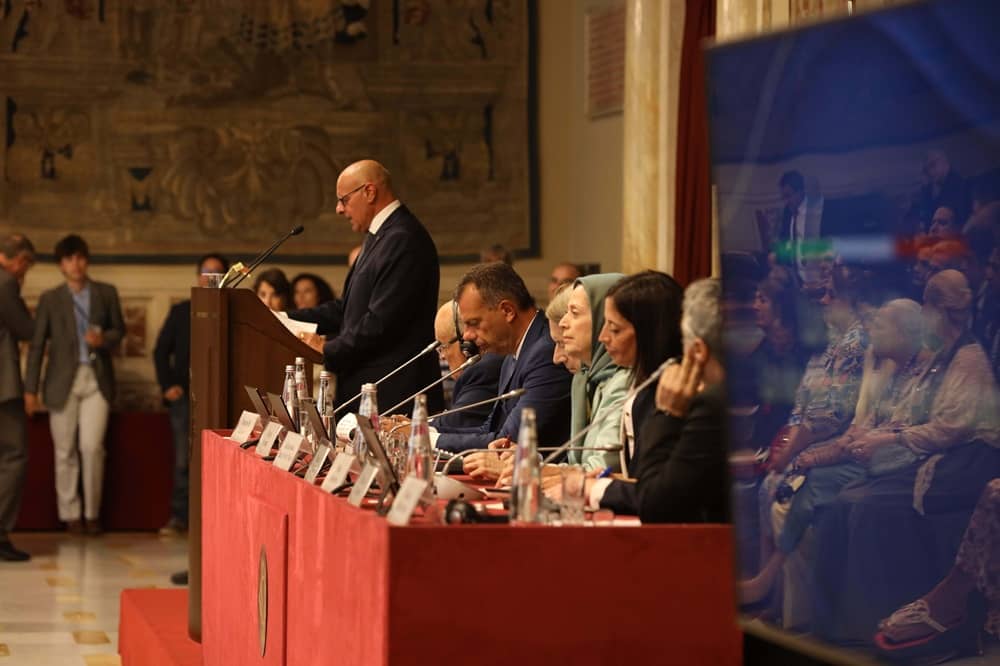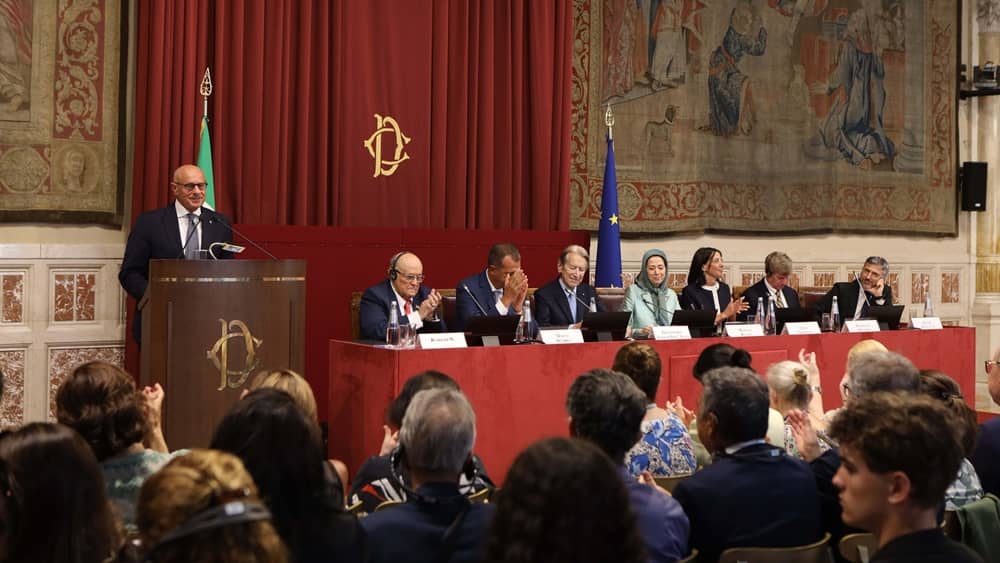
At an international conference at the Chamber of Deputies, Fabio Rampelli—Vice President of the Italian Chamber of Deputies and prominent member of the ruling Fratelli d’Italia party—outlined Italy’s policy stance regarding the ongoing crisis in Iran.
Rampelli highlighted the structural weaknesses of the clerical dictatorship, noting that widespread public protests have exposed the regime’s inability to address economic distress and rising inflation. He condemned the brutal security response, pointing to coordinated violence by the police, the Islamic Revolutionary Guard Corps (IRGC), and armed forces against peaceful citizens.
Detailing legislative action, Rampelli recalled multiple cross-party resolutions passed by the Italian Parliament committing the government to pursue international investigations, demand the suspension of death sentences, and enforce targeted sanctions. He emphasized that European Union sanctions, extended through 2027, specifically target perpetrators of repression and the IRGC without undermining civilian access to essential goods.
On foreign policy, Rampelli condemned the regime’s destabilizing regional and global role, including its military support for rogue states, funding of regional armed groups, and actions threatening maritime trade routes. He reaffirmed the European Council’s non-negotiable position that Iran must never obtain nuclear weapons. Supporting a firm yet open diplomatic line, Rampelli stressed that lasting peace requires steadfast defense of fundamental human rights and international law, leaving Iran’s political future to its own people.
A translated version of Fabio Rampelli’s speech follows:
Welcome—and welcome back to those who have been here before, as this is not the first time, we have gathered to discuss Iran and its future. So, welcome back to them, and welcome to those joining us for the first time in this magnificent hall. As you know, it is rightly considered the solemn heart of the Chamber of Deputies at Montecitorio—a palace that serves as the temple of Italian democracy.
Allow me, first of all, to express my gratitude to the Honorable Naike Gruppioni—who is not only a colleague but a friend—and to all the organizers of this “Iran of the Future” conference. A warm welcome to our distinguished foreign guests who honor us with their presence: Mr. Patrick Kennedy; Mr. Rudolph Giuliani, former prosecutor and former mayor of New York from 1994 to 2001—as we all know, much has been said in Italy about the example he set in leading a city as complex as New York, almost more complex than Rome, I dare say; Maryam Rajavi, President-elect of the National Council of Resistance of Iran; Senators Marco Scurria and Giulio Terzi di Sant’Agata; and Mauro Bazzucchi, journalist and moderator of this event.
@fabiorampelli , Vice President of the chamber of deputies, along with lawmakers from both houses and featured speeches from @maryamrajavi , @rudygiuliani and @pjk4brainhealth discuss an alternative temporary government in Iran #freeiran pic.twitter.com/FsSMpHu5l7
— Rudy W. Giuliani (@RudyGiuliani) July 18, 2026
My thanks go as well to all the parliamentary colleagues, deputies, and senators present today. You are not here for mere formal attendance. Everyone who has consistently participated in these initiatives—whether in the cool of this hall or in the squares outside Montecitorio and Palazzo Madama—has done so with total conviction, deep empathy, and the hopeful conviction that we can contribute to relieving the suffering of the Iranian people. They are engaged in a long, seemingly endless struggle for freedom, peace, and democracy—though we hope its end is near.
Today’s meeting allows us to address complex and urgent issues: the current political and social condition of the Islamic Republic of Iran, the role the international community must play in promoting stability in the Middle East, the protection of human rights, and the prospects for a credible path toward peace and democracy for the Iranian people.
The necessary premise for any reflection is that when we speak of Iran, we are speaking of an ancient, highly cultured, and demographically young society that has lived for decades under an institutional system that stifles its fundamental freedoms and severely compromises its future development.
The Iranian political landscape has undergone a profound transformation in recent years. The outbreak of widespread, fierce protests in the Islamic Republic has highlighted deep structural weaknesses in the ruling apparatus—particularly its inability to respond to economic distress marked by soaring inflation, especially on food items. Furthermore, the security forces’ crackdown was brutal. The regime demonstrated an unfortunate alignment among the police, the IRGC, and the armed forces, leading to devastating consequences for citizens who suffered physical violence and the total suppression of basic freedoms.
The “Woman, Life, Freedom” movement, which erupted in September 2022 following the death of Mahsa Jina Amini in police custody, was much more than a temporary protest. It signaled a structural rupture between the younger generations—with Iranian women at the forefront—and a regime that can no longer meet basic expectations of freedom, dignity, and political participation.
The Italian Parliament acted swiftly. On December 21, 2022, the Foreign and European Affairs Committee of the Chamber unanimously approved a joint resolution on human rights in Iran. It committed the Government to act bilaterally and multilaterally to demand the suspension of death sentences against protesters, support the independent international investigation established by the UN Human Rights Council, and firmly advocate within the EU framework for targeted sanctions against human rights violators.
On March 13, 2024, the same Committee unanimously passed another resolution committing the Government to condemn systematic gender discrimination and violence against women and girls by the Islamic Republic, while demanding the unconditional release of arbitrarily detained prisoners of conscience.
🚨 Italy's Deputy Speaker: The EU Must Recognize Iran's Resistance
In an exclusive interview with Simay Azadi, @fabiorampelli, Vice President of Italy's @Montecitorio, told our reporter @Ehsaneghbale that the EU and Italy should first:
"Recognize the Iranian resistance. It is… pic.twitter.com/PBE7EKVEu5— SIMAY AZADI TV (@en_simayazadi) July 19, 2026
Additionally, the Standing Committee on Human Rights in the World, chaired by the Honorable Laura Boldrini, conducted numerous hearings during the 19th legislature regarding Iran. These included testimony from human rights activists on September 27, 2023—marking one year since Mahsa Amini’s death—and a hearing with Narges Mohammadi on February 19, 2025. More recently, on March 12, 2026, the Senate Foreign Affairs and Defense Committee held hearings with representatives of the Iranian diaspora in Italy.
Further demonstrating international backing for the Iranian people’s aspirations, the UN Human Rights Council extended the mandate of the Independent International Fact-Finding Mission for two additional years. This decision ensures continued oversight of allegations involving mass arrests, political executions used as deterrents, wartime emergency measures applied to justify summary proceedings and land confiscations, and systemic discrimination based on gender, ethnicity, religion, or political belief.
In terms of international relations, Iran’s actions in recent years have driven instability both regionally and globally. Military support provided to the Russian Federation in its war of aggression against Ukraine—through the supply of drones and ballistic missiles—support for non-state armed groups in the Middle East and Red Sea region (such as the Houthi movement), and actions disrupting freedom of navigation in the Strait of Hormuz have all fueled a crisis threatening vital global energy and trade routes.
The twelve-day conflict between Iran and Israel in June 2025, the snapback of UN nuclear non-proliferation sanctions in September 2025, the memorandum of understanding signed weeks ago with the United States, and the subsequent resumption of hostilities all reflect a volatile situation. The international community must navigate this environment with firmness, balance, and resolve.
In its conclusions from the European Council meeting on June 18–19, 2026, the Council reaffirmed a non-negotiable principle: Iran must never be allowed to acquire a nuclear weapon. Full and verifiable compliance with obligations under the Non-Proliferation Treaty through cooperation with the IAEA remains an essential condition for any broader diplomatic resolution. The European Union has urged the Iranian regime to end violence and repression against its people, demanding respect for universal human rights and the fundamental freedom of Iranians to choose their own future. To this end, the EU will continue working on restrictive measures against those responsible.
The recent resumption of hostilities between the United States and Iran has underscored the urgent need for greater European involvement in managing the crisis, particularly after Europe was largely excluded from earlier consultation rounds. We must keep in mind that the shared goal of all nations is the stabilization of a region that remains critical to global security and the economy.
In line with its multilateral tradition, Italy supports maintaining a demanding, unbroken diplomatic channel between the EU, Iran, and the United States to reduce the risk of regional escalation. Italy maintains that pursuing peace does not conflict with standing firm on fundamental rights; rather, human rights are a prerequisite for peace. This requires protecting human rights defenders, women, and minorities inside Iran—through persistent monitoring of individual cases, supporting defense lawyers, and condemning executions—as well as abroad, by combating transnational repression and supporting the diaspora.
Italy fully supports civil society and the EU sanctions framework established in 2011 to address grave human rights violations—a framework recently extended through 2027 that covers hundreds of designated individuals and entities, including asset freezes targeting the Islamic Revolutionary Guard Corps.
We must emphasize that these tools do not target the Iranian people. They target those responsible for repression: senior leaders of the coercive apparatus, perpetrators of violence against peaceful protesters, judges issuing convictions without due process, and commanders overseeing transnational repression operations that have reached EU member states.
At the same time, sanctions must not restrict civilian access to essential goods and services. On this point, the Italian Parliament has taken a clear position. Resolutions passed by the Senate Foreign Affairs and Defense Committee on January 14, 2026, and the Chamber’s Foreign Affairs Committee on January 15, 2026, both commit the Government to support targeted individual and sectoral sanctions at the European level while safeguarding humanitarian channels for the civilian population.
Distinguished colleagues, honored guests: the history between Europe, Italy, and Iran is long, rich with cultural, scientific, and human exchanges that far predate the events of recent decades. Today, we reaffirm our resolve against oppressors and our solidarity with those who resist.
We recognize that shaping the future of Iran is up to the Iranian people themselves, but the international community must ensure that this future can be built in freedom, security, and under international law.
I have spoken at some length, but it was necessary to do justice to the extensive work Italian institutions have carried out in solidarity with the people of Iran.
Thank you.