

Five-minute read
The IRGC’s latest anniversary statement is less about a battle in 1988 than about the organized resistance it fears inside Iran today
Why would a regime issue an urgent political warning about a military operation that took place thirty-eight years ago?
That is the question raised by the latest statement from Iran’s Islamic Revolutionary Guard Corps (IRGC). On Sunday, July 26, 2026, state-controlled media circulated an IRGC declaration marking the anniversary of what the regime calls Operation Mersad—the military response to Operation Eternal Light, launched by the National Liberation Army of Iran in the summer of 1988.
The statement presents itself as a commemoration of a historic victory. In reality, its language is dominated not by confidence, but by anxiety: repeated warnings about vigilance, infiltration, national unity and the continuing influence of the People’s Mojahedin Organization of Iran (PMOI/MEK).
At the beginning of its statement, the IRGC declares: “The historical memory of the Iranian nation shows that one of the most magnificent manifestations of the power and insight of the proud Iranian people emerged in the confrontation with the current of hypocrisy and the struggle against the hated and terrorist Monafeqin group, creating the epic of Mersad.”
The expression “Monafeqin”, meaning “hypocrites”, is the derogatory term routinely used by the Iranian regime for the MEK. Its repeated appearance throughout the statement illustrates how deeply the organization remains embedded in the regime’s political vocabulary and security calculations.
Most revealingly, the IRGC does not confine its accusations to 1988. It explicitly links the MEK to Iran’s recent nationwide uprising and acknowledges that the organization played what it calls an “effective and prominent role” in the events of January 8 and 9, 2026. That admission explains why the regime remains haunted by Operation Eternal Light nearly four decades later.
Thirty-Six Years After NLA’s Grand Operation, #Iran’s Regime Shivers While Hailing Its Survivalhttps://t.co/5wj000ZU5S
— NCRI-FAC (@iran_policy) July 28, 2024
The military challenge Tehran has never forgotten
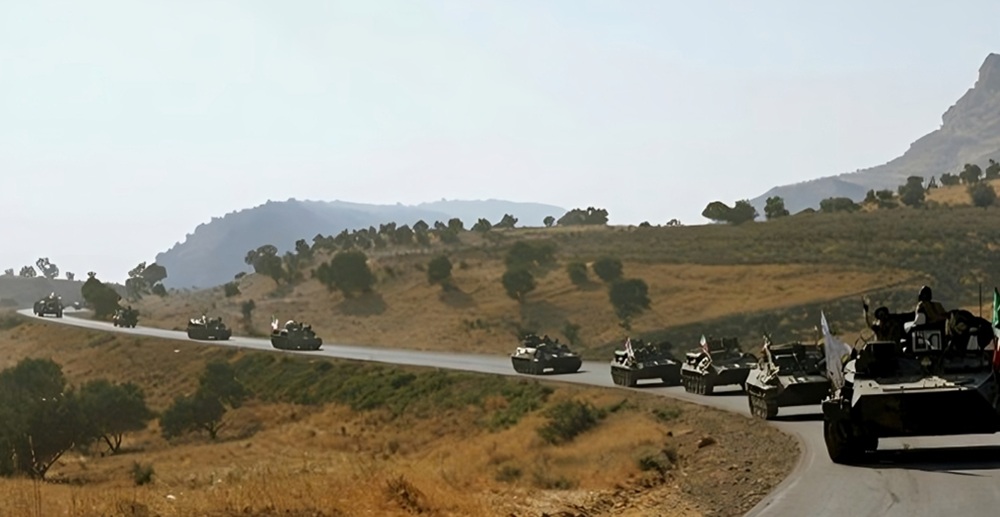
Operation Eternal Light—known in Persian as Forough Javidan—was launched in late July 1988 by the National Liberation Army, the military arm of the Iranian Resistance at the time.
Its forces advanced rapidly through western Iran, taking control of Kerend and Islamabad-e Gharb and moving towards Kermanshah, one of the largest cities in western Iran. The offensive represented a direct attempt to break through the regime’s military defenses and open the way towards Tehran. Independent historical accounts confirm that the force penetrated deep into Iranian territory.
The clerical establishment mobilized the Revolutionary Guards, the regular army, air power, helicopters, local militias and every available military and logistical resource to halt the advance.
The regime subsequently named its counteroffensive Operation Mersad and has commemorated it ever since as proof that the Iranian regime survived a mortal threat.
That annual ritual is itself significant. Governments normally commemorate decisive victories to celebrate an enemy that has been permanently defeated. Tehran, however, commemorates Eternal light while simultaneously warning each new generation that the same enemy remains active, organized and dangerous.
"The graves at Khavaran may remain unmarked, but the regime’s true fears are highly visible. When Tehran uses today’s wartime tensions as a smokescreen to hang dissidents in 2026, it is answering the very questions it tries to suppress," Dr. @MasumehBolurchi writes on the…
— NCRI-FAC (@iran_policy) July 20, 2026
The latest IRGC statement even calls for the “permanent rereading” of the MEK’s history, particularly for Iran’s younger generation. It urges the public to remain alert to the organization’s influence and warns repeatedly against what it describes as the danger of opposition “infiltration.”
The latest statement calls not for the closure of a historical chapter, but for its perpetual reopening: “It is necessary permanently to reread the crimes of the Monafeqin, to keep open their black and repulsive file, and to preserve the historical lessons of the conduct of this hated and corrupt sect for the continuing awareness of all sections of society, especially the younger generation.”
This is not the language of a regime that believes the challenge ended in 1988. It is an instruction to continue a state-directed political campaign against the MEK thirty-eight years after the battle itself.
The most important passage is about 2026, not 1988
The central political message of the statement appears in a passage dealing with the recent uprisings.
The IRGC declares that the MEK has played an “effective and prominent role” in unrest during recent years, including what it calls the “failed coup of 18 and 19 Dey 1404”—the Iranian-calendar dates corresponding to January 8 and 9, 2026.
The IRGC states: “The history of the Islamic Revolution shows that the terrorist Monafeqin group has always operated, under the support of the system of domination, as the foot soldiers and fifth column of the sworn enemies of Iran and Iranians, has refrained from no act of treachery, and has played an effective and prominent role in the blind seditions of recent years, including the failed coup of 18 and 19 Dey 1404.”
#Iran’s Top Officials Warn of @Mojahedineng Influence and Looming Revolthttps://t.co/uJxSXN18t9
— NCRI-FAC (@iran_policy) April 18, 2025
The regime’s use of the phrase “failed coup” is designed to strip the uprising of its popular and domestic character. Yet beneath the propaganda is a highly consequential admission: the Revolutionary Guards themselves are attributing an “effective and prominent role” in the uprising to the MEK.
The choice of those dates is crucial. The nationwide protests that began in late December 2025 escalated dramatically on January 8 and 9. Demonstrations spread across Iran, the authorities imposed a nationwide internet blackout, and security forces launched an exceptionally violent crackdown. Reuters reported widespread demonstrations and lethal gunfire, while Amnesty International later described January 8 and 9 as the peak of mass unlawful killings during the uprising.
By describing a popular uprising as a “coup,” the regime attempts to erase its domestic and social character. The terminology allows the authorities to portray citizens demanding political change as participants in a foreign conspiracy rather than Iranians rebelling against repression, corruption and clerical rule.
Yet the accusation also contains an important admission. The IRGC is acknowledging that, during the most dangerous days of the uprising, it saw the MEK not merely as an exiled political organization or a media opponent, but as an operational force with influence inside the country.
One need not accept every claim made by either side to recognize the significance of that statement. The conclusion comes from the regime’s own words: thirty-eight years after Operation Eternal Light, the Revolutionary Guards still identify the same organized opposition as a major factor in contemporary uprisings.

From a border-based army to Resistance Units inside Iran
In 1988, the National Liberation Army confronted the regime as a conventional military force advancing from Iran’s western border. That army is no longer stationed on Iran’s frontier. The threat perceived by Tehran has changed form.
The MEK now describes its organized networks inside Iran as Resistance Units: decentralized groups operating across Tehran and numerous provincial cities. The Iranian Resistance reports that these units carry out coordinated anti-regime activities, challenge symbols and centers of repression, distribute opposition messages and seek to encourage and sustain uprisings. Recent reports have documented claimed Resistance Unit activities across dozens of Iranian cities.
The IRGC statement’s repeated warnings about the MEK’s role in recent unrest, internal infiltration, public vigilance and the need to preserve national unity strongly suggest that it is this domestic network—not a conventional army at the border—that now concerns the regime most. The statement warns:

“Without doubt, the vigilance, intelligence and insight of the mobilized people in preserving national unity and cohesion will safeguard the country’s authority and strength and render futile the project of deception and trickery pursued by the front of hypocrisy and hostility.”
A government confident in its public legitimacy would not normally need to invoke nationwide vigilance against an opposition force supposedly defeated nearly four decades earlier. The warning makes sense only if the regime believes the MEK possesses a continuing organizational presence capable of influencing events inside Iran. This is the central difference between 1988 and today.
Operation Eternal Light presented the ruling establishment with a visible military column advancing towards Kermanshah. Today, the regime fears a dispersed and less visible force embedded within Iranian society—a network capable of maintaining political organization despite arrests, executions, surveillance and internet shutdowns.
From Tehran’s perspective, that is an even more difficult threat to contain. A conventional force can be bombed, surrounded or blocked on a highway. A decentralized resistance operating across many cities cannot be defeated in a single battle.
July 25—Iran
PMOI Resistance Units across Iran commemorate the anniversary of Operation Eternal Light, the great offensive by the National Liberation Army in 1988 that brought the regime to its knees. pic.twitter.com/IjP3qEzyx4— People's Mojahedin Organization of Iran (PMOI/MEK) (@Mojahedineng) July 27, 2026
A declaration of fear disguised as a victory statement
The Iranian regime wants Operation Eternal light remembered as the moment it permanently destroyed the threat posed by the organized Iranian Resistance. Its behavior tells a different story.
Thirty-eight years later, the IRGC still publishes national statements about the battle. It still uses the anniversary to demand loyalty to clerical rule. It still warns the public about MEK influence. And most significantly, it now connects that historic confrontation to the largest and bloodiest uprising Iran has experienced in recent years.
The latest declaration should therefore not be read merely as another piece of anniversary propaganda. It is a political assessment of the regime’s present vulnerability.
In 1988, Tehran feared an organized liberation army approaching the gates of Kermanshah.
In 2026, it fears that the spirit of that resistance has moved inside Iran—into its provinces, cities and rebellious communities.
The geography has changed, but the nightmare has not.
For all its claims of victory, the IRGC’s message reveals a regime that remains preoccupied with the same possibility that terrified it thirty-eight years ago: that a nationwide uprising, joined with an organized resistance movement, could ultimately bring down the clerical dictatorship.