

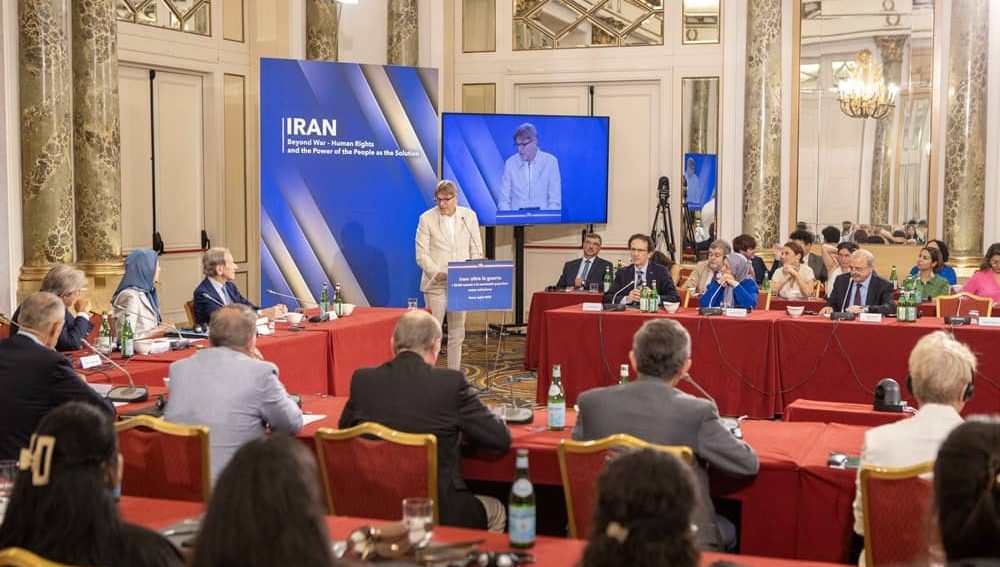
Former Belgian Prime Minister Guy Verhofstadt delivered a compelling speech at the “Iran Beyond War, the Power of the People” conference in Rome on July 17, 2026. Addressing Mrs. Maryam Rajavi, he praised her leadership of the Iranian Resistance during these existential times.
Verhofstadt rejected the false dichotomy of choosing between war and appeasement, calling on European leaders to abandon their detrimental “policy of silence” and adopt a robust “Third Strategy”.
This strategy relies on two crucial pillars:
-
Total Regime Isolation: Verhofstadt urged the international community to move beyond merely designating the IRGC as a terrorist organization. He called for comprehensive sanctions against all regime enablers—including police, financial, and religious officials—as well as the complete expulsion of all regime diplomats and the immediate seizure of their international assets.
-
Active Engagement with the Opposition: The second pillar demands formally recognizing the democratic opposition as the sole legitimate representative of the Iranian people. This includes collaborating with the provisional government, using Mrs. Rajavi’s Ten-Point Plan as a constitutional foundation, and granting the resistance Iran’s official seats and diplomatic roles in international organizations.
By officially backing the NCRI, Verhofstadt concluded, European leaders can apply real pressure on the regime and pave the way for a free, democratic republic in Iran.
Excerpts of Guy Verhofstadt’s speech follow:

Thank you. Thank you very much for giving me the floor. First of all, I want to express my thanks to Mrs. Rajavi for her leadership in these very difficult times, these existential moments for Iran. We all have the impression that in these days, weeks, and months—I hope not years—we will determine the future of this great country and its great people. And the question that I want to raise today, as indicated behind me, is this: are there only two solutions or two approaches to the question of Iran? War or appeasement?
Because we practiced appeasement in the past for years, and we still continue to do so in Europe, I am a little bit less positive about the European approach of the last few years. Is there no other way? Is there only war, as declared and happening right now in Iran? We increasingly have the impression that it is a permanent state of war, going up and down, with huge consequences for the whole world. Or, if we don’t want war, is it appeasement? Is there no other choice we can make to solve the crisis around Iran, and mainly to liberate the people living in Iran? Because that is the purpose.
So, the question today remains: what is the way forward? Is there an alternative to a biased MoU, a continuous war game as happening today, or the appeasement policy of the past, especially applied by the European side? I think there is one, and it would be good if European leadership—not just American leadership—would press for it. Because in these last months, I have heard a lot about the mullahs, a lot about American leadership, and everything that is happening on the battlefield. But I have not heard much about European leadership or European solutions in these difficult times.
I think that a third strategy is possible. I call it a strategy of active engagement by the democratic world with the Iranian people and the Iranian Resistance, as quickly as possible. And such a new strategy of active engagement with the Iranian people will be based, I think, on two pillars, Mrs. Rajavi.
Former Belgian PM @guyverhofstadt: "This year will be special because it will be the year of change in #FreeIran2025, freedom from the mullahs’ dictatorship. Around the world, people are rising against dictatorship."#NCRIAlternative pic.twitter.com/ENcBmqU8cr
— NCRI-FAC (@iran_policy) February 8, 2025
The first pillar is to completely isolate the mullah regime as quickly as possible. It is very good that finally the Islamic Revolutionary Guard Corps has been designated by most nations as a terrorist organization, as we asked for four or five years ago—or at least four years ago. But that is not enough. There is more than only the Islamic Revolutionary Guard. There is also a need to sanction all the people involved in this regime who form its backbone. That can be prison guards, policemen, military personnel, religious figures, responsible people in the banks and financial institutions in Iran, and also many people in the scientific world who are working with this Iranian regime.
Secondly, isolating this regime means ejecting all diplomats, embassies, and ambassadors from our own capitals. Why do we continue to discuss and reason with these people who do not represent the Iranian people, but only represent a criminal regime in Iran? And third, it means that we have to seize all wealth, real estate, and bank accounts that they possess outside Iran, as quickly as possible. Those are the three things to do. It is fantastic, and we have always asked for it, to recognize the IRGC as a terrorist organization, but more needs to be done. Because otherwise, the IRGC will continue its work through the means, the hands, and the instruments of the people working for the regime.
That is the first pillar: definitely isolating the regime. And the second pillar, which has not been done either, is engaging with the democratic opposition and the organized resistance in the most serious way, as quickly as possible, by recognizing this democratic opposition and this organized resistance as the sole representative today of the Iranian people. That cannot be the mullah regime. That can only be the democratic opposition.
So, the question today for our leaders, Mrs. Rajavi, is what does recognizing the opposition and the organized resistance mean? It means working with them on a future constitution for a democratic republic. It is saying to the democratic opposition and organized resistance, “Okay, put a constitution together that can be the basis for a future democratic republic in Iran.” That also means working together with the provisional government. You have formed the provisional government; it is the moment to start working. Third, it also means giving the seats of the Iranian country today in international organizations to them. Why continue with these people of the mullah regime in international organizations? They could be replaced by people from the democratic opposition and the organized resistance. And finally, it also means recognizing the representatives of the democratic opposition and the organized resistance as the sole representatives, assigning them tasks as diplomats and formal ambassadors in international relations.
Former Belgian PM @guyverhofstadt outlines a bold strategy for Europe:
– Designate #IRGCterrorists
– Impose tougher oil and banking sanctions
– Expand personal sanctions on regime officials
– Recognize Iran's democratic alternative and standing with its organized resistance pic.twitter.com/gCi2730SbO— NCRI-FAC (@iran_policy) December 24, 2024
That is all what it means. It doesn’t mean simply saying, “Oh yes, we know the resistance, we know the democratic opposition.” It means taking formal steps so that in the international and diplomatic world, they are seen as the representatives of the Iranian people. That will put real pressure on Iran. And I think that the Ten-Point Plan of Mrs. Rajavi is a very good starting point for that constitution and for that recognition of the democratic opposition and the organized resistance.
So, my wish is that, as quickly as possible, our European leaders would not only stop their appeasement policy or their current policy of silence—which I think is even worse than an appeasement policy, a pure silence policy—and would start to have an active role in this conflict. And that active role in this conflict can be the recognition of the democratic opposition and of the organized resistance, as quickly as possible, as the real, formal representatives of the Iranian people.
And so, Mrs. Rajavi, you know I have followed you in many capitals in Europe. We have already done a lot of things in Brussels. We have already done a lot in the Parliament of the French Republic. Today, we are in Rome. I have only one wish: that next time, you invite me to Tehran, as quickly as possible.
Thank you.