

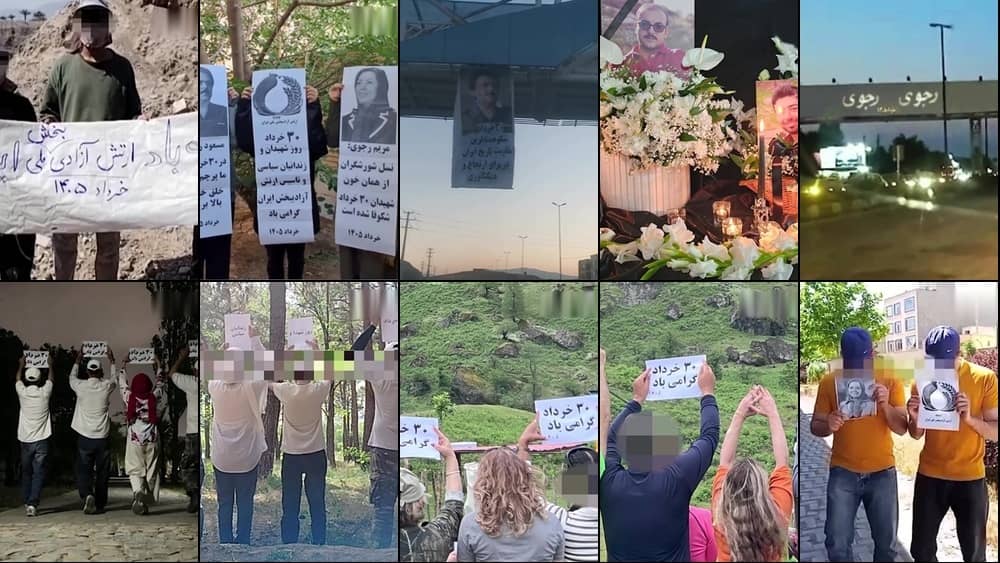
Over the past week from June 14 to June 21, 2026, MEK Resistance Units carried out a sustained nationwide campaign of defiance across more than thirty Iranian cities and towns, including a concentrated wave of 45 coordinated operations that struck IRGC Basij bases, judicial facilities, and regime propaganda centers while torching official banners and projecting anti-regime messages. The operations, which combined direct attacks with symbolic actions and youth-led protests, marked the 45th anniversary of the June 20, 1981, uprising and took place amid the regime’s ongoing political fragility following the death of Supreme Leader Ali Khamenei and a sharp rise in political executions.
June 20, 2026
Resistance units in Zahedan took to the streets on the eve of the anniversary to mark June 20 as the Day of Martyrs and Political Prisoners. Activists displayed banners and placards that welcomed the recent ceasefire while emphasizing that war had served as the regime’s shield against popular uprisings and that peace represented its ultimate poison. The units underscored that the pursuit of nuclear weapons and regional warmongering remained central pillars of the ruling religious fascism. They drew a firm line against every form of dictatorship, repeating the Iranian people’s central slogan of “Neither Shah nor mullahs” and declaring that a dictator remains a dictator whether wearing a crown or a turban. Placards affirmed that while Ali Khamenei’s son sought to preserve power and the son of the former shah sought to acquire it, the eras of both the monarchy and the mullahs had ended, with the overthrow resting solely with the Iranian people, their organized resistance, and the National Liberation Army of Iran.
Commemorating the 45th anniversary of the June 20, 1981, uprising—the day of Martyrs and Political Prisoners—PMOI Resistance Units launched a sweeping campaign of 45 coordinated operations against regime targets across Iran. pic.twitter.com/T7WKm9HCBN
— People's Mojahedin Organization of Iran (PMOI/MEK) (@Mojahedineng) June 20, 2026
June 19, 2026
On June 19, Resistance Units executed a coordinated campaign of forty-five operations across Iran to commemorate the anniversary. In Tehran, units set fire to the municipality building in District 4, a known gathering point for regime mercenaries preparing attacks on protesters, and hurled Molotov cocktails at an Islamic Revolutionary Guard Corps Basij base. Similar strikes hit Basij bases in Eslamshahr, Qaemshahr, and Ahvaz. Another blaze targeted the judicial headquarters used by executioners in Mohammadshahr near Karaj. In Iranshahr, fire struck the administration for anti-Islamic propaganda and the office of the Supreme Leader’s representative. In Khash, a fire hit the Basij base of the anti-Imam Ali battalion. In Chabahar, Molotov cocktails were thrown at a Basij base and at a cultural complex named after the slain Ghasem Soleimani, while banners of the Supreme Leader were set ablaze. Basij bases were set on fire in Khorramshahr, Shahrekord, and multiple locations across Zahedan, including facilities tasked with spying on and suppressing students as well as named sites associated with specific commanders. Additional fires consumed Basij bases in Neyshabur and Sabzevar, a center described as promoting ignorance and crime in Borujen, and an anti-Islamic propaganda organization in Farrokhshahr.
Simultaneously, activists systematically torched propaganda banners featuring the images of Ali Khamenei, his son Mojtaba Khamenei, and regime founder Ruhollah Khomeini. These acts occurred in Tehran (including multiple instances and specific banners of Mojtaba Khamenei described as bloodthirsty, as well as combinations with Khomeini), Karaj, Mashhad, Isfahan, Shiraz, Sari (where one banner carried the explicit message “Death to the oppressor, whether Shah or Leader, death to Khamenei, viva Rajavi”), Kerman, Hamadan, Zahedan (including one bearing “Long live Rajavi, long live the National Liberation Army of Iran”), Shahrekord, Sabzevar (multiple sites), Rafsanjan, Farsan, Farrokhshahr, Nikshahr, and Khash.
June 18—Iran
PMOI/MEK Resistance Units carry out 45 daring activities against regime centers and targets to mark the 45th anniversary of the June 20, 1981, uprising, the Day of Martyrs and Political prisoners. pic.twitter.com/iU55J2n4Tc— People's Mojahedin Organization of Iran (PMOI/MEK) (@Mojahedineng) June 19, 2026
June 18, 2026
A nationwide surge in symbolic and promotional operations illuminated cities from major metropolises to deprived border areas. Resistance units installed large banners on highways, laid flowers in thoroughfares, and held revealing placards in Tehran, Mashhad, Isfahan, Tabriz, Shiraz, and extending to Saravan, Zahak, Baneh, and Sardasht. In Astara, a large placard draped over a bridge highlighted national solidarity. The operations demonstrated that the message of resistance and the National Liberation Army (NLA) had transcended ethnic and regional boundaries, evolving into a nationwide demand. Handwritten slogans and projections rejected any return to past dictatorships, emphasizing the NLA as the only path to liberation and the enduring guarantor of peace, freedom, and independence for Iran.
June 17, 2026
Resistance Units conducted widespread image projection and placard operations across multiple provinces. In Tehran, slogans reading “Salute to Rajavi” appeared on Shaghayegh Street and “Death to the oppressor, be it the Shah or the Leader” on Qazvin Street; in Goldad Park, placards honored executed members Babak, Pouya, Mohammad, and Akbar as teachers of sincerity and steadfastness. In Mashhad, projections at Izadi Park and Ferdowsi Market declared that on June 20 the people had raised the flag of their honor. In Isfahan, messages on Toobi Street and Moshfegh Kashani Street honored the blood price paid by martyrs for freedom and independence. In Karaj on Ghalam Street, projections stated that the NLA remained the enduring guarantor of peace, freedom, and independence. Similar displays appeared in Sari on Mahyar Street rejecting the principle of Velayat-e Faqih and saluting the army of freedom; in Hamadan on Tohid Boulevard affirming the NLA’s role; in Bandar Abbas on Forough Street and at the Baran residential complex highlighting the lesson that the only answer to the mullahs is fire and affirming the NLA; in Ilam on Azadi Street describing June 20 as the red line between surrender and resistance and on Chalsara Street affirming the NLA; in Shahrekord on Saadi Street repeating the raised flag of honor; in Kermanshah on Javanshir Street declaring the National Liberation Army the only path to salvation through fire and freedom; and in Boukan on Shura Street repeating “Death to the oppressor, whether Shah or Leader.”
From Tehran to Saravan, PMOI Resistance Units illuminate Iran on 45th anniversary of June 20 uprising https://t.co/yksNUESFWY
— People's Mojahedin Organization of Iran (PMOI/MEK) (@Mojahedineng) June 18, 2026
June 16, 2026
Young rebels intensified activities as part of the “Tuesdays No to Executions” campaign in its 125th week. Coordinated actions took place across Astara, Urmia, Ahvaz, Shiraz, Isfahan, Mashhad, Tabriz, Tehran, Karaj, Rasht, Yazd, Sonqor, Qazvin, and Kermanshah. In parallel street-level operations, groups marched holding placards commemorating June 20. Large placards were hung from pedestrian bridges in Tehran featuring the photo of Massoud Rajavi alongside the National Liberation Army emblem with the message that June 20, 1981, marked the dawn of the most magnificent resistance in Iranian history. In Mashhad, a large banner read “Down with the oppressor, be it the Shah or the Supreme Leader.” In Tabriz, a photo of Massoud Rajavi was installed with the text that the rule of the mullahs must come to an end. In Urmia, photos of Maryam Rajavi were held. In Tehran, flower wreaths were left to honor the Day of Martyrs and Political Prisoners.
June 14, 2026
Resistance Units launched extensive operations in Sanandaj, Dorud, Lahijan, Karaj, Sari, Kermanshah, Bandar Abbas, Birjand, Mashhad, Tabriz, Shiraz, Kashan, Fasa, Zanjan, Qazvin, Ahvaz, Isfahan, and Shahreza. Activists installed large placards and posters from pedestrian bridges and held banners featuring images of Massoud and Maryam Rajavi. Core messaging focused on the NLA as the nightmare of the mullahs’ regime and the only path to salvation. Banners carried slogans such as “Down with Khamenei, salute to Rajavi,” “Down with the rule of the mullahs,” and declarations that no army or power on earth is stronger than the collective will for freedom. The actions tied directly to the historical significance of June 20 as the most glorious chapter of resistance and a defining turning point.
June 17—Iran
PMOI/MEK Resistance Units across Iran mark the 45th anniversary of the June 20, 1981, uprising, known as the "Day of Martyrs and Political Prisoners," by projecting images of Iranian Resistance leaders and anti-regime slogans in public locations. pic.twitter.com/F3ulAjG68y— People's Mojahedin Organization of Iran (PMOI/MEK) (@Mojahedineng) June 18, 2026
The regime’s reliance on intensified terror and executions has demonstrably backfired. Following the massive January 2026 nationwide uprising that brought the state to the brink of collapse and the death of Ali Khamenei on February 28, 2026, the installation of his son Mojtaba has failed to restore legitimacy or capacity for reform. The recent execution of eight PMOI members and more than twenty youths involved in the January protests, alongside the broader surge in political killings, was intended to deter further unrest. Instead, these measures have coincided with sustained, geographically diverse operations by Resistance Units that have struck regime security infrastructure and propaganda symbols in dozens of cities. The persistence of these actions, including 630 defensive operations during the January uprising and the February 23 assault on Khamenei’s headquarters by 250 fighters, reveals an organized domestic network that the regime has been unable to dismantle. The synchronized internal campaign and the massive June 20, 2026, rally in Paris, expected to draw more than 100,000 supporters, amplify the same rejection of both monarchical and clerical dictatorship under Maryam Rajavi’s Third Option and the NCRI’s Ten-Point Plan for a democratic, secular republic with gender equality and abolition of the death penalty. These developments expose the clerical system’s internal deadlock: its strategy of repression has neither restored deterrence nor prevented the continued projection of an alternative grounded in popular sovereignty, leaving the regime increasingly isolated and unable to project genuine invincibility.