

A weekly overview from July 11–18, 2026, details a synchronized Europe-wide mobilization by Iranian diaspora communities and international supporters, challenging the clerical regime’s propaganda while expressing robust support for Iran’s democratic alternative. Spanning multiple European capitals, this coordinated campaign capitalized on the United Kingdom’s landmark decision to designate the Islamic Revolutionary Guard Corps (IRGC) as a terrorist organization. Through rallies, human rights exhibitions, and public demonstrations, the diaspora movement actively amplified the internal defiance of domestic Resistance Units, demanding the dismantling of the theocracy, rejecting any return to monarchy, and urging the international community to recognize the democratic roadmap for a secular republic.
July 16, 2026
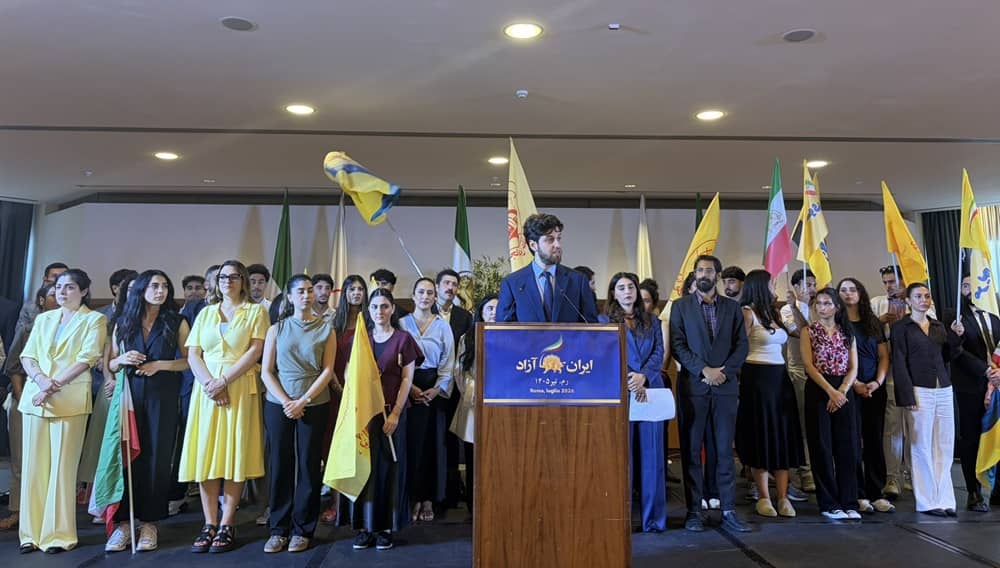
In Rome, thousands of Iranian exiles and prominent international figures gathered for a mass rally demanding an end to executions and the establishment of a democratic republic. National Council of Resistance of Iran (NCRI) President-elect Maryam Rajavi addressed the crowd via video message, presenting her Ten-Point Plan for a secular, non-nuclear Iran. Speeches by former U.S. Congressman Patrick Kennedy, and former New York Mayor Rudy Giuliani highlighted that internal resistance, rather than external intervention, drives true change. The gathering firmly rejected both the current religious dictatorship and the former monarchical regime.
Mayor Rudy Giuliani @RudyGiuliani addressing a free Iran conference in Rome, July 16, 2026, examining the roadmap for change, rejecting the mullahs & IRGC, AND the monarchy & SAVAK. He said the MEK is the only viable force able to confront the IRGC and effect change inside Iran. pic.twitter.com/sWj9RmNEKt
— Alireza Jafarzadeh (@A_Jafarzadeh) July 18, 2026
July 15, 2026
In Paris, NCRI supporters organized public book stands and photo exhibitions to condemn the recent surge in executions targeting political prisoners and protesters arrested during the January 2026 uprisings. Organizers engaged with the French public to call for international solidarity, emphasizing the Iranian people’s total rejection of all forms of authoritarian rule, whether theocratic or monarchical.
July 14, 2026
Coordinated demonstrations swept Northern and Western Europe following the UK’s blacklisting of the IRGC. In Gothenburg, supporters staged a dual rally welcoming the terrorist designation while standing in solidarity with the 129th week of the “Tuesdays Against Executions” campaign. Protesters highlighted the critical situation of 1,500 hunger-striking prisoners in Ghezel Hesar Prison, demanding the closure of the Iranian embassy in Sweden. In Copenhagen, Iranians similarly rallied to celebrate the IRGC proscription, calling for the expulsion of regime agents and the closure of the embassy in Denmark. Meanwhile, in Hamburg, supporters of the Iranian Resistance gathered to hold a victory celebration marking the British policy shift against the regime’s primary apparatus of terror.
Video#Berlin Car Caravan by PMOI Supporters Welcomes #UK Designation of IRGC as Terrorist Organization – July 13, 2026#BlacklistIRGC pic.twitter.com/8N58Cm6sdD
— Iran Freedom (@4FreedominIran) July 14, 2026
July 13, 2026
The diplomatic offensive centered outside the UK Parliament in London, where activists gathered in Parliament Square to hail the official terrorist designation of the IRGC as a crucial blow to Tehran’s regional destabilization and domestic repression. In Berlin, a high-visibility convoy of vehicles waving Iranian flags and PMOI emblems filed through city streets to celebrate the listing and demand popular sovereignty. Concurrently, supporters in Paris maintained public visibility by hosting another book table and photo exhibition documenting the sacrifices of the domestic uprising.
July 11, 2026
Global human rights exhibitions marked the start of the weekly mobilization. In Gothenburg, diaspora members rallied to support internal Resistance Units, advocate for Maryam Rajavi’s Ten-Point Plan, and demand that senior regime officials face international tribunals for crimes against humanity. In Bucharest, an interactive photo exhibition attracted local Romanian citizens who expressed solidarity with the campaign to abolish the death penalty. A similar memorial exhibition in Berlin drew deep support from German locals, including a ten-minute public prayer for Iran’s freedom led by a resident named Mr. Markus. Finally, in Malmö, protesters rallied specifically to denounce the death sentence given to 25-year-old political prisoner Arghavan Fallahi, holding her picture and chanting to demand an immediate halt to her execution.
2-Thousands of Iranians rallied in Rome on July 16, 2026 as @Maryam_Rajavi addressed the Italian Senate and Parliament, voicing support for the democratic alternative, the NCRI, and a democratic republic for Iran.#NCRIAlternative #No2ShahNo2Mullahs #FreeIran10PointPlan pic.twitter.com/0fak6Kzu4m
— Iran Freedom (@4FreedominIran) July 17, 2026
This week’s global mobilization underscores an acute existential deadlock for the Iranian regime, demonstrating that Tehran’s reliance on domestic executions and terror has definitively backfired. Rather than stabilizing the state during its fragile leadership transition following the death of Ali Khamenei, escalating repression has instead triggered a synchronized domestic and international backlash that erodes its remaining authority. The UK’s designation of the IRGC as a terrorist entity represents a profound structural failure for the regime’s isolation strategy, stripping away the facade of invincibility that the clerical elite desperately tries to project. Facing an organized domestic underground alongside a unified international diaspora capable of mobilizing across major capitals, the newly installed faction under Mojtaba Khamenei enters power profoundly weakened, proving that state terror can no longer suppress the momentum toward a democratic alternative.