

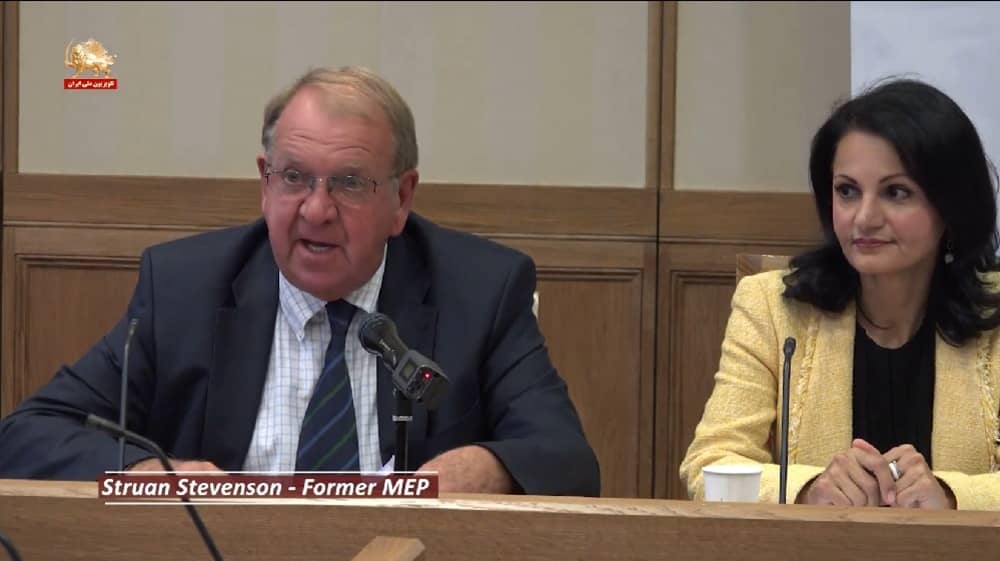
At a gathering in the U.K Parliament on July 16, 2025, Struan Stevenson, former Scottish MEP and longtime advocate for Iranian democracy, told the British lawmakers and members of the Iranian Resistance that Tehran’s theocracy is nearer to collapse than ever—and neither a return to monarchy nor appeasement will save it. Citing the near‑disintegration of the regime’s “axis of resistance,” Stevenson called the moment “an almost unprecedented opportunity for regime change.”
Yet, he said, whenever the mullahs wobble, Reza Pahlavi—ex‑Shah Mohammad‑Reza’s son—“pops up” to present himself as savior. Stevenson ridiculed Pahlavi’s recent media tour and his attempts to rally Iranians during the 12-day war, arguing the crown prince misread public sentiment, alienated ordinary citizens by siding with Israel, and revealed tone‑deaf privilege from a life “financed by $25–30 billion looted by his father.”
Stevenson reminded listeners that most Iranians still link the Pahlavi era with SAVAK torture, Western imperialism, and entrenched inequality—just as they now link the Islamic Revolutionary Guard Corps and Basij militia with brutality. Graffiti across Iran reading “Down with the oppressor—be it the Shah or the mullahs” signals, he said, that youth will follow neither.
The text of Struan Stevenson’s speech follows. It has lightly been edited for clarity and flow.
Here are the insightful remarks of @StruanStevenson on the false notion of restoring monarchy in Iran, delivered at a UK House of Lords conference, where lawmakers from both houses and various political groups supported the #IranThirdOption. pic.twitter.com/fqtWXxsP2m
— SIMAY AZADI TV (@en_simayazadi) July 20, 2025
Thank you very much, Baroness O’Loan.
As a fragile ceasefire is maintained between Israel, America, and Iran, the world is holding its breath following a series of critical developments.
This past year, as Sir Desmond Swain said, with the virtual collapse of the regime’s so-called Axis of Resistance, there is an almost unprecedented opportunity for regime change.
But—and I think Baroness Verma mentioned this too—true to form, every time there’s the faintest hint of collapse of the mullahs’ regime, up pops Reza Pahlavi, the son of the former Shah and the self-proclaimed crown prince of Iran.
I understand he was here on June 30, where I’m told that a London office of a very high-priced U.S. lobby firm arranged a meeting for him with a handful of peers and MPs. But let me tell you: Pahlavi’s calls for the Iranian people to rise up against the current theocratic regime during the twelve-day war have spectacularly backfired.
He seriously misread the situation—siding with Israel in his bid to inspire people in Iran to overthrow Khamenei.
The truth is, his lack of support, his privileged background, and the historical baggage of the Pahlavi family’s repressive rule have ensured that Reza Pahlavi will never be the leader of a democratic Iran.
He is the clown prince, or as some have said, the emperor with no clothes, as he jets around the Western world making his claim for the Peacock Throne. Since the 1979 revolution, which saw the overthrow of his father, the public sentiment toward the Pahlavi family has been overwhelmingly negative.
Most Iranians associate the Shah’s regime with oppression, human rights abuses, and Western imperialism—all of which have created a deep-seated distrust of monarchy as a form of governance.
#UK Parliamentarians Champion ‘Third Option’ for #Iran, Rejecting War and Appeasementhttps://t.co/INZfBcU61N
— NCRI-FAC (@iran_policy) July 19, 2025
Let’s not forget that the Shah’s hated secret police, SAVAK, routinely tortured dissidents—whipping them with electric cables, tearing out their fingernails and toenails to extract false confessions—before executing them. And today, the Iranian people suffer the same vicious brutality under the Islamic Revolutionary Guard Corps and the Basij militia.
That’s why the political landscape in Iran today is marked by a desire for genuine democratic reform and self-determination. Young Iranians will never rally behind a figure who represents the failures of the past.
Reza Pahlavi’s life of luxury—funded by the estimated $25 to $30 billion that his father looted from the country—further alienates him from the Iranian people. Living in exile in a wealthy suburb of Washington, D.C., he symbolizes the elitism and detachment that Iranians resent.
Placards reading “Down with the oppressor, be it the Shah or the mullahs” and “No to the crown, no to the turban” are now appearing regularly on bridges and buildings across Iran, and are chanted by protesters in the streets.
And let’s not forget that he has admitted to being in direct communication with the IRGC—the regime’s Gestapo—which he claims is necessary to “maintain order” after the overthrow of the mullahs.
My interview on the frenzy of executions in Iran with Simay Azadi https://t.co/79D0RhpZMn
— STRUAN STEVENSON (@STRUANSTEVENSON) July 20, 2025
He said, “I’m establishing a formal channel for military, security, and police personnel to reach out directly to me, my team, and our expanding operation.”
He claimed, “I know these officers, these soldiers, these brave men exist because they are reaching out to me and telling me they want to be part of this national salvation.”
Describing members of the IRGC and Basij as “brave men” will have outraged tens of thousands of families whose loved ones have been arrested, tortured, or murdered by the regime’s repressive forces. It’s no wonder that the people of Iran reject both the current criminal theocracy and the past cruel monarchy.
Thank you very much.