
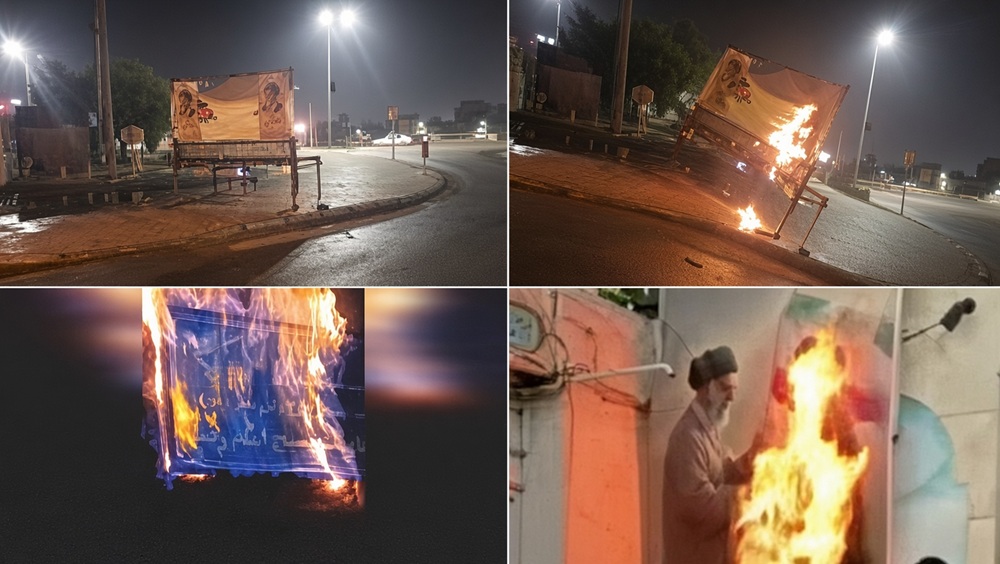
Between November 15 and November 21, 2026, MEK Resistance Units executed an intense, nationwide campaign of anti-repression operations, direct strikes on regime security infrastructure, and widespread anti-dictatorship messaging across more than three dozen Iranian cities. Timed to commemorate the anniversary of the bloody November 2019 (Aban) uprising and bolster the “No to Executions Tuesdays” campaign, these daring actions targeted Islamic Revolutionary Guard Corps (IRGC) Basij bases, state propaganda outlets, and symbols of the ruling theocracy from the capital to peripheral provinces. Despite an escalating wave of executions and heavy security deployments under Masoud Pezeshkian’s administration, the geographic breadth and operational coordination of these underground networks underscore a deepening political crisis and systemic vulnerability within the clerical establishment.
November 20, 2026
In Zahedan, Resistance Units organized widespread public messaging campaigns highlighting excerpts from Iranian Resistance leaders Massoud Rajavi and Maryam Rajavi, calling for an organized uprising to overthrow the clerical dictatorship and establish a democratic republic. The units displayed placards and slogans rejecting both monarchical and clerical tyranny, proclaiming “Death to the oppressor, be it the Shah or the Leader,” and celebrating the awarding of the 2026 Magnitsky Human Rights Award to political prisoner Mohammad Javad Vafaei Sani as a tribute to all incarcerated dissidents. The messaging also condemned the regime’s plundering of national wealth for nuclear projects and regional warmongering, as well as plans to install surveillance cameras in school classrooms out of fear of student-led uprisings.
On November 16, 2026, PMOI Resistance Units carried out 20 daring operations across Iran, marking the seventh anniversary of the November 2019 uprising. The operations targeted the regime's centers of repression and propaganda in Tehran and several other cities. pic.twitter.com/uXvJH3k2Hl
— People's Mojahedin Organization of Iran (PMOI/MEK) (@Mojahedineng) November 19, 2026
November 19, 2026
Resistance Units carried out large-scale evening image projections and fifty coordinated public operations across eighteen cities as part of the eighth series of the November 2019 uprising campaign. Illuminated portraits and revolutionary slogans were projected onto major thoroughfares, including Niayesh Highway in Tehran, Isar Street in Bandar Abbas, and Soleyman Khater Street in Sanandaj, saluting the 1,500 martyrs of the November 2019 protests and declaring the current generation one of rebellion. Collective public displays, placard installations, and graffiti campaigns rejecting both monarchical and clerical dictatorship and endorsing the National Council of Resistance of Iran’s democratic platform were simultaneously executed in Tehran, Karaj, Tabriz, Isfahan, Shiraz, Rasht, Qazvin, Zahedan, Iranshahr, Sarpol-e Zahab, Kangavar, Mahabad, Javanrud, Kermanshah, Ahvaz, Mashhad, Hamadan, Ilam, and Babolsar.
On the anniversary of the November 2019 uprising, PMOI Resistance Units across Iran carried out 30 daring operations against the regime's centers and symbols of repression and corruption, proving that the spirit of the uprising remains alive despite years of brutal repression. pic.twitter.com/4wYipanVEP
— People's Mojahedin Organization of Iran (PMOI/MEK) (@Mojahedineng) November 18, 2026
November 18, 2026
In Qazvin, Resistance Units launched a targeted anti-regime campaign coinciding with the visit of the regime’s president Masoud Pezeshkian, saturating neighborhoods with printed leaflets, handwritten flyers, and spray-painted graffiti denouncing his administration’s record of executions. Slogans across the city read “Qazvin is no place for Pezeshkian, get lost” and “The president of this regime is the backer of every crime,” directly linking the government’s economic policies and lethal repression to the supreme leader’s apparatus.
On the same day, the seventh series of the Aban campaign saw Resistance Units execute twenty fiery operations against state security and administrative centers across fifteen localities. Blazes struck the repressive governorate building in Felard (Chaharmahal and Bakhtiari province), IRGC Basij bases in Ludab (Kohgiluyeh and Boyer-Ahmad province) and Iranshahr, and both an IRGC base and the regime’s Khomeini Relief Foundation office in Zahedan. Units also set fire to IRGC Basij bases in Tehran, Mashhad, Isfahan, Ahvaz, Sardasht (Dezful), Saravan, and Chabahar, while torching propaganda banners of Ruhollah Khomeini, Ali Khamenei, Mojtaba Khamenei, and slain regime commanders in Tehran, Isfahan, Qazvin, Hamadan, Zahedan, Zabol, and Bukan.
🚨 Simay Azadi Exclusive | PMOI Resistance Units Report 30 Operations Across Iran
Exclusive footage obtained by Simay Azadi shows highlights from 30 operations reported by PMOI Resistance Units on November 14, targeting IRGC Basij bases and other government facilities across… pic.twitter.com/Fxw79uZCBg
— SIMAY AZADI TV (@en_simayazadi) November 15, 2026
November 17, 2026
Marking the weekly “No to Executions Tuesdays” protest movement, Resistance Units conducted coordinated photo-displays and flyer distributions in Tehran, Hamadan, Rasht, Isfahan, Ardebil, and Saveh to celebrate the 2026 Magnitsky Human Rights Award granted to death-row political prisoner Mohammad Javad Vafaei Sani. In Tehran and Ardebil, units circulated Vafaei Sani’s defiant prison declaration rejecting forced televised confessions and submission, quoting his pledge: “The regime wants repentance, television interviews, and surrender from us, but our answer is clear: we will never submit to humiliation”. In Hamadan, tributes honoring Vafaei Sani and the martyrs of November 2019 declared that “the executioner’s noose no longer has an effect on Damavand,” while justice-seeking families in Rasht issued a statement hailing the international award as recognition of all incarcerated dissidents and demanding the immediate release of political prisoner Manouchehr Fallah. Parallel solidarity actions in Isfahan and Saveh reinforced calls for the abolition of the death penalty and the release of all political detainees.
Meanwhile, the sixth series of the November 2019 uprising campaign generated fifty distinct operations across eighteen cities, featuring collective displays and graffiti in Tehran, Tabriz, Karaj, Mashhad, Shiraz, Isfahan, Shahin Shahr, Rasht, Gilan-e Gharb, Qazvin, Zanjan, Bushehr, Sari, Hamadan, Ramhormoz, Gorgan, and Zahedan.
November 15—Iran
PMOI/MEK Resistance Units mark the seventh anniversary of the November 2019 uprising with anti-regime activities across Iran. They sent the message that the spirit of the uprising lives on and Iran's people reject all forms of dictatorship, including the mullahs… pic.twitter.com/VGMEuXSxP5— People's Mojahedin Organization of Iran (PMOI/MEK) (@Mojahedineng) November 17, 2026
November 16, 2026
Resistance Units executed twenty coordinated strikes against regime repression centers and propaganda symbols across eleven cities as part of the fifth series of the Aban uprising campaign. In Kermanshah, units ignited blazes at a regime seminary used for the suppression of women, struck an IRGC Basij base, torched a Basij base, and burned banners of Ali and Mojtaba Khamenei. In Ahvaz, incendiary devices set fire to the regional offices of the state-affiliated Ettela’at newspaper. IRGC Basij bases were also set ablaze in Shahr-e Rey, Isfahan, Mahshahr, and Rask, while an anti-student Basij base and a Khamenei banner were burned in Zahedan. Additional blazes destroyed state propaganda banners in Nikshahr, Jolfa, Marivan, Isfahan, and Tehran.
Tehran
A group of Resistance Units hold placards with the message: "Freedom will come with the slogan 'we can and we must'" pic.twitter.com/Ebql15eGQu— People's Mojahedin Organization of Iran (PMOI/MEK) (@Mojahedineng) November 20, 2026
November 15, 2026
Opening the week’s commemorative campaign for the November 2019 uprising, Resistance Units projected six large-scale illuminated images in Tehran (along Imam Ali Highway and Shaghayegh Street) and Mashhad (along Aboutaleb Boulevard, Mahdi Street, and Amiriyeh Boulevard). The projections displayed slogans establishing a clear demarcation against all forms of dictatorship—whether clerical or monarchical—and calling on freedom-seekers to rise up. Concurrently, units carried out fifty operations, including leaflet distributions, wall slogans, and public displays, across Tehran, Tabriz, Karaj, Shiraz, Qazvin, Hamadan, Babol, Takab, Iranshahr, Arak, Kermanshah, Zahedan, Bushehr, Shahriar, and Mashhad.
November 20—Zahedan, southeast Iran
PMOI/MEK Resistance Units resume weekly activities, reiterating their commitment to the struggle to overthrow the mullahs' regime and their rejection of all forms of dictatorship, whether religious or monarchical. pic.twitter.com/1XvXqFQFRU— People's Mojahedin Organization of Iran (PMOI/MEK) (@Mojahedineng) November 21, 2026
The operational tempo documented between November 15, and November 21 reveals a stark strategic reality inside Iran: the clerical regime’s reliance on capital punishment, surveillance, and economic austerity has failed to deter organized domestic resistance. Rather than cowing the population, the escalation of executions and the installation of security apparatus in schools and public spaces have galvanized a disciplined underground network capable of striking IRGC Basij compounds and state media hubs across major urban centers and border provinces alike. By simultaneously rejecting both the ruling theocracy and a return to monarchical autocracy, these operations expose the regime’s acute political deadlock—demonstrating that behind Tehran’s projection of domestic control lies a brittle state confronting an increasingly coordinated national uprising.