

Three-minute read
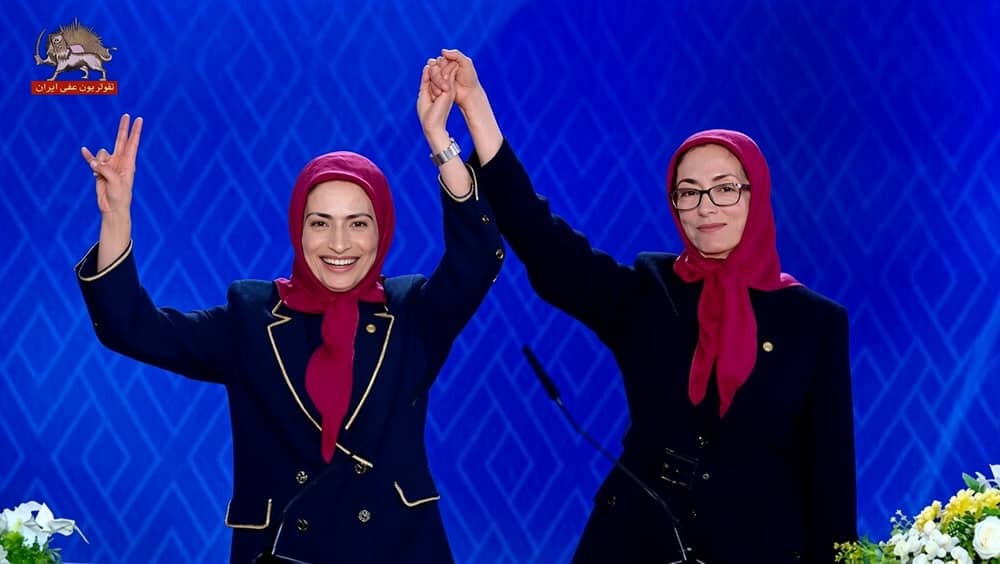
On September 6, 2026, the People’s Mojahedin Organization of Iran elected Mahnaz Maimanat as its new Secretary-General. The PMOI selects its Secretary-General through a three-stage election process involving progressively broader participation within the organization. In the first round, members of the Central Council take part in the selection, followed in the second round by officials and cadres from different sections of the organization. Both stages are conducted by secret ballot. The process concludes with a third and final round, in which all available members participate in an open vote by show of hands.
The gathering for the election of the new Secretary-General was convened by Zohreh Akhyani, Chair of the PMOI’s Central Council. During the first round of voting, Mahnaz Maimanat emerged as the leading candidate with 56 per cent of the vote, while Badri Pourtabbakh and Narges Azdanlou received 24 per cent and 20 per cent respectively.
Within 24 hours, the clerical dictatorship’s reaction appeared.
Mashregh News, an outlet run by the IRGC Intelligence Organization, repeatedly called Maimanat a terrorist, described the PMOI as a “dead cult,” invoked alleged foreign intelligence connections, and ran the extraordinary headline: “Promotion of the Head of the Gang Luring Girls.”
The intensity—and particularly the gendered language—was more revealing than the accusations themselves.
Mahnaz Maimanat Elected Secretary-General of the PMOI at a Major Gathering Marking the Start of the Organisation’s 62nd Year https://t.co/JzPqYIxXcr via @Mojahedineng
— People's Mojahedin Organization of Iran (PMOI/MEK) (@Mojahedineng) September 6, 2026
The threat of another model
The PMOI does not place women in leadership as a symbolic answer to clerical dictatorship. It has spent nearly four decades reorganizing its own hierarchy around female leadership, culminating in an all-female Central Council and successive women serving as Secretary-General.
That matters because the conflict with Tehran is not merely over compulsory veiling. At its deepest level, the Islamic Republic’s gender order concerns authority: who possesses it, whose judgment commands obedience, and what place women are permitted to occupy in society.
The PMOI has developed an opposing answer. Women do not merely have rights within its structure; they exercise authority. Men operate under female leadership. Women select and succeed other women.
For a regime whose political and clerical commanding heights remain overwhelmingly male, this is not cosmetic disagreement. It undermines one of the assumptions on which its social order rests.
This is what makes Mashregh News’ reference to “luring girls” particularly telling. It strips women of political agency. A young woman who joins the opposition, in this narrative, cannot have reached a political conclusion; she must have been deceived. A woman who leads cannot represent legitimate authority; she must be dangerous, manipulated, or criminal.
The misogyny is embedded in the explanation itself.
Mahnaz Maimanat Elected Secretary-General of the PMOI at a major gathering marking the start of the organisation’s 62nd yearhttps://t.co/rRaTQ7mWfX pic.twitter.com/iJ7NqNGhyz
— Maryam Rajavi (@Maryam_Rajavi) September 7, 2026
The audience inside Iran
The most important audience for this confrontation is not abroad. It is inside Iran.
Iranian women and young people have experienced the question of political authority physically. They have faced compulsory-veiling enforcement, arrests, surveillance and repeated crackdowns. During the nationwide protests that began in late 2025, Amnesty International documented an exceptionally deadly state response followed by mass arrests and enforced disappearances.
They therefore encounter Maimanat’s election against a very particular background.
For a young woman living under a state that regulates her appearance and circumscribes her legal and political standing, a political movement in which women repeatedly occupy the highest executive authority is not merely offering a slogan about equality. It demonstrates that another arrangement has already been practiced among Iranians.
That distinction is important.
Hope in periods of repression rarely comes from abstract promises alone. It also comes from evidence that relationships considered immutable are, in fact, changeable.
June 21, 1996 – London
At a time when the Iranian regime denied women even the most basic rights, NCRI President-elect @Maryam_Rajavi unveiled a bold vision for the future: a free Iran founded on full gender equality.
These 14 articles—ratified by the NCRI—outline the legal… pic.twitter.com/meC4BAa2jT
— NCRI-FAC (@iran_policy) July 1, 2025
The language of a terrified regime
And it helps explain why Tehran responds so aggressively. The IRGC mouthpiece could simply have ignored an opposition leadership election held outside Iran. Instead, on September 7, it published an extended assault on Maimanat, her history, her family and, conspicuously, her relationship with women and girls.
The reaction does not by itself measure the PMOI’s reach inside Iran. But it reveals the political argument the regime feels compelled to contest.
The danger for a deeply misogynistic order is not merely a woman opposing it.
It is the existence of an organized Iranian movement that has lived for decades according to the proposition that women can command, men can follow them, and other women can raise them higher still.
For generations told that the existing hierarchy is natural, religious or unavoidable, that is more than symbolism.
It is evidence that it can be otherwise.