

Three-minute read
The Iranian regime’s internal divisions over the Financial Action Task Force (FATF) have reached new heights, exposing the systemic contradictions and economic vulnerabilities plaguing the country. The decades-long deadlock over the FATF’s anti-money laundering and counter-terrorism financing requirements has become a litmus test for the regime’s survival strategies and conflicting priorities.
The FATF, an intergovernmental organization established by the G7 to combat illicit financial activities, has long demanded Tehran’s compliance with key conventions, including the Palermo Convention and the Combating the Financing of Terrorism (CFT) framework. The regime’s non-compliance has left the country on FATF’s blacklist, further isolating it from the global financial system.
Adopting these conventions would necessitate transparency that threatens the regime’s financial channels supporting proxies such as Hezbollah and the Houthis. Ali Nikzad, former Deputy Speaker of the Iranian Parliament, admitted in 2021, “If we accept FATF, it means exposing our methods of bypassing sanctions.”
#Iran News:
Clerical Regime Remains on #FATF Blacklist Amidst Warnings Over Terror Financing and Money Laundering Riskshttps://t.co/mKDqQmICdI— NCRI-FAC (@iran_policy) October 26, 2024
Political Infighting Escalates
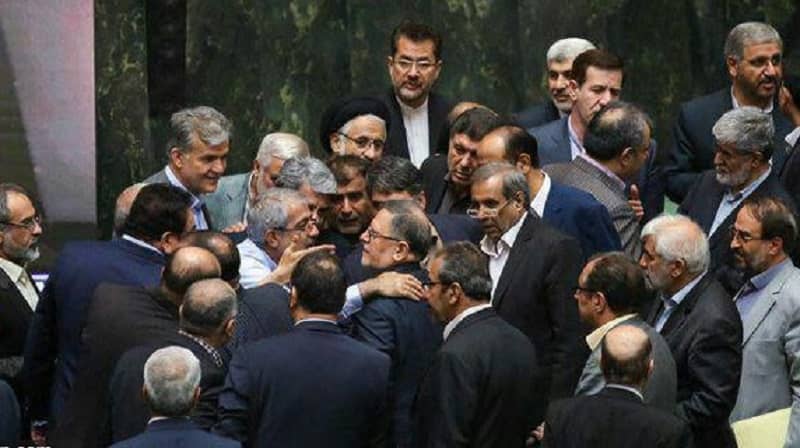
The regime’s internal discord over FATF erupted after Mohsen Dehnavi, a spokesman for the Expediency Discernment Council, announced plans for technical reviews of FATF-related bills. His statement prompted an immediate backlash in the Majlis (Parliament), with fierce opposition from extremist factions close to the regime’s Supreme Leader Ali Khamenei.
Speaker of the Parliament Mohammad-Bagher Ghalibaf tried to defuse tensions, stating, “Our stance on FATF was made clear during the previous parliamentary session. The matter is now under the jurisdiction of the Expediency Council.” Yet, his comments failed to quell dissent, as 120 MPs signed a letter opposing FATF review, accusing the government of jeopardizing national security.
MP Mohammad-Taghi Naghdali, harshly criticized the government’s approach, declaring, “If CFT and Palermo are approved behind closed doors, it will spark outrage and deepen mistrust.” He accused proponents of these conventions of seeking to sell out the country’s sovereignty under the guise of economic recovery.
Kayhan Newspaper Reminds #Pezeshkian Who Holds the Final Say on FATF in #Iranhttps://t.co/5LzgiQ9p97
— NCRI-FAC (@iran_policy) September 20, 2024
Khamenei’s Calculated Silence
Khamenei, who has the final say on all state matters, has remained strategically ambiguous. While the proposal to revisit FATF discussions reportedly came with his tacit approval, hardline factions have resisted any move that could weaken the Revolutionary Guard’s financial apparatus.
Asghar Fakhrieh Kashan, a former deputy at Iran’s Central Bank, revealed that a consensus was reached between President Masoud Pezeshkian and Khamenei to allow FATF deliberations, further deepening intra-regime divisions. Fakhrieh Kashan noted, “The state is walking a tightrope, trying to balance internal pressures and economic survival.”
Economic and Social Consequences
Opposition to FATF compliance stems from fears of losing key financial pathways, but failure to act prolongs Iran’s economic isolation. This paralysis exacerbates public dissatisfaction amid rising inflation, unemployment, and poverty.
The regime’s resistance to transparency underscores its reliance on illicit networks and corruption. Mahmoud Vaezi, a former cabinet minister and a key figure in the revisionist faction, argued that “crossing the FATF hurdle is in our national interest.” However, factions aligned with Khamenei fiercely oppose such concessions, warning that any submission to international demands would only invite further pressures and lead to ultimate capitulation.
#Iran News: #FATF Identifies High-Risk Jurisdictions, Iran’s Regime Remains on Blacklisthttps://t.co/4Hz4yXx5Fa pic.twitter.com/ZISjK76JnN
— NCRI-FAC (@iran_policy) June 28, 2024
Meanwhile, Ali Shamkhani, Secretary of the Supreme National Security Council, criticized the polarizing rhetoric surrounding FATF, stating on the banned social media platform X, “This is a technical issue, not a platform for political theatrics. Divisive politics will only deepen the country’s challenges.”
Regime’s Dilemma: A Choice Between Survival and Transparency
Iran faces a stark choice: accept FATF compliance and risk undermining its support for regional proxies, or continue defying global norms, which leads to greater economic hardship and international isolation. Some analysts describe the regime’s predicament as choosing between “rapid self-destruction” or “gradual implosion.”
MP Mohammad Koochakzadeh epitomized the internal clash, lambasting the government for “serving U.S. interests” by entertaining FATF compliance. He accused the so-called reformist factions of selling out Iran’s sovereignty, saying, “These officials are leading us into America’s hands under the guise of negotiations.”
FATF Mention during #Iran’s Sham Election Debate Sparked Internal Clasheshttps://t.co/bX0n2TBFk3
— NCRI-FAC (@iran_policy) June 22, 2024
Public Discontent and Implications for the Future
The FATF deadlock has not only paralyzed decision-making but also exposed the deep ideological fissures within the regime. The standoff reflects broader conflicts between factions: one insists on circumventing sanctions and defying international treaties, arguing that any compliance with the West will weaken the regime and hasten its downfall, while the revisionist faction contends that continued confrontation with the West will exacerbate economic pressures and fuel public unrest, potentially igniting a popular uprising.
Caught in a deadlock, Khamenei has exhausted his tactics, struggling to manipulate the rival factions that once deceived both Iranian society and the international community. Confronted by a convergence of deepening crises, he finds himself unable to placate his disillusioned base, appease an outraged populace, or satisfy an international community increasingly demanding accountability.