

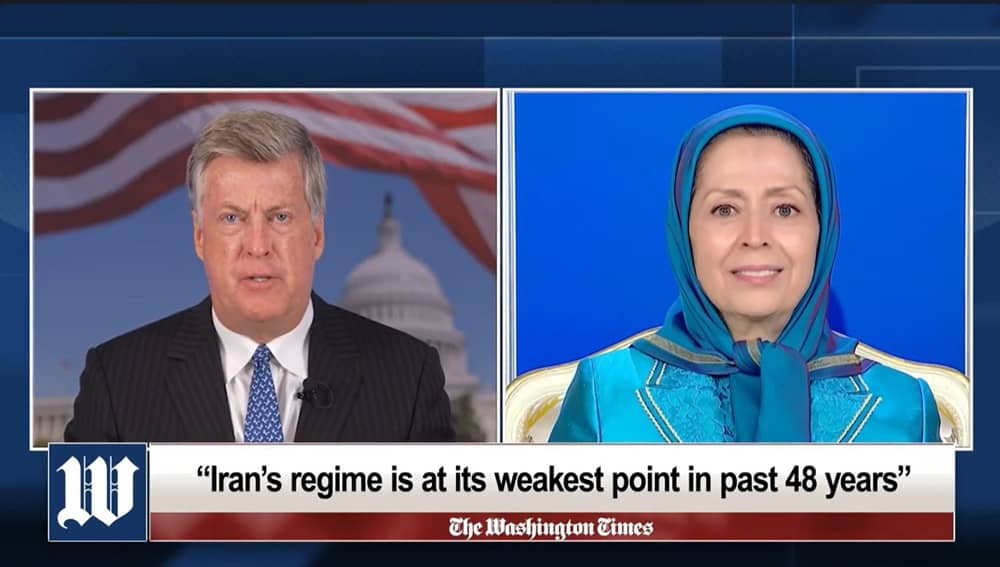
In an exclusive Washington Times interview with host Tim Constantine, NCRI President-elect Mrs. Maryam Rajavi asserted that the Iranian regime is currently at its weakest point in 48 years. She noted that a recent surge in executions—including 23 political prisoners over the past month—reflects the government’s deep fear of defiant youth and the expanding influence of Resistance Units. Rejecting claims of the Iranian regime’s resilience, Mrs. Rajavi emphasized that the strategy for overthrowing the religious dictatorship relies on the fusion of popular uprisings with an organized resistance on the ground.
The NCRI President-elect detailed a clear political transition roadmap, explaining that following the regime’s collapse, a provisional government would hold free and fair elections within six months to establish a Constituent Assembly. This transition is guided by the Resistance’s Ten-Point Plan, which champions a democratic republic, gender equality, the separation of religion and state, and internal autonomy for oppressed nationalities. Highlighting the pivotal role of women, she pointed out that female leadership is deeply institutionalized within the movement, with women comprising 52 percent of the NCRI. Finally, Mrs. Rajavi called on the international community to recognize the Iranian people’s organized resistance and hold the regime’s leaders accountable for crimes against humanity.
The text of Washington Times interview with Mrs. Maryam Rajavi follows:

1. You know, analysts and experts look at the conflict between the United States and Iran and they look at the success the United States has had. Militarily, they’ve done an enormous amount of damage. You’ve seen relationships change in the Gulf, the United States relationships seem to be even stronger, and Iran seems to be on its own. The leadership has been cleaned out, not only the Supreme Leader, but many of the top leaders have been cleaned out there, and yet the regime is still there. Some pundits would tell you it’s even stronger, that their resilience is so strong they may be in a stronger position than they were before February 28th. Is that a correct assessment?
In my view, this assessment is incorrect, because the regime is at its weakest point in the past 48 years. The super-crises that led to the January uprising have not only remained unresolved but have in fact intensified after the war. This assessment overlooks two key realities:
First, the executions in recent weeks demonstrate the regime’s deep concern about defiant youth and resistance units. This reflects the strength of the resistance and the weakness of the regime. As you know, in the past month alone, at least 23 political prisoners have been executed: eight members of the MEK and commanders of resistance units, and also 15 others who were participants in the uprising. Some family members of these martyrs, who sought to retrieve the bodies of their loved ones, have also been arrested.
Finally, the analysis you mentioned underestimates the explosive state of society and the accumulation of public discontent in Iran. The regime has no way out of these crises.
Do not forget that just one year before the fall of the Shah’s dictatorship, some were calling it an “island of stability,” while others claimed Iran was not even in a pre-revolutionary phase. Yet, we saw that contrary to those assessments, the Shah’s dictatorship was rapidly overthrown.
2-You mentioned the executions that have gone there, and human rights groups are saying there have been a couple of dozen, and you mentioned 8 of those are MEK members. Why do you think the regime, the Iranian regime as it exists now, is carrying these out? But more importantly, what’s the message that that sends to the rest of the world?
The regime’s objective in carrying out these executions is to prevent an uprising and also to instill fear in the people who rose up in January for freedom and the overthrow of the regime. It knows that the war will eventually end, and that the already explosive conditions in society will become even more intense, with larger uprisings on the horizon. Therefore, on the one hand, it seeks—by its own calculation—to instill fear and terror among the public, especially the youth, to deter them from pursuing protest and rebellion.
In an interview with @TimConstantine1 of the @WashTimes on the current situation in Iran and the Iranian people’s struggle for freedom, I stressed that the viable solution to the Iranian crisis is regime change by the people of Iran and the organized Resistance. https://t.co/fFiEJa0uFL pic.twitter.com/ahSPa22WeJ
— Maryam Rajavi (@Maryam_Rajavi) May 20, 2026
On the other hand, it aims to prevent young people from joining resistance units and to halt their expansion, because these units play a significant role in organizing, spreading, and sustaining uprisings.
However, what the regime fails to grasp is that it is confronting a generation that is in no way willing to tolerate the mullahs’ crackdown and suppression. This is a generation that has found its path in organized resistance and is prepared to pay whatever price it takes.
As Thomas Paine said, “We have it in our power to begin the world over again.”
3-You have long talked about overthrowing the regime would take actual resistance on the ground. You’ve been very clear that needs to be people on the ground. What would that actually look like? How would that realistically unfold? And then what credible alternative exists if that effort for overthrow is successful?
The clear alternative—and the proven solution to the Iran question—is change brought about by the Iranian people themselves, through organized resistance and resistance units.
Our specific strategy for overthrowing this regime is centered on the fusion of two elements: one is popular uprising and organized resistance, including the resistance units. Both elements have been tested and can be observed.
On the one hand, the social conditions are far more explosive than during the January uprising, and there is no doubt that larger uprisings are on the horizon.
On the other hand, organized resistance is far more prepared than in the past. Resistance units—only during the January uprising alone—carried out 630 operations against repressive centers to protect the protesters. On February 23, 250 MEK fighters launched an assault on Khamenei’s heavily guarded headquarters. Resistance units, in their quantitative and qualitative expansion, have evolved into organized units of a liberation army.
In addition to the resistance units, there exists a vast, organized social network of MEK supporters across the country, playing an effective role in uprisings. Their struggle in cities and their resistance in prisons have had a profound impact on society. For example, members of a six-member MEK unit, commanded by Vahid Bani-Amerian, in the days before their execution, sang a collective anthem inside prison. This profoundly moving footage has now gone viral. International television channels have broadcast it repeatedly; French television, in airing their images, described it as a powerful symbol of the Iranian people’s resistance and dignity and is quite powerful.
Here, I have their pictures. This is the scene where they had stood in prison and were singing together.
As I have repeatedly stated, real change in Iran requires a combat-ready, organized force on the ground. The fake alternatives, polished through social media engineering and glossy television programs, lack even the slightest real role or relevance. These represent remnants of the former dictatorship who aspire to return Iran to the past. But a people who sacrifice their lives do so not for a return to the past, but for a democratic future.
One must not lose sight of the fact that elevating a manufactured alternative built around the Shah’s son and the remnants of the former dictatorship serves as one of the clerical regime’s key levers to confront and contain the uprising and the organized Resistance.
Watch full interview: https://t.co/kWFaAi6x7W pic.twitter.com/sFxS648mlx
— Washington Times Opinion (@WashTimesOpEd) May 21, 2026
4-The United Stats disagreement with Iran is only a couple of months old, you have been fighting this battle for a long long time. What is your plan? Do you have a specific plane for Iran’s future? And if there is a regime change, what would the transition look like?
We, the Iranian Resistance, have presented a clear political roadmap for the period following the overthrow of the current regime. Under the Council’s official plan, after the regime’s overthrow, a provisional government designated by the Council will, within a maximum of six months, hold free and fair elections for a constituent and national legislative assembly, thereby transferring sovereignty to the people. The provisional government will then resign, after six months, enabling the constituent assembly to designate a government to administer the country.
The political foundation of this transition is outlined in the Resistance’s Ten-Point Plan: a republic based on the separation of religion and state, pluralism, freedom of parties and the press, the abolition of the death penalty, gender equality, an independent judiciary, autonomy for oppressed nationalities, and a non-nuclear Iran.
Therefore, our emphasis is on a republic grounded in freedom and democracy. And as Abraham Lincoln said in your own history, the fundamental principle is that government must be “of the people, by the people, and for the people.”
This is a must-watch for all who want to see an end to the rule of the terrorist mullahs in Iran while avoiding foreign boots on the ground or appropriating money. Mrs. Maryam Rajavi explains the depth, capabilities, and intent of the organized Iranian resistance to overthrow the… pic.twitter.com/RDHl2LKA69
— Alireza Jafarzadeh (@A_Jafarzadeh) May 20, 2026
5-The current regime has a reputation for oppressing women. And yet since 2017 women have been the ones who seem to be at the forefront of the protests on the ground in Iran. And at the same time, when I look at your group, not only you, but primarily all the leadership in your organization is female. Is that coincidence? And and how is it that women are taking such a strong role in a country that has tried to hold women down?
I must state clearly that this coincidence in timing is not accidental at all. The reality is that the prominent and active role of Iranian women in the nationwide uprisings of recent years was not spontaneous or created overnight. Rather, it is rooted in 48 years of struggle by Iranian women in the political and social spheres, as well as in the arenas of military battles, where MEK women played a leading and pioneering role. Under this regime’s rule, thousands of courageous women activists and MEK members have been arrested, tortured, and executed. And today, one thousand heroic women serve in the MEK’s Central Council, assuming leadership and guiding responsibilities at every level of this movement. Moreover, women constitute 52 percent of the more than 450 members of the National Council of Resistance of Iran. In this way, women’s leadership has been institutionalized within the resistance and serves as a springboard for achieving genuine gender equality. This is a source of inspiration and motivation for women across Iran.
According to the Council’s program and its Ten-Point Plan, equality for women and their full participation in all spheres of society—especially in political leadership—will guarantee democracy and development in a future Iran.
6- Following the death of Iran regime’s Supreme Leader, Ali Khamenei, you announced the formation of a provisional government. And to be perfectly candid, there were some critics out there that said that was premature. Why did you think it was important to make that announcement then, to make that formation then? And what makes the provisional government legitimate?
The provisional government is part of a pre-defined plan by the NCRI Iran for the transitional period. Its announcement at a time when the regime is experiencing severe fragility and weakness highlights the fact that a credible alternative exists—one capable of transferring power to the Iranian people in an orderly, calm, and democratic manner after the regime’s overthrow.
Regarding legitimacy of the provisional government, I must say that under conditions of repression—where free elections are impossible—the measure of legitimacy for any political force is its level of active participation in resistance and its demonstrated commitment to democratic principles in practice. The legitimacy of the provisional government is rooted in 45 years of unrelenting struggle against religious tyranny and in the sacrifice of more than 100,000 martyrs.
This government is based on a clear and publicly declared political program, grounded in principles such as free elections, the rule of law, separation of religion and state, and gender equality.
I must add that the provisional government does not seek to replace the will of the people; rather, it aims to facilitate its realization. We have consistently stated that we do not seek power for ourselves, but intend to transfer power to the Iranian people.
The mandate of the provisional government is to hold free elections within a maximum of six months for the formation of a Constituent Assembly. Immediately thereafter, the provisional government will resign so that the representatives elected by the people in the Constituent Assembly can establish a new government to carry forward the affairs of the country.
Question by @TimConstantine1 in an exclusive @WashTimes interview with @Maryam_Rajavi:
What would overthrow by people on the ground realistically look like—and what credible alternative exists after the regime falls?
Mrs. Rajavi’s answer:
• Real change must come from the… pic.twitter.com/yqx6O4dZkt— Hamid Azimi (@no2censorship) May 20, 2026
7-In the recent past, the collapse of oppressive rulers, like in Libya, for example, or maybe a great example would be in Iraq and Saddam Hussein. The collapse of those leaderships has ended up in chaos, in instability all over. If there is a regime change in Iran, can a different path be taken? Can that instability be avoided?
Such a threat does not exist in Iran. Neither the experiences of Iraq and Libya are applicable to Iran, nor is a “Chalabi-style” scenario conceivable, nor is a return to monarchical dictatorship. For several reasons:
First, there exists in Iran a deep and powerful societal desire for regime change and the attainment of freedom and democracy. For the past 45 years, there has been a continuous resistance aimed at overthrowing the regime. This prolonged struggle serves as a unifying force among the diverse components of Iranian society.
It must be noted that in Iraq and Libya, no credible alternative existed. The fall of those regimes occurred largely as a result of the sudden collapse of state structures. In contrast, change in Iran is fundamentally relies on the people and in an organized resistance that is backed by a political alternative and a provisional government.
In Iran, there exists an opposition force with defined structure, program, and networks, which has a clear roadmap for the “day after” the regime’s overthrow. And as I said, a time-bound provisional government has been proposed with the explicit mandate to hold free elections. In other words, a designed mechanism exists to prevent a power vacuum.
It must be borne in mind that Iran possesses a long-standing national identity and a deeply rooted, cohesive social structure; it was not a state born out of the postwar global partitions that followed major wars.
8-Your critics say that while you have a strong presence, you and your organization have a strong following abroad, they question how much of a following you really have inside the borders of Iran. Is there concrete evidence? Can you lay out examples of where the NCRI has a following on the ground?
Let us begin with the regime’s daily executions themselves: if the MEK did not have — and does not have — a social base of support, why do the clerical rulers persistently execute its members? As I mentioned, recently, eight MEK members were executed in just the past three weeks. In total, more than 100,000 members of the resistance have been executed by this regime. In the book you see here, the names of 20,000 of them have been compiled under conditions of severe repression, their names and pictures.
Therefore, if the resistance had no base in Iran, it would not have endured for 60 years—indeed, it would not have survived even six.
Resistance Units carried out over 4,000 anti-repression operations in the past year alone. Is it conceivable for such a scale of operations to occur without a broad social base?
During the January uprising alone, 2,000 MEK members disappeared—killed, or imprisoned. Yet at the same time, we are witnessing a growing number of women and young people joining the ranks of the Resistance Units.
Senior regime officials—including Ali Khamenei—have repeatedly acknowledged that the primary threat inside Iran is the MEK and that it plays a pivotal role in inciting uprisings. For 45 years, the slogan “Death to the MEK” has been a staple of the regime’s official and religious ceremonies.
Over the past two years, the regime has held a so-called absentia trial in Tehran—convened every two weeks—targeting 104 members of the resistance. Its purpose is to level accusations in an effort to halt the growing trend of youth joining the movement. In this very so-called “trial,” death sentences have been issued against me and other members.
I must also recall that, relying on its popular network, this resistance was the first to expose the regime’s secret nuclear program in 2002, and has carried out more than 130 such revelations since then.
At the same time, it is precisely this domestic social base that has enabled the resistance to maintain its financial independence to this day.
Watch full interview: https://t.co/kWFaAi6x7W pic.twitter.com/sFxS648mlx
— Washington Times Opinion (@WashTimesOpEd) May 21, 2026
9-I’m not sure that some in the West realize how large the ethnic diversity is in Iran. And diversity can be a great asset, but it also creates some challenges. You talked earlier about your 10-point plan. In that plan, do you have specifics to how to meet the various demands or the various needs of all these different ethnic groups within one nation?
Preserving Iran’s territorial integrity and national unity is possible precisely through guaranteeing the rights of all its constituent peoples and components. That is why we advocate internal autonomy for oppressed nationalities such as the Baluchis, Kurds, Arabs, and Turkmen.
For many years, the NCRI has adopted a comprehensive plan for autonomy in Iranian Kurdistan. This plan represents an advanced model for democratic self-governance for Iranian Kurdistan.
Conversely, those who refuse to recognize the rights of oppressed nationalities are, in practice, pursuing the path of division and fragmentation in the country — a course the people of Iran firmly reject.
10-We’ve talked about the NCRI, we’ve talked about your organization and who makes it up, we’ve talked about action on the ground. There’s one question remaining, and that is, what are you looking for from the international community in support for your efforts?
As I recently stated at a meeting at the European Parliament:
The Iranian people expect the international community to predicate any diplomatic engagement or agreement on the halt in executions and the release of political prisoners.
Furthermore, the regime’s dossier of human rights violations must be referred to the United Nations Security Council, so that its leaders can be held accountable for crimes against humanity.
The regime’s embassies should be closed, and agents and operatives of the Ministry of Intelligence and the Revolutionary Guards must be expelled from all countries.
Also, the requisite technical infrastructure must also be provided to ensure the Iranian people have access to a free and unrestricted internet.
Finally, it is essential that regime change by the Iranian people and their organized resistance be recognized, along with the provisional government announced by the NCRI.
Mrs. Rajavi before I let you go, anything else you would like to share with our audience?
Thank you. Allow me to say a few words and to repeat that four decades ago, the Iranian Resistance, with its deep understanding of the nature of the religious dictatorship in Iran, emphasized that this regime is incapable of reform and that the only solution is the overthrow of this brutal dictatorship.
Our program can be summarized as: Freedom, Equality, and the separation of religion and state.
Our struggle and sacrifices are not aimed at gaining power, nor do we seek a share of power. Our only goal is to establish popular sovereignty and democracy.
Thank you again.
https://www.washingtontimes.com/news/2026/may/20/maryam-rajavi-irans-regime-weakest-point-decades/