

Four-minute read
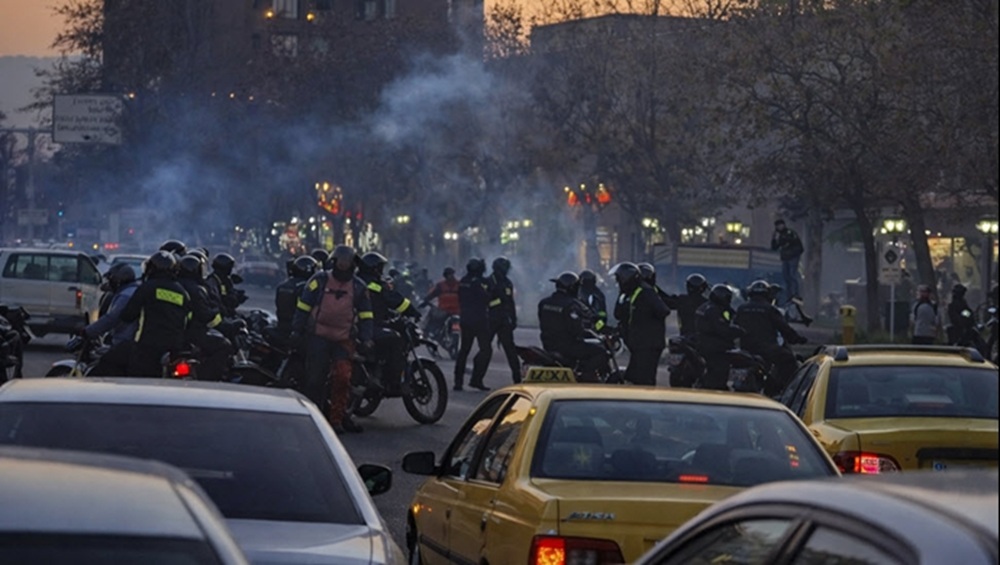
Since the recent war involving the United States, Israel, and the clerical regime in Iran, one scene has been repeated almost every night: the regime has been bringing its own limited social base into the streets. Nightly rallies, motorbike and car convoys, flag-waving ceremonies, religious chanting, war slogans, food distribution, the mobilization of teenagers and families tied to state institutions, and even public weapons training on state television have all become part of this orchestrated spectacle.
At first glance, the regime wants the world to believe that “the people” stand behind it. But the political reality is the opposite. These gatherings are not primarily a sign of strength; they are evidence of the regime’s deep fear of the Iranian people and of the possibility that the street may once again return to the hands of a rebellious society.
The regime knows that in Iran, the street is not merely a public space. It is the decisive political battlefield. The uprisings of December 2017, November 2019, 2022, 2025, and other waves of protest showed that when the Iranian people enter the streets, the foundations of the ruling system begin to shake. That is why, after the war, the regime has tried to occupy the streets at night with members of Basij, their families and others dependent on the regime, thereby preventing the formation of real protest centers.
"The regime finds itself trapped between the prospect of renewed foreign #IranWar and the danger of a people’s armed uprising. As a result, Tehran is increasingly resorting to wartime posturing," @MansoreGolestan writes.https://t.co/y4QCukZXPw
— NCRI-FAC (@iran_policy) May 20, 2026
Some Western media outlets, seeing large crowds in Tehran, have suggested that the war has pushed people to “rally around the flag”. This interpretation is deeply misleading if it ignores the machinery behind these gatherings. Crowds brought into the streets through the Basij, the IRGC, mosques, government offices, state-linked institutions, administrative pressure, financial incentives, food distribution, and other benefits cannot be treated as evidence of free public support.
This must also be seen alongside the intense security atmosphere that followed the war. Instead of trusting society, the regime immediately resorted to arrests, checkpoints, phone inspections, internet shutdowns, security accusations, espionage charges, and repression. This alone reveals that the regime itself knows the people have not rallied behind it. If genuine support existed, such intimidation — including cutting or restricting people’s access to communication — would not be necessary.
The recent admission by Ahmadreza Radan, the regime’s police chief, is particularly revealing. He announced that since the beginning of the war, more than 6,500 people had been arrested as “traitors” and “spies”, adding that arrests related to the December unrest were still continuing. He also stated that 567 of those arrested were special cases linked to “MEK”, and “counter-revolutionary groups” — language that points to the Resistance Units and defiant youth fighting the regime’s repression.
"The widening crackdown comes as the country struggles to stabilize after #IranWar that degraded significant portions of its infrastructure, while simultaneously exposing vulnerabilities inside the clerical dictatorship," writes @MasumehBolurchi.https://t.co/vkaKRzSuu2
— NCRI-FAC (@iran_policy) April 16, 2026
This confession exposes the regime’s real fear of an internal uprising rather than external war. Whenever the regime faces social protest, it tries to attribute it to foreign enemies in order to justify arrests, torture, executions, and repression. Therefore, when Radan speaks of thousands of arrests, he is in fact admitting that the regime’s main war continues inside the country: a war against a society that has repeatedly shown its desire to end this system.
The same logic applies to the execution of political prisoners and protesters. Through execution, the regime seeks to tell the street that every organized movement, every protest, every network of resistance, and every voice calling for regime change may be answered with death. Yet the very intensity of this repression shows that the regime is not facing scattered and harmless dissatisfaction. It is facing an explosive society, and it knows that organized resistance exists within it.
This is why the role of the MEK Resistance Units is so important to the regime. The authorities understand better than many foreign observers that uprisings do not endure without organization. Public anger is widespread, but what can transform anger into a political uprising is continuity, networks, slogans, leadership, and purpose. That is why the regime’s security officials, alongside general labels such as “spy” and “counter-revolutionary”, repeatedly refer to “MEK”. Their focus on the MEK and the Resistance Units reflects recognition of a real threat: the connection between social anger and organized resistance.
"Leaked documents and public statements alike confirm that the clerical leadership views @Mojahedineng’s decentralized #MEKResistanceUnits not as a relic but as a persistent, adaptive strategic threat capable of giving direction, continuity and staying power to public…
— NCRI-FAC (@iran_policy) May 20, 2026
Foreign war may damage facilities, but, an internal uprising threatens the regime’s existence, and a people’s street movement can strike at the very heart of the Velayat-e Faqih system.
The nightly gatherings, therefore, should be interpreted correctly. They are not proof of popular support. They are not proof of stable control over society. They are a form of preventive occupation of the street. A regime that must use food, money, fear, patronage, flags, propaganda, security forces, and even televised weapons training to fill the streets is not confident in its people’s support.
The international community should not mistake the regime’s staged crowds for national unity. The real issue is not whether the regime can manufacture nightly rallies, but whether the Iranian people have the right and the support to reclaim their own streets. The recent wave of arrests and executions makes one fact clear: the regime has identified its main enemy — and that enemy is the Iranian people and their organized resistance. The world can now see clearly that the current crisis in the region, and its wider consequences for international security, will not be resolved as long as this regime remains in power. The only real solution lies in the overthrow of the clerical regime by the Iranian people in the streets, with the support and organization of their Resistance. For this reason, the international community must stand with the Iranian people and the Iranian Resistance, and support their demand for freedom, democratic change, and an end to this regime.