

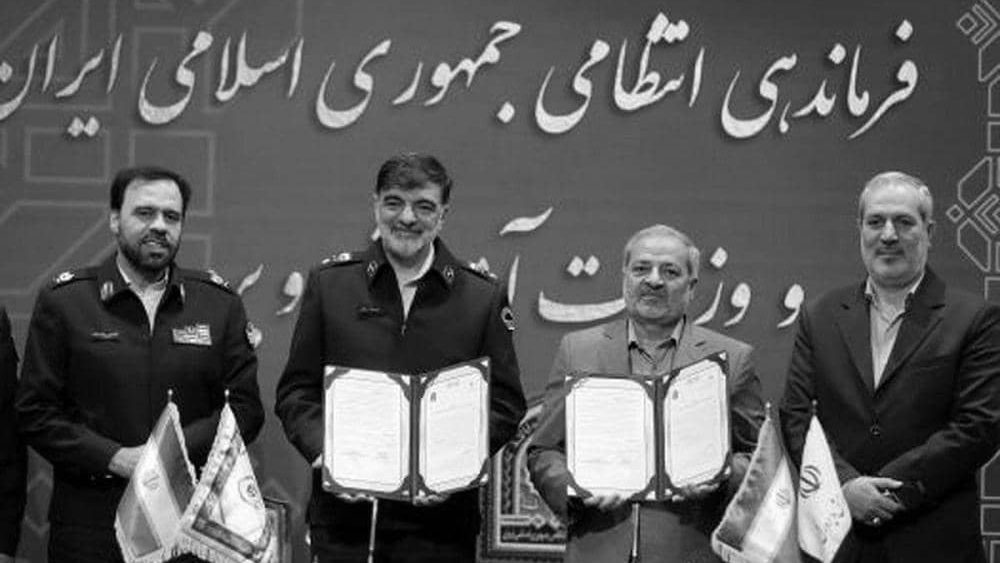
April 20, 2025 – In a revealing display of the Iranian regime’s escalating fear of youth-led unrest, Minister of Education Alireza Kazemi and State Security Forces Commander Ahmadreza Radan signed a formal agreement in Tehran to merge security enforcement with the country’s education system. The memorandum, signed during a high-level conference of cultural and social managers, signals a full-scale regime effort to regain ideological control over Iran’s younger generation — and may pave the way for expanded surveillance and behavioral monitoring in schools under the pretext of preventing social harm.
Kazemi, expressing unconditional loyalty to the security forces, declared: “I am proudly a soldier of Commander Radan.” He added, “Education is entirely at your service, and your mission is our mission. We have one shared mission in the Islamic Republic.” He emphasized that a “serious and fundamental revision” is underway in the educational system to prioritize “religious foundations, the culture of prayer, and Quranic values.”
According to Kazemi, “the Ministry of Education’s mission is to transmit culture, beliefs, and values to the new generation.” He said the regime must identify “leading norms” in society and turn them into “a national and familial discourse.” He called the country’s main crises “cultural,” warning that the roots of Iran’s economic and social problems lie in the people’s failure to internalize “correct consumption culture,” a concept that, in his view, must be instilled from early childhood.
NCRI Statement: #Iran’s Rebellious Youth Ignite Fiery Uprising Despite Suppressive Forces on High Alerthttps://t.co/9J0ooePo5m pic.twitter.com/0BriBfHg5g
— NCRI-FAC (@iran_policy) March 12, 2024
Radan, for his part, admitted that students have always been central to the regime’s political calculations. “Who is most targeted by the enemy?” he asked rhetorically. “Perhaps better than us, the enemy has understood that the most influential segment in Iranian society is the students.” Referring to the regime’s recruitment of child soldiers during the Iran-Iraq War, Radan added, “It was from the schools that we sent martyrs to the front lines.”
In one of the clearest acknowledgments of generational vulnerability, Radan warned against what he called a “mafia of thought abduction” aimed at young minds through virtual platforms. He emphasized that the “formation of mental and behavioral systems happens in childhood and adolescence,” stressing that “our missions progress better through schools.”
“Don’t let the [MEK] deceive our children, they are worse than infidels. Yet, pretend to support women," Esmail Roshantan, Khamenei's representative in Tabriz warned about Iran's opposition impact on Iranian youth. #IranRevolution2022 https://t.co/qKy2aSInBp pic.twitter.com/ITl621CRVH
— NCRI-FAC (@iran_policy) October 15, 2022
The joint pact, as reported by PANA News Agency, aims to “develop educational, social, and cultural cooperation,” increase “public awareness,” and “prevent social harms.” But beyond bureaucratic language, the agreement reflects the regime’s deeper panic: a generation no longer controlled by clerical dogma, one that has led the uprisings of recent years with unprecedented courage and clarity.
In this context, the regime’s rush to militarize education and bind it to state repression betrays a truth it can no longer suppress: Iranian youth, particularly women and students, have emerged as the moral and strategic spearhead of the struggle for freedom. The ruling clerics may rewrite textbooks and deploy police in classrooms, but the battle over Iran’s future is already underway—on the very terrain they fear most.