

Three-minute read
Behind every busted front company and intercepted shipment of drone components lies a sprawling, state-sponsored enterprise designed to bleed Western technology into the hands of the Iranian regime. For years, the international community has played a tireless game of Whac-A-Mole, arresting individual operatives and sanctioning shell corporations. Yet, the illicit supply chains remain stubbornly intact. The reality that Western governments often hesitate to officially acknowledge is that the regime’s diplomatic missions do not merely represent Tehran’s political interests; they serve as the operational springboards for sanctions evasion, espionage, and terror.
The Illicit Supply Chain
A review of recent federal indictments and arrests paints a vivid picture of how deeply entrenched these procurement networks are. Operating under the guise of legitimate commerce, dual citizens and foreign nationals exploit international hubs to funnel sensitive technology to the Islamic Revolutionary Guard Corps (IRGC), the Atomic Energy Organization of Iran (AEOI), and the Central Bank of Iran (CBI).
The methods vary, but the objective remains the same: circumventing export controls to fuel the regime’s military and nuclear ambitions. In June 2026, Jamshid Ghomi was arrested in California for allegedly supplying over 250 metric tons of sophisticated U.S. networking and encryption equipment to the AEOI and the Ministry of Defense. In December 2024, Mahdi Mohammad Sadeghi was charged in Massachusetts with conspiring to export U.S. microelectronics specifically for IRGC military drones—technology tied directly to attacks on U.S. personnel in the Middle East.
The NCRI Secretariat and @Maryam_Rajavi warn: no more appeasement of the clerical regime and block all sanction-evasion routes. A timely reminder of Tehran’s sophisticated playbook to bypass global sanctions: https://t.co/s3mKfqRB9R”
— NCRI-FAC (@iran_policy) September 28, 2025
Others act as the regime’s mules. Gholam Reza Goodarzi was intercepted in Texas in August 2024 while attempting to smuggle aircraft and UAV components concealed in his luggage to Iran via Dubai. Meanwhile, operatives like Kambiz Attar Kashani, who pleaded guilty in 2022, established front companies in the UAE to funnel restricted electronics to the Central Bank of Iran, an entity sanctioned for financing Hezbollah and the IRGC Quds Force. Even hard currency is systematically siphoned; Kambiz Eghbali was arrested in October 2024 for a scheme utilizing U.S. gift cards to illegally transfer dollars to Iranian enterprises.
The Diplomatic Springboard
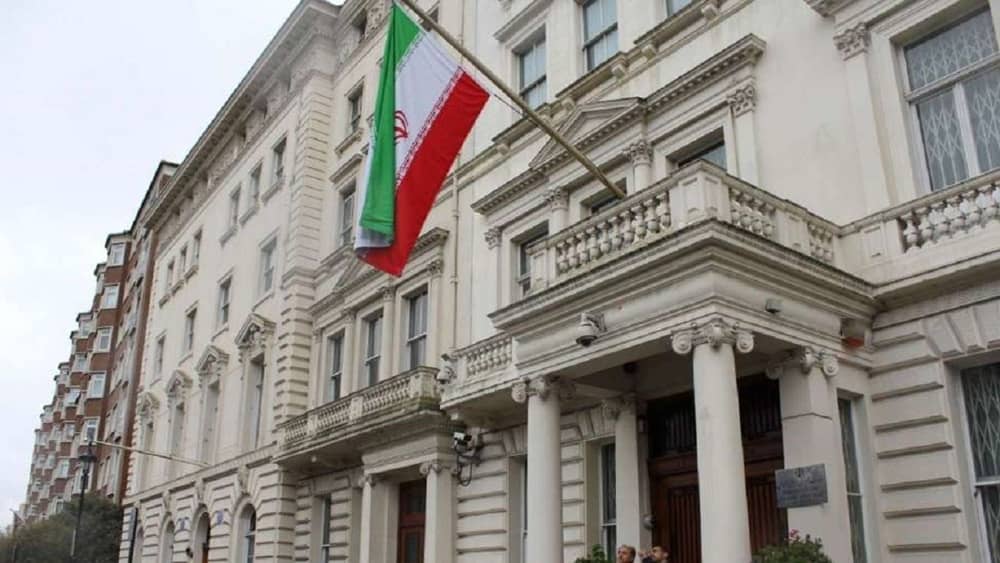
While the individuals caught in the crosshairs of the U.S. Justice Department represent the logistical arms of this enterprise, the brain trust is frequently housed within the fortified walls of Iran’s embassies and consulates. Under the protections of the Vienna Convention, diplomatic mechanisms—most notably the diplomatic pouch, which cannot be searched or seized by host nations—offer an unhindered pipeline for transferring cash, sensitive physical components, and classified instructions to operatives on the ground.
Historically and contemporarily, the IRGC and the Ministry of Intelligence and Security (MOIS) embed their personnel within these diplomatic outposts. Rather than fostering bilateral relations, these “diplomats” act as handlers. They provide the necessary logistical planning, surveillance capabilities, and recruitment infrastructure to sustain illicit front operations and proxy cells in the West (Pop & Silber, 2020).
The Iranian Foreign Ministry, diplomats and embassies are all parts of the clerical regime's terror machine.#BlackListMOIS #ExpelIranDiplomatTerrorists #FreeIran#Iran
— Maryam Rajavi (@Maryam_Rajavi) January 8, 2019
A prominent example of this abuse of diplomatic privilege occurred in 2018, when Assadollah Assadi, an Iranian diplomat stationed at the embassy in Vienna, was arrested for hand-delivering a sophisticated explosive device to a proxy cell in Europe. The operation underscored how embassies double as command centers for state-sponsored terrorism. In the realm of sanctions evasion, these same diplomatic networks provide the intelligence, secure communications, and financial backing necessary for agents like Reza Dindar—who operated a massive procurement network out of China before his 2025 arrest—to route restricted goods back to Tehran undetected.
Ending the Whac-A-Mole Game
The arrests of individual smugglers and procurement agents are tactical victories, but they are ultimately strategic failures if the structural enablers are left untouched. Every time a Ghomi or a Kashani is incarcerated, the regime simply activates another sleeper agent, coordinates a new shell company through an allied capital, and continues its work.
As long as these so-called diplomatic centers, which are only serving the regime’s malign agendas and not the host nation, are allowed to operate, they render any international mechanism for holding the regime to account as futile. Thus, if the international community is serious about holding the regime to account, it must begin with the spring board and not trying the endless Whac-A-Mole game.