

Three-minute read
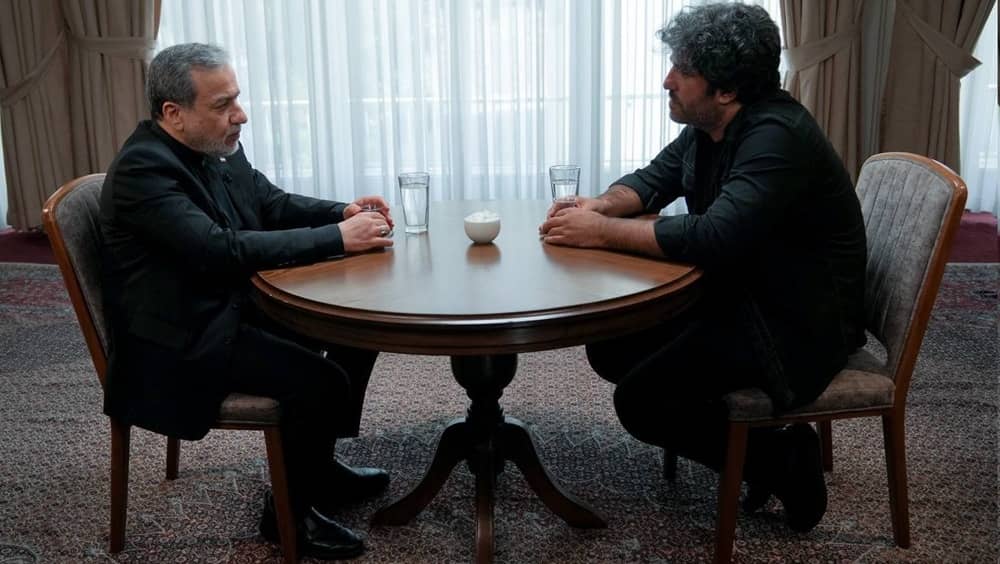
When Iranian regime’s foreign minister Abbas Araghchi sat down with a state security-affiliated documentary filmmaker Javad Mogouee for a wide-ranging television interview published on July 19, 2026, the timing was not accidental. The multi-part conversation — recorded before the latest resumption of hostilities with the United States — arrived at the precise moment the clerical regime’s internal fissures have become impossible to conceal. “Warmongers” have openly accused the regime’s negotiators of staging a “soft coup” against “the Islamic Republic’s revolutionary ideals.”
Araghchi’s interview was not journalism; it was a factional rebuttal dressed as one.
The surface argument was familiar: Iran went to war because it refused Washington’s demand for zero-percent uranium enrichment, and it was the Americans who “misjudged Iran’s preparedness.” Araghchi insisted the regime “resisted their irrational demand” and that “negotiations did not provoke the war.” He framed the 12-day war of June 2025 as a strategic draw, claiming the two sides ended up “acting as superpowers.”
But woven through the bravado was a revealing admission. When Mogouee pressed him on why Iran refused even a temporary or multi-year suspension of enrichment during the negotiations, Araghchi answered that accepting it would have inflicted “greater damage than war”, because “it would have amounted to surrendering the country’s dignity.”
As the 2026 #IranWar grinds on and diplomacy stalls, one July from the past offers a stark, often-overlooked lesson about what ultimately shapes the regime’s fate.
What really ended the fighting in 1988 — and what it means for ending today’s war. via @khansari_m…— NCRI-FAC (@iran_policy) July 18, 2026
Strip away the diplomatic veneer and what remains is a confession: the clerical regime cannot take a single step backward without risking its own disintegration. This is not a strategic posture; it is a structural condition. Any concession threatens to expose the void at the center of a system that has long substituted coercion for consent.
For decades, the National Council of Resistance of Iran (NCRI) has argued that the regime’s belligerence is not a negotiating tactic but a survival mechanism. Khamenei built his doctrine on the premise that every retreat invites further enemy advance and leads, step by step, to capitulation. Araghchi effectively confirmed this calculus on camera. The regime does not equate defeat with Iran’s destruction; it equates retreat with its own and Khamenei died proving it.
The pattern is not new. After the 1979 revolution, the regime engineered its confrontation with Iraq, calling the resulting eight-year war a “divine blessing.” When Iraq withdrew from Iranian soil and the United Nations offered ceasefire resolutions, Tehran refused for six more years—until the National Liberation Army of Iran’s 1988 operations showed Khomeini that the continuation of war might lead to his own fall, posing a larger threat than stopping it. The NLA forced Khomeini to accept what he famously called “drinking poison.” The psychological blow contributed to his rapid physical decline; he was dead within eleven months, proving that ending the war was indeed deadly for him.
"Washington was prepared to provide a financial and #diplomatic lifeline; however, Tehran's regime lacked both the will and the capacity to play along. Because it is too weak and fragile to accept it," @MehdiOghbai writes.https://t.co/6R3QiV6hSS
— NCRI-FAC (@iran_policy) July 14, 2026
Today, the calculus is identical; only the price is higher. Iran’s defense budget (per official admissions) consumed roughly 27 percent of national spending in the most recent fiscal year — approximately $16 billion out of $59 billion, according to assessments. Tehran doubled its funding to Hezbollah to $2 billion while channeling hundreds of millions more to the Houthis, Iraqi Hash-al Shaabi, and other militia clientele. The nuclear program’s estimated cumulative cost — in lost investment and oil revenue alone — stands at well over $2 trillion, a figure that has only grown if war damage is included.
These expenditures have come at the direct expense of an economy in free fall. By late 2025, the rial had lost roughly 84 percent of its value in a single year, plunging to 1.4 million per dollar — compared with 70 at the time of the revolution. Inflation ran at 42 percent; food staples surged by 70 percent. The protests that erupted were the largest since 1979, and the regime’s response — mass killings, sweeping arrests, a near-total internet blackout — confirmed what The Conversation called “a full-blown ideological crisis,” not merely an economic one.
"As #IranWar outcome reveals the bankruptcy of both the theocracy’s defiance and the monarchy’s reliance on foreign powers, it vindicates only those whose strategy has always been self-reliant, independent, and grounded in the organizational capacity to bring about regime change…
— NCRI-FAC (@iran_policy) June 16, 2026
This is the context that makes Araghchi’s interview so revealing. A regime that pours its diminishing resources into missiles, proxies, and a nuclear program while its population goes hungry is not projecting strength. It is broadcasting the one thing it cannot say aloud: that it possesses no social capital and knows it cannot earn any. The prioritization of war-making over nation-building is an admission that the regime’s survival depends entirely on external conflict — because internal legitimacy vanished long ago.
Araghchi told Mogouei, “We do not fight unless the cost of fighting is less than the cost of not fighting.” Read correctly, this is not a doctrine of restraint. It is a confession that peace is the greater threat — because peace would force the regime’s factions to turn on each other without a common enemy to hold them together. War is the only glue; without it, the factional edifice collapses. That is not the mark of a state. It is the signature of a system whose only remaining unity is fear of itself and of its own people.