

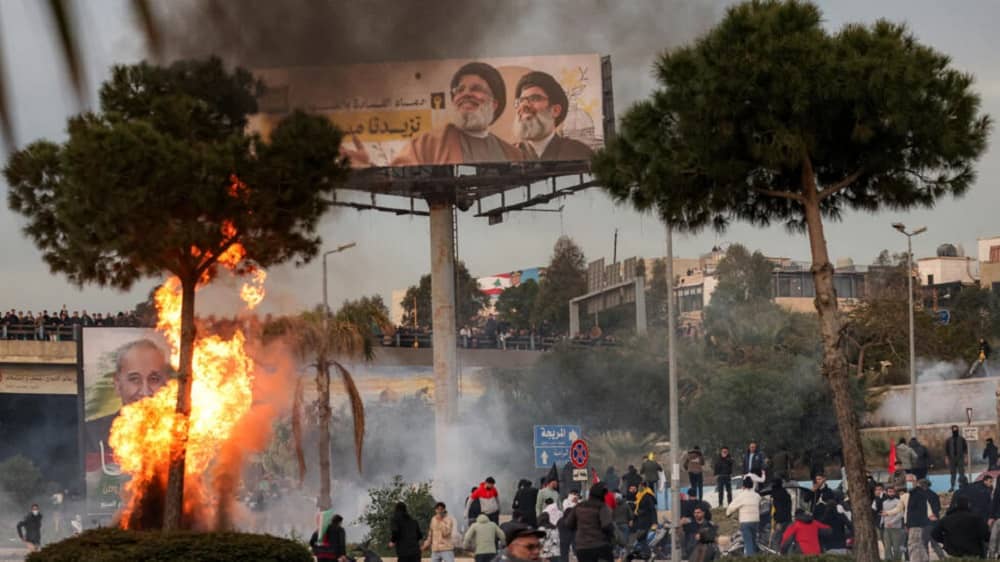
Violent clashes erupted between the Lebanese Army and Hezbollah supporters on February 15 near Beirut’s Rafik Hariri International Airport, following the Lebanese government’s decision to ban Iranian flights from landing in the capital. The confrontation marks a serious escalation in tensions between the Iran-backed militia and Lebanon’s security forces, amid growing public and political resistance to Tehran’s influence in the country.
According to Monte Carlo Doualiya, Hezbollah organized a mass protest blocking access to the airport after Lebanese authorities refused landing clearance to two Iranian planes. The demonstration quickly turned chaotic as protesters attempted to storm security barriers and clashed with army forces, leading to the injury of 23 soldiers, including three officers. Lebanese security forces fired tear gas to disperse the crowd, citing the violation of prior agreements to keep the protest peaceful.
Following the clashes, Hezbollah accused the Lebanese Army of attacking its supporters, claiming that the use of tear gas was an unjustified provocation. In a statement published by Asharq Al-Awsat, Hezbollah denounced the “assault on peaceful citizens” and called for an “urgent investigation” into the army’s actions. The party also demanded the government reverse its decision to ban Iranian flights, insisting that Lebanon must resist foreign pressure.
#Iran News: #Hezbollah Supporters Protest After Lebanese Authorities Block Iranian Flighthttps://t.co/bEtRKVJXht
— NCRI-FAC (@iran_policy) February 14, 2025
Lebanese authorities, however, stood firm on their decision, reaffirming on February 16 that Iranian flights would be suspended until at least February 18. Monte Carlo Doualiya reported that in response, the clerical regime in Iran blocked Lebanese planes from repatriating stranded Lebanese citizens from Tehran, escalating the diplomatic standoff.
In the aftermath of the clashes, the Lebanese Army launched security operations in Hezbollah-controlled areas of southern Beirut, including Burj al-Barajneh, where several arrests were made. Local reports described gunfire and explosions in the area, highlighting rising instability in Hezbollah strongholds. A widely circulated video showed security forces apprehending protest participants, with speculation that some detainees were linked to Hezbollah’s leadership.
#Iran News: #Lebanon Intensifies Airport Inspections to Block Iranian Cash Transfers to Hezbollahhttps://t.co/fCa4Lb52E2
— NCRI-FAC (@iran_policy) February 10, 2025
The events mark a significant turning point in Hezbollah’s relationship with the Lebanese state, as the government under Prime Minister Nawaf Salam and President Joseph Aoun adopts a more assertive approach against the Iran-backed militia. Political analysts quoted in Asharq Al-Awsat noted that the growing pushback from the Lebanese Army and state institutions signals a weakening of Hezbollah’s grip on national security matters.
The Hezbollah-Lebanese Army standoff comes amid mounting regional challenges for Tehran, with the Iranian regime’s proxies facing increasing resistance in Lebanon, Iraq, Syria, and Yemen. Observers suggest that the Lebanese government’s defiance of Iranian demands—backed by the military’s decisive intervention—reflects Tehran’s declining ability to dictate terms in Beirut.
As the Lebanese state asserts itself more boldly, Hezbollah finds itself in one of its most precarious positions in years, raising questions about the future of Tehran’s influence in Lebanon and the broader region.