

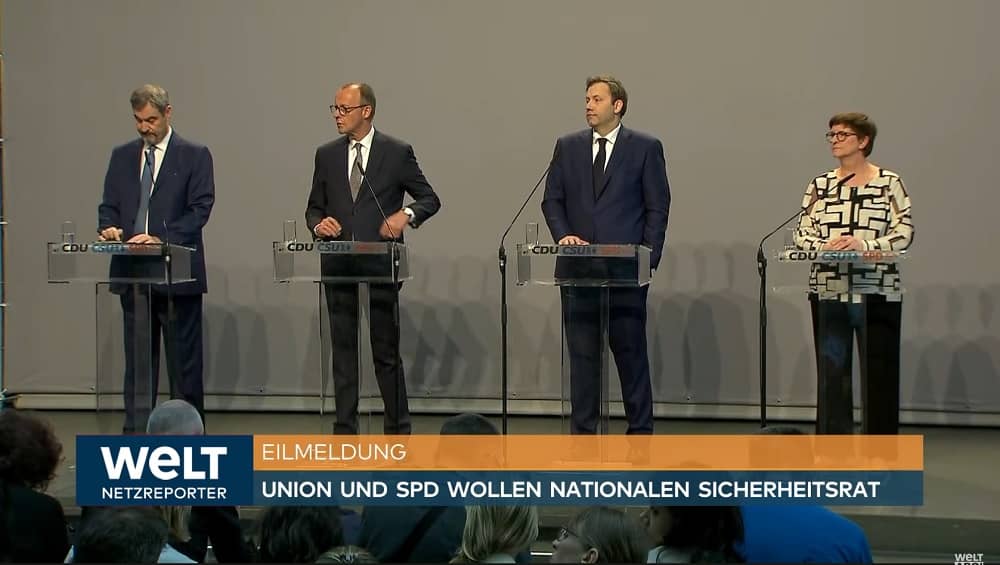
Germany’s new governing coalition has signaled a strong, coordinated stance against the Iranian regime’s nuclear ambitions, ballistic missile program, and support for terrorism, as reflected in the newly published coalition agreements of the country’s leading political parties. The documents underscore the growing resolve in Berlin to confront Tehran’s destabilizing activities.
The Social Democratic Party (SPD) lays out the most direct call for escalation of EU-level pressure, explicitly supporting the designation of the Iranian regime’s Islamic Revolutionary Guard Corps (IRGC) as a terrorist organization: “With our partners France, the United Kingdom and the USA, we will work to ensure that Iran’s nuclear program is ended, the destructive role of the regime in the region is curtailed, and the ballistic missile program is stopped. We support international sanctions against the Iranian regime and continue to strongly advocate for placing the Revolutionary Guards on the EU terror list. We will increase pressure by comprehensively closing sanctions loopholes and by targeted support for human rights defenders, especially women.” (SPD Coalition Agreement 2025–2029, p. 131)
The Christian Democratic Union (CDU) and Christian Social Union (CSU) also reaffirm their commitment to containing Iran’s nuclear ambitions. Their coalition paper supports the ongoing E3+3 diplomacy framework while emphasizing sanctions and verification mechanisms: “We call on Iran to eliminate all doubts about the exclusively peaceful nature of its nuclear program. A nuclear-armed Iran poses a danger to the entire region and beyond and would severely damage global efforts toward disarmament and non-proliferation. We support all efforts within the E3+3 (Germany, France, UK, USA, Russia, China) for a diplomatic resolution to the Iran conflict, adhering to the ‘dual-track’ approach of cooperative offers and targeted sanctions.” (CDU/CSU Coalition Agreement 2025–2029, p. 122)
Together, these positions reflect a hardening stance within Germany’s governing coalition toward Tehran — driven by concerns over nuclear escalation, regional instability, and systemic human rights violations. Both parties signal that Germany will pursue closer alignment with international partners to contain the regime’s threats and confront the regime’s aggressive policies.