

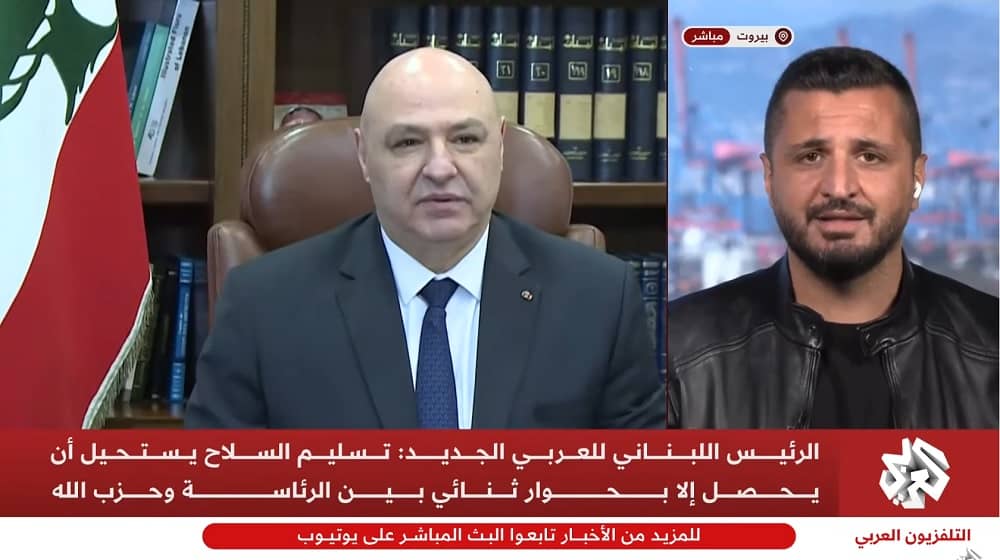
According to a report by Al Araby TV on April 15, 2025, Lebanese President Joseph Aoun announced that the process of disarming Hezbollah is “moving forward effectively” and that “2025 will be the year the Lebanese state monopolizes all weapons.” The statement marks a rare moment of political clarity in Lebanon’s long struggle to reclaim sovereignty from Tehran’s most entrenched proxy force.
The broadcast cited Aoun as confirming that the Lebanese army has been active in southern Lebanon and the Bekaa Valley—traditionally Hezbollah strongholds—where it has closed tunnels and seized weapons caches. Importantly, these operations occurred “without resistance from Hezbollah,” which Aoun framed as evidence that “the path to national arms control is not blocked.”
This is a direct challenge to the Iranian regime, which has long relied on Hezbollah not only as a strategic military asset but also as a political lever inside Lebanon. For decades, Hezbollah has operated as a state within a state—its weapons stockpiles and paramilitary forces entirely outside Beirut’s chain of command. But Aoun’s latest message reflects a shift: that this impunity may finally be ending.
Watch the second episode of this series, picturing why and how the terrorist regime in #Iran created the #Hezbollah. pic.twitter.com/UztKPRe55C
— NCRI-FAC (@iran_policy) January 8, 2024
President Aoun stated that Hezbollah “does not wish to enter a new war” and has refrained from retaliating to Israeli violations. He also said that this position has been conveyed to the United States, implying that Hezbollah—and by extension, Iran—is keen to avoid direct confrontation.
While careful to emphasize that disarmament will not be imposed by force, Aoun made it clear that the only legitimate arms in Lebanon must be under state authority. For the Iranian regime, this signals a growing erosion of influence in a region where its proxies once acted with impunity.
#Iran News: Tehran Uses #Hezbollah Disarmament Talk as Tactical Move to Delay Escalation Before U.S. Talks – Al-Arabhttps://t.co/My1UBWBee6
— NCRI-FAC (@iran_policy) April 11, 2025