

Three-minute read
As the clerical regime in Iran faces deepening domestic turmoil and heightened international pressure, officials and state media have intensified their warnings about foreign threats, signaling a defensive posture against perceived external encroachments. These warnings, filled with aggressive rhetoric and alarmist predictions, reflect the regime’s growing concerns over its vulnerabilities.
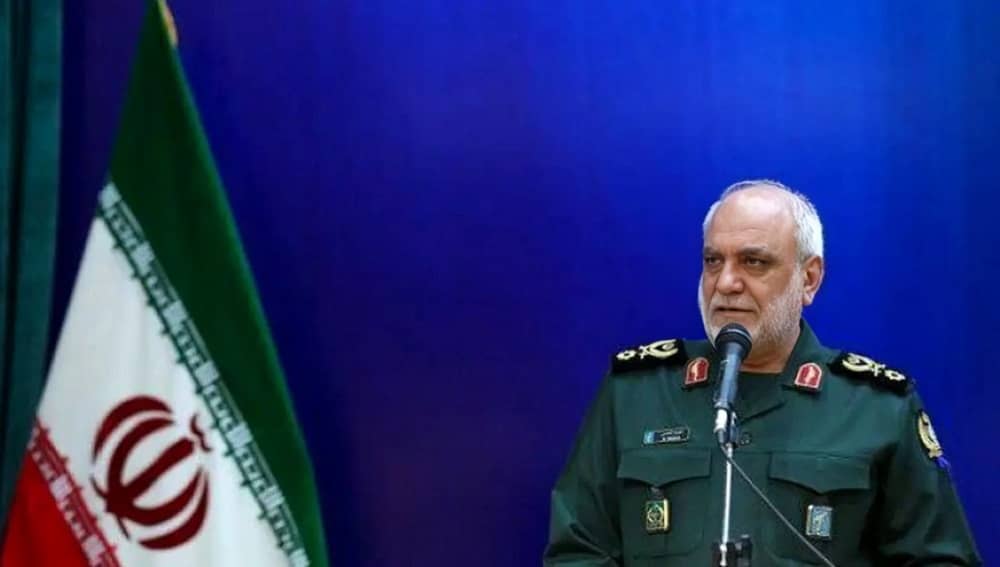
Majid Khademi, head of the Intelligence Protection Organization of the Islamic Revolutionary Guard Corps (IRGC), issued a stark warning on February 12: “If our national interests are threatened, we will put their national interests at risk across the world.”
“Since Trump possesses a certain degree of transparency, he openly expressed the inherent characteristics of the Americans,” Khademi added. “Therefore, as the Supreme Leader has stated, we have no restrictions on engaging with the world; our red line is negotiating with the Americans.”
Escalating Internal Repression
In a speech on February 11, Ahmadreza Radan, the chief of the State Security Forces, attempted to reassure the regime’s demoralized forces by recalling past struggles and framing them as proof of the regime’s resilience. Revisiting one of the regime’s longstanding fears, he fixated on its arch-enemy, the Mujahedin-e-Khalq Organization (MEK/PMOI), using the pejorative term Monafeqin (hypocrites) to vilify them. “Those who called themselves Mujahideen were, in reality, even more hypocritical than the hypocrites,” he said, claiming that the regime’s early security forces “gouged out the eye of sedition” and systematically crushed opposition. Seeking to instill resolve, he warned that “sedition, turmoil, doubt, and hesitation—of any kind—are thorns along the path,” urging security forces to stay vigilant and committed.
#Iran’s Officials Use Bold Rhetoric at 1979 Revolution Rallies to Mask Unprecedented Vulnerabilityhttps://t.co/S3iD9GFBOi
— NCRI-FAC (@iran_policy) February 10, 2025
Meanwhile, Mohammad Ebadi-Zadeh, Supreme Leader Khamenei’s representative in Bandar Abbas, reinforced the regime’s sense of looming threats: “Every year, we say this year is important, but this year is very important. The enemy has been scheming against us. May God never bring the day when they succeed in overthrowing the Islamic Revolution.”
Nuclear Standoff and International Pressure
Parallel to these domestic warnings, the regime is facing renewed international scrutiny over its nuclear program. Farhikhtegan Daily reported on February 11 that Western nations are pressuring the International Atomic Energy Agency (IAEA) to censure the regime’s nuclear activities. “The second phase of Trump’s psychological operation is to push the agency towards issuing a negative report and passing a resolution against Iran,” the newspaper claimed.
In response, Iranian officials and state media have adopted a more confrontational tone, warning of severe consequences if the pressure continues. Tehran has already taken steps to expand its nuclear capabilities, including “increasing the number of advanced centrifuges, initiating gas injection in new facilities, reviving nuclear reactors, and attaining the capacity to produce metallic uranium,” Farhikhtegan noted. The newspaper further emphasized that “Iran insists these actions are within its legal rights, but if Western nations persist with their coercion, Tehran may even consider exiting the Treaty on the Non-Proliferation of Nuclear Weapons (NPT).”
Why #Iran's Regime Cannot Negotiate with the U.S.https://t.co/Saa010Slk8
— NCRI-FAC (@iran_policy) February 9, 2025
This narrative of victimhood is reinforced by Shargh Daily, which on February 11 warned of “difficult days ahead”. The newspaper stressed that “the only way to navigate this narrow passage is through meeting the people’s legitimate demands, fostering social participation, and embracing rational governance and the rule of law.”
Economic Desperation and the FATF Dilemma
Amid worsening economic conditions, former Iranian diplomat Abolfazl Zohrehvand warned against the regime’s accession to the Financial Action Task Force (FATF), linking it to further economic collapse. In an interview aired on state television, Zohrehvand declared: “If we sign it, it will be the beginning of our troubles. We must abandon FATF altogether; a second JCPOA would be dangerous for us.”
Iran’s internal economic crisis is also fueling broader anxieties. Arman Meli reported on February 11 that “if economic problems continue at this pace, social consequences will follow.” Political analyst Majid Abhari warned: “The market for foreign exchange and gold is inflamed. If decision-makers do not act wisely, the situation will deteriorate further.”
#Iran’s Leadership Unites Behind #Khamenei’s Hardline Stance Against U.S. Negotiationshttps://t.co/cNKeSgWHql
— NCRI-FAC (@iran_policy) February 9, 2025
Farhikhtegan Daily also sounded the alarm on February 12 over what it described as Tehran’s failure to adapt its diplomatic strategy to the evolving realities in Syria. The newspaper warned that “the fall of the Assad government in Syria marked a major setback,” emphasizing that without decisive action, Tehran risks being sidelined from shaping the future of the region. The article lamented the regime’s reliance on “clichéd diplomacy” and urged policymakers to devise a concrete strategy to restore lost influence. It further noted that weeks have passed since Syria’s political transformation, yet Tehran remains “waiting to see how the new authorities behave,” a stance it criticized as passive and dangerous. The newspaper cautioned that if this inertia continues, Iran “will find itself removed from the list of influential players in Syria,” effectively losing the strategic foothold it once considered indispensable.
A Regime on its Backfoot
As economic instability, factional infighting, and international isolation deepen, Iran’s leadership has adopted an increasingly combative stance. The repeated warnings from state officials and media indicate a regime under siege, both from within and without. While the rhetoric of defiance may serve as a short-term strategy to rally supporters, the reality remains that Iran is struggling to maintain its grip amid mounting pressures. Whether through economic crises, political infighting, or external isolation, the cracks in the regime’s foundation continue to widen.