

Three-minute read
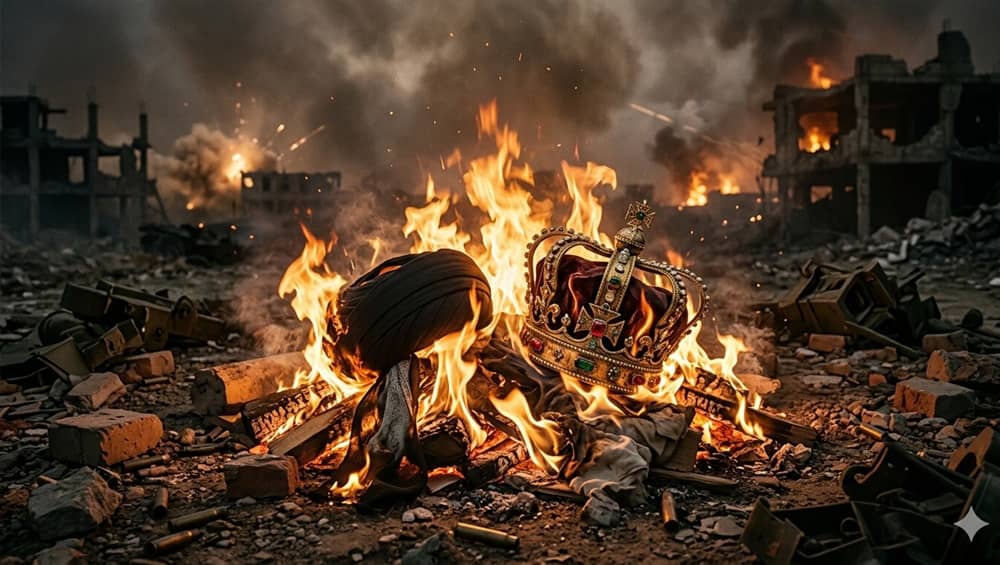
The memorandum of understanding between Tehran and Washington, finalized on June 14–15, 2026, has not brought relief to either of the two forces that bet their futures on the continuation of war. The clerical dictatorship—whose survival architecture depends on permanent crisis—face the terrifying prospect of governing a devastated country in peacetime. The remnants of the Pahlavi monarchy, who staked their relevance on the war’s capacity to topple the regime, watches the military pressure Reza Pahlavi championed give way to a diplomatic outcome he worked to prevent. Both are the biggest losers of the ceasefire.
The Regime Forced to the Table
The clerical dictatorship did not negotiate by choice. It was dragged to the table by the destruction of its military infrastructure, the death of its Supreme Leader, the collapse of its proxy network, and a naval blockade that severed its economic arteries. Left to its own devices, the regime would have remained united in defiance—a defiance rooted not in zealotry but in the most fundamental doctrine of Khamenei’s four decades of rule.
The hardliners who fiercely oppose the ceasefire are not mere ideological fanatics. Their opposition follows a calculated logic inherited from Ali Khamenei, who declared in Mashhad on March 20, 2016:
“When you retreat in the face of the enemy while you can resist him, the enemy will advance. He does not stop.”
He returned to this theme repeatedly. In May 2019: “Negotiating is not a means to eliminate America’s hostility: it is a tool in its hands to apply hostility.” In September 2025, months before his death: “Accepting such negotiations signifies submission, fear, and trembling—a surrender.” This was coherent strategic calculus: any concession opens the door to further demands—today the nuclear program, tomorrow the missiles, then the velayat-e faqih itself. Sitting at the table is, in this worldview, the first step toward dissolution.
"Reza Pahlavi’s open advocacy for foreign military intervention, combined with repeated claims of #IRGC support that have never materialized, reveals a figure whose strategy is not rooted in Iranian society but in foreign powers," @MehdiOghbai writes.https://t.co/OuqH0T7yaR
— NCRI-FAC (@iran_policy) April 10, 2026
The Fracture Peace Detonates
This is why the ceasefire is an existential threat. While war raged, IRGC hardliners maintained near-total control. Under the pretext of national security, they suppressed dissent, silenced the rival wing, and justified the continued immiseration of 90 million Iranians. The Paydari Front wielded the war as a weapon against any voice of compromise.
Now the lid has been removed. The IRGC commanders who built their post-Khamenei power on confrontation find themselves without a battlefield. As Kayhan editor Hossein Shariatmadari—Khamenei’s de facto spokesman—warned: “A ceasefire, compromise and negotiation are a gift to the enemy… talk of a truce will weaken unity, encourage divisions and embolden compromise-seeking currents.” He was right—though not as he intended. Without war to justify suppression, the dormant crises surge back: labor strikes, retiree rallies, the women’s movement, economic catastrophe. The regime’s deepest fear was never the American military. It was the Iranian people.
The Iranian Resistance, which for nearly five decades has sought freedom and peace, welcomes any understanding to end the war and the suffering of the Iranian people. In Iran, no one except the remnants of the mullahs and the Shah has wanted or wants war.
The effort to produce… pic.twitter.com/KAzWfRlbW7
— Maryam Rajavi (@Maryam_Rajavi) June 14, 2026
The Pretender Without a War
Reza Pahlavi, the son of deposed Shah, built his strategy on a single wager: that US and Israeli military force would destroy the regime and deliver him to power. His statements leave no ambiguity. On February 28, 2026, as strikes began: “The aid that the President of the United States promised to the brave people of Iran has now arrived. This is a humanitarian intervention.” At Munich on February 14: “Military action could either weaken the regime or hasten its downfall.” When the April 8 ceasefire was announced, he told supporters: “I know that news of the ceasefire has disheartened many of you.” At his April 23 Berlin press conference: “No deal will solve this. No negotiations will solve this. It is in their DNA.”
His pro-war posture was amplified by a well-resourced ecosystem. Some of the Persian-language, foreign-funded media devoted 81% of their protest coverage to promoting Pahlavi. Yet the gap between his media profile and genuine support inside Iran remained the fatal weakness. The bombs fell, the Supreme Leader died, and the regime still stands. Pahlavi is left with a record of welcoming strikes on his own country, opposing every diplomatic off-ramp, and building a presence inflated by foreign broadcasters and bot networks rather than the will of the Iranian people.
"@Maryam_Rajavi stressed that lasting peace, 'as the Iranian Resistance has stressed for the past 45 years, can only be achieved through the overthrow of the terrorist and warmongering dictatorship of the absolute clerical rule (Velayat-e-Faqih) by the Iranian people and the…
— NCRI-FAC (@iran_policy) April 8, 2026
Who Wins When Both Lose
The January 2026 uprising—in which millions took to the streets before being drowned in blood—marked a turning point. It pushed a large portion of the population irrevocably toward radical regime change by whatever means necessary. That energy has not dissipated; it has been compressed under the weight of war and wartime repression.
The ceasefire removes the compression. And as the war’s outcome reveals the bankruptcy of both the theocracy’s defiance and the monarchy’s reliance on foreign powers, it vindicates only those whose strategy has always been self-reliant, independent, and grounded in the organizational capacity to bring about regime change from within Iran. Neither the turban-clad clerics retreating behind factional barricades nor the exiled prince broadcasting from Maryland possess what the moment demands: a force rooted in the Iranian people, organized for sustained resistance, and beholden to no foreign patron.