

THIS PAGE WILL BE UPDATED WITH THE LATEST NEWS
UPDATE: 8:00 AM CEST
Iranian Dissident Group Welcomes Steps to End War, Says Peace Is ‘Poison’ to Regime Survival
 Maryam Rajavi, president-elect of the National Council of Resistance of Iran (NCRI), on Monday welcomed the emerging U.S.-Iran understanding aimed at ending hostilities while asserting that peace poses a greater threat to the survival of the Islamic Republic than military confrontation.
“The Iranian Resistance, which for nearly five decades has sought freedom and peace, and has, through 133 revelations in the past 35 years, acted as the most important barrier in preventing the ruling theocracy from acquiring the bomb, welcomes any understanding to end the war and the suffering of the Iranian people,” Rajavi said in a statement.
“In Iran, no one except the remnants of the mullahs and the Shah has wanted or wants war,” she added.
Rajavi’s remarks came one day after President Donald Trump announced that the United States and Iran had reached a memorandum of understanding establishing a 60-day framework for negotiations over Tehran’s nuclear program while paving the way for the reopening of the Strait of Hormuz and the lifting of the U.S. naval blockade. The agreement is expected to be formally signed Friday in Switzerland.
Rajavi said the regime’s pursuit of nuclear weapons, support for terrorist proxies, and efforts to destabilize the Middle East are central pillars of its strategy for preserving clerical rule.
PMOI Resistance Units Continue Campaign Across Iran Ahead of Historic June 20 Gathering
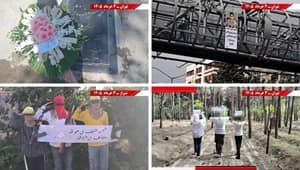
Across Iran, a sweeping campaign of defiance is unfolding. On June 14, 2026, the Resistance Units of the People’s Mojahedin Organization of Iran (PMOI/MEK) continued their extensive operations across the country to commemorate the 45th anniversary of the June 20, 1981, uprising.
This internal mobilization honors a defining historical milestone in the Iranian people’s struggle for freedom and demonstrates profound, on-the-ground solidarity with the impending massive rally of the Iranian Resistance in France. As the regime desperately clings to power through terror, the courageous actions of these units prove that the nationwide resistance movement remains highly active and deeply rooted within Iranian society.
The Resistance Units have showcased significant operational reach, executing their campaign in major cities and provinces spanning the entirety of Iran. Reports of their activities have emerged from Sanandaj, Dorud, Lahijan, Karaj, Sari, Kermanshah, Bandar Abbas, Birjand, Mashhad, Tabriz, Shiraz, Kashan, Fasa, Zanjan, Qazvin, Ahvaz, Isfahan, and Shahreza. In these cities, activists have taken immense risks to install large placards and posters from pedestrian bridges, while others have held banners featuring the images of Iranian Resistance leaders Massoud and Maryam Rajavi.
Iran MOU Sparks Open Infighting Within Regime Ranks
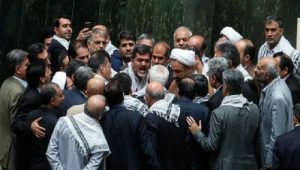
As Tehran and Washington move toward a new memorandum of understanding, criticism from regime insiders and supporters is increasingly spilling into public view, exposing growing divisions within the Iranian establishment.
The announcement of a new memorandum of understanding (MOU) between Tehran and Washington has triggered a wave of criticism and public infighting within Iran’s ruling establishment, with regime supporters, hardline media outlets, and senior political factions openly attacking government officials involved in the negotiations. The controversy intensified after U.S. President Donald Trump announced that Washington and Tehran had reached an understanding and suggested that negotiations were continuing over issues including Iran’s nuclear activities and regional security arrangements.
While Iranian authorities have released few details about the agreement, the lack of transparency has fueled criticism from hardline factions and prompted an increasingly public confrontation between rival camps within the regime.
One of the sharpest attacks came from Hossein Shariatmadari, the Supreme Leader’s representative at Kayhan. In a June 15 editorial titled “Memorandum of Understanding or a Gift to Trump?”, Shariatmadari complained that the Supreme National Security Council had provided almost no information about the contents of the agreement.
Iran’s Food Costs Surge as State Media Warn of Growing Class Divide

For an Iranian family of four, the cost of basic food items now consumes 71.5 percent of the minimum wage. As Iran’s inflation persists, local publications are signaling that the country’s economy is approaching a threshold where the cost of daily survival may soon exceed the total income of a working-class household.
Reports published by Iran’s state-affiliated media on June 9 and June 10, 2026, provide a stark look at this decline, documenting soaring prices and the rapid erosion of government-provided safety nets.
The government’s ““food basket“” program—a metric used to track the cost of essential calories—has become a primary indicator of the crisis. According to Eghtesad News, the cost of a single-person basket rose from 2.576 million tomans (approx. $14.75) in December 2025 to 5.034 million tomans (approx. $28.83) in May 2026.
Feminization of Poverty in Iran Under War and Inflation

Iranian Women’s Share of the International Day of Family Remittances; Feminization of poverty in Iran under the shadow of inflation. June 16 has been designated by the United Nations as the International Day of Family Remittances; a day when the importance of financial stability and household welfare is emphasized worldwide. However, an examination of the economic realities reveals a completely critical picture, where destructive policies have fueled an unprecedented expansion of the feminization of poverty in Iran.
The systematic exclusion of women from the economic cycle and the destruction of household income have directly led to a dangerous phenomenon known as the “feminization of poverty.” In a report titled “When Poverty Takes on a Female Face,” the state-run website Asr Iran quotes the vice-president of the National Union of Female Workers, admitting to the roots of the crisis of women’s poverty in Iran: “While Iran’s economy has not yet recovered from the shocks of war, stagnation, and long-term internet disruptions, fresh signs of the ‘feminization of poverty’ and the expansion of unemployment among female workers have emerged…”
Iran: Critical Situation of Women Detained During Nationwide Protests
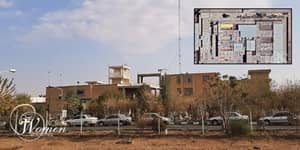
Reports indicate a worsening situation of the women detained in Langroud Prison in Qom, a facility that has become one of the main detention centers for women arrested following the nationwide protests of January 2026.
A large number of women political prisoners are being held in Langroud Prison, including young women and even girls under the age of 18.
Many of these detainees remain in a state of legal uncertainty. Many face charges, including participation in nationwide protests, organizing gatherings, leading street demonstrations, or damaging facilities affiliated with the ruling authorities. However, there is little clear information available regarding the legal status of a significant number of these prisoners or the progress of their cases.
A considerable number of these political prisoners are under the age of 20, and serious concerns remain about the circumstances of some of them. The continued detention of minors in inadequate conditions, combined with prolonged uncertainty surrounding their legal cases, has raised significant legal and humanitarian concerns.
Iran’s Defining Choice: The Democratic Alternative Beyond Monarchy and Theocracy
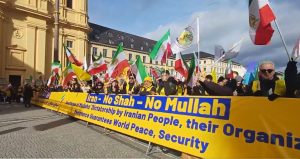
For nearly five decades, Iran has been shaped by a profound political conflict whose significance extends far beyond a simple contest for power. What stands before the Iranian people today is the culmination of 47 years of resistance, sacrifice, political experience, and historical testing. Understanding this reality—and distinguishing between authentic democratic forces and deceptive alternatives—is essential to identifying the path toward the overthrow of the ruling clerical regime and the establishment of a free Iran. The current political landscape is not a blank slate. It is the result of decades of struggle between two opposing visions: one represented by the system of Velayat-e Faqih and its mechanisms of repression, and the other embodied in the democratic forces that reject all forms of dictatorship, whether religious or monarchical.
The strategic priority of the clerical regime’s political apparatus has become increasingly clear. After decades of testing every available method of repression, propaganda, and manipulation, the regime understands that its greatest threat is not foreign pressure or internal factional disputes. Its greatest threat is the emergence of a credible, independent democratic alternative capable of connecting with Iranian society.
Iran’s Child Labor Crisis: When Poverty Steals Childhood and the Future
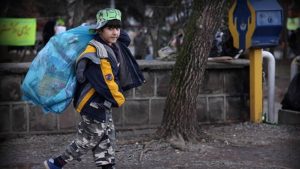
Behind every child selling flowers at a traffic light, sorting garbage in a recycling center, carrying heavy loads in a marketplace, or weaving carpets in a remote village lies a painful reality: the systematic failure of a state that has abandoned its responsibility to protect its most vulnerable citizens.
While much of the world has made significant progress in reducing child labor, Iran is moving in the opposite direction.
According to child rights activists, worsening poverty, rising school dropout rates, weak social support systems, and the absence of transparent statistics have transformed child labor into one of Iran’s most severe and persistent social crises. The situation has become even more alarming in the wake of recent economic shocks and wartime disruptions, which have accelerated the number of children leaving school and entering the labor market.
The growing presence of child workers is not merely a symptom of economic hardship. It is a reflection of deeper structural failures that have accumulated over decades and now threaten the future of an entire generation.
Cyberattack on Iranian Regime Banks Causes Widespread Disruptions in Banking Services

A cyberattack seriously affected the financial resources of the Iranian regime. A widespread disruption in Iran’s banking network beginning in the early hours of Saturday, June 13, caused the suspension of part of the country’s banking services nationwide. Reports indicate that the disruption resulted from a cyberattack and affected four of the country’s largest banks.
According to state-run media reports, the services of Bank Melli Iran (National Bank), Bank Saderat Iran, Tejarat Bank, and Export Development Bank of Iran have experienced widespread problems since the early hours of the morning. As a result of the disruption, many customers have been unable to access mobile banking, online banking, and other electronic services.
Reports also indicate disruptions in point-of-sale payment terminals and difficulties in processing financial transactions across various parts of the country, causing confusion among citizens and disrupting routine commercial activities.
Livelihood Protests Erupt Across Iran Again
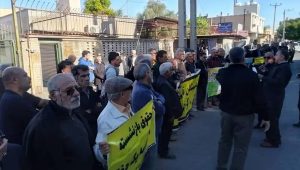
Protests once again flared up in cities across Iran. As economic crises deepened and livelihood pressures increased, various Iranian cities witnessed protest gatherings by different social and occupational groups on Sunday, June 14. Retirees, bakers, motorcycle delivery drivers, and victims of an economic fraud case took to the streets with different demands but a common underlying grievance, protesting the authorities’ failure to address their concerns. The breadth of these protests once again demonstrated that livelihood-related protests have become one of the most significant expressions of public dissatisfaction in the country.
A group of victims of the “Fardadkar Amitis” company gathered in front of the Tehran Prosecutor’s Office to protest the prolonged handling of their case. The protesters say that despite six years having passed since the case was opened, it has still not been referred to court.
According to the protesters, the delay in judicial proceedings has not only imposed heavy financial losses on them but has also caused significant emotional and psychological hardship for the families involved. They called for an immediate resolution of the case and the start of judicial proceedings.