

THIS PAGE WILL BE UPDATED WITH THE LATEST NEWS
UPDATE: 8:30 AM CEST
Iranian Political Prisoners Support Resistance Telethon from Inside Prison Walls
In August 2026, defying the regime’s severe repression and a wave of executions following recent uprisings, political prisoners in Ghezel Hesar and Central Karaj prisons sent messages of support to the 30th national telethon of Simay-e Azadi (INTV), the television network of the Iranian Resistance.
The ability and willingness of political prisoners to communicate with a banned opposition network from inside the regime’s most notorious prisons proves that the regime’s campaign of terror has utterly failed to break the morale of the Iranian resistance.

Simay-e Azadi relies entirely on donations from the Iranian people—both inside and outside the country. This financial support guarantees the political independence of a movement that relies solely on the will and capacity of the people and is not dependent on foreign powers.
During the 30th telethon, citizens took immense risks to contribute. A courageous member of the Resistance Units from Isfahan contacted the network, stating they proudly donated 100 million rials for the organization’s telethon, wishing for the freedom of Iran through the Iranian Resistance and sending their greetings to Resistance leaders Massoud and Maryam Rajavi.
How Government Corruption Turned Iran’s Oil Wealth into a Chain of Economic and Institutional Crises
How does a country blessed with some of the world’s largest oil and gas reserves find itself trapped in a quagmire of chronic inflation, currency devaluation, systemic corruption, and a massive exodus of human and financial capital, rather than standing at the pinnacle of development? Answering this requires moving beyond surface-level economic concepts and diving into the deep layers of “political economy.”
A close look at Iran’s economy demonstrates how oil revenues, in the absence of democratic and transparent institutions, led to the formation of a “rentier state.” A cascade of crises followed one another, beginning with Dutch disease and the destruction of domestic production, leading to budget deficits and money printing, and resulting in structural inflation.
Ultimately, it culminated in the state’s capture by a military-security oligarchy, fostering crony capitalism, monopolies, and the irreversible flight of elites and capital. Iran’s economic problem is not a lack of resources; it is the governance of those resources.
Iran’s Regime Is Trapped in the Predicament of Overthrow
There is a fundamental difference between saying that the Iranian regime must eventually be overthrown and saying that it is now trapped in the predicament of overthrow.
The first has been a political reality for decades. The second describes the regime’s present condition. Since June 1981, when the regime closed the remaining avenues for political competition and entered an era defined by mass executions, repression, and systematic violence, its survival has depended on suppressing its opponents rather than resolving the crises that produced opposition in the first place.
For decades, however, the regime managed to survive. It repeatedly adapted its methods, shifted its tactics, exploited international circumstances, and used crises to postpone its reckoning with the Iranian people.
That period may now be coming to an end.
The regime today appears to be approaching what can be described as the “predicament of overthrow”: a situation in which the mechanisms that once prolonged its survival are increasingly contributing to its vulnerability.
Iran Regime’s Security Shake-Up Exposes Growing Power Struggle and Internal Weakness
The abrupt replacement of Mohammad Bagher Zolghadr by Mohsen Rezaei as secretary of Iran’s Supreme National Security Council has exposed growing tensions at the highest levels of the regime and highlighted its increasing reliance on the Islamic Revolutionary Guard Corps (IRGC) to manage mounting political and security crises.
The appointment came after several days of conflicting reports, denials, and unexplained reversals concerning Zolghadr’s position. The contradictory accounts have fueled speculation that the change was not a routine administrative decision but the outcome of a power struggle between President Masoud Pezeshkian and the emerging power structure surrounding Supreme Leader Mojtaba Khamenei.
According to reports published inside Iran on Sunday, August 9, an order attributed to Mojtaba Khamenei appointed Rezaei as his representative on the Supreme National Security Council. Hours later, Pezeshkian formally appointed Rezaei as secretary of the council.
The sequence of events was significant. It suggested that the presidency was effectively compelled to accommodate a decision originating from the new leadership structure.
Fresh Warning Over Continued IRGC Attacks on Commercial Shipping

The Joint Maritime Information Center (JMIC) said that attacks and harassment by Iran’s Islamic Revolutionary Guard Corps (IRGC) against commercial shipping in the Strait of Hormuz are continuing.
According to the notice, these activities include radio contact with vessels, drone flights over them, and targeted monitoring of commercial ships.
The center wrote that such behavior indicates that Iran’s regime seeks to consolidate its presence along key routes and maintain pressure on transiting vessels. The threat level in the Middle East maritime region was assessed as “severe.”
According to the same notice, kinetic activity, including projectile impacts and near-miss explosions, has continued along Oman’s southern routes between Limah, Khasab, and Kamzar.
The notice, covering the period from March 1 to August 9, was issued by the United Kingdom Maritime Trade Operations (UKMTO), the primary authority for receiving and disseminating reports of maritime incidents in the region.
Aref Khoshkar’s Case: Execution of an Innocent Protester to Suppress Society
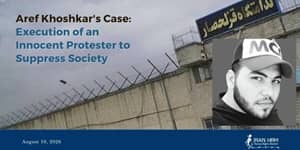
Aref Khoshkar, a detained protester from the 2022 protests, was tried by the judiciary of the Islamic Republic of Iran on charges of killing a Basij member during the protests and was sentenced to death. Aref Khoshkar was arrested in the Fallah neighborhood of Tehran on November 11, 2022, and was hanged in Ghezel Hesar Prison on July 15, 2026. Examining the documents of Aref Khoshkar’s case—who is one of dozens of protesters being hanged while innocent, solely to suppress society and prevent massive social protests—clearly illustrates how Iran’s judiciary has transformed into a tool for the survival of its rulers. A dangerous precedent that, if not halted by the international community, will undoubtedly spread rapidly to other non-democratic regimes; because they will know there is no accountability and that they can freely violate human rights and the right to life to whatever extent they wish without facing any practical accountability from the international community.
Documents obtained from Aref Khoshkar’s trial and their examination clearly indicate that the judgment issued by Branch 13 of the First Criminal Court of Tehran contained serious ambiguities regarding the identity of the shooter, the type of weapon, the correlation between the forensic report and available evidence, the manner of relying on witness testimonies, and the basis for attributing the murder. Despite this, the sentence of Qisas (retribution in kind / execution) was issued and carried out in this case.
Iran Had $379 Billion in Current-Account Surpluses. Much of It Never Reached the Domestic Economy
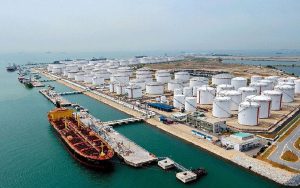
Three decades of foreign-currency surpluses, hundreds of billions of dollars in capital outflows, the mounting debt of the country’s largest revenue-generating company, and another surge in inflation raise a question: if the problem was simply a lack of resources, where did all that money go?
Economic documents published in Iran show that the country’s inflation and cost-of-living crisis cannot be explained simply by a “lack of money.” Iran has had access to vast foreign-currency resources over the past several decades, but capital flight, inefficient financial structures, uncertainty, and inflationary monetary and fiscal policies have prevented a large share of those resources from being converted into investment, real income and economic security for households.
Between 1997 and 2025, Iran exported about $2.34 trillion worth of goods and services. Imports over the same period totaled nearly $1.98 trillion, while the country’s current account, according to Central Bank figures reviewed by Donya-e Eqtesad, recorded a surplus of about $379.5 billion. But $228 billion — roughly 60% of that surplus — either left the country as capital outflows or never returned to Iran’s domestic economy.
Toronto Rally Marks 38th Anniversary of 1988 Massacre and Demands End to Executions in Iran
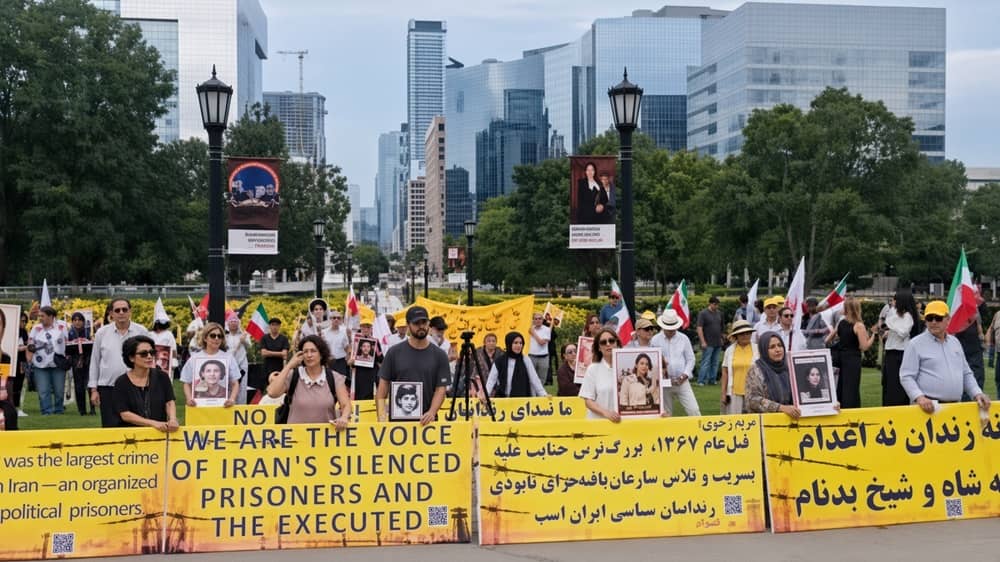
On August 8, 2026, Iranian-Canadian supporters of the Iranian Resistance — the National Council of Resistance of Iran (NCRI) and the People’s Mojahedin Organization of Iran (PMOI/MEK) — gathered at Queen’s Park South Lawn in Toronto for a rally marking the 38th anniversary of the 1988 massacre of political prisoners in Iran and expressing solidarity with the “No to Executions” campaign. The event, held at 3 p.m., paid tribute to the approximately 30,000 political prisoners executed without due process that summer and condemned the continuing wave of executions targeting protesters and political opponents in the country.

Participants remembered every life lost in the 1988 extrajudicial killings and stood with the families still seeking truth and justice. Organizers highlighted that repression has not stopped: 77 executions were recorded in Iranian prisons in July 2026 alone. Speakers emphasized that the people of Iran deserve freedom, justice, due process, human dignity, and the right to determine their own democratic future. A central demand of the demonstrators was the rejection of both monarchical dictatorship and the mullahs’ dictatorship, while stressing that the 30,000 victims of 1988 continue to await accountability.
Gothenburg Gathering Marks Iran’s Constitutional Revolution, Rejects All Forms of Dictatorship
Gothenburg, Sweden – August 8, 2026: Supporters of the People’s Mojahedin Organization of Iran (PMOI/MEK) gathered to commemorate the Constitutional Revolution of 1906. The movement sought to establish representative government, strengthen the rule of law and place limits on absolute political power.

The participants, chanting slogans against the monarchical dictatorship, particularly in the aftermath of Iran’s Constitutional Revolution, when the achievements of that revolution were trampled upon and an era of dictatorship and dependency was once again imposed on Iran, paid tribute to the leaders of the Iranian people’s freedom movements, from Sattar Khan and Bagher Khan to Dr. Mohammad Mossadegh.