

 NCRI – A deal was signed on June 15 with three Iranian companies in the southern region of Osalouyeh to develop 6 phases of South Pars oil and gas field, equivalent to 8 standards phases. The clerical regime’s President, Mahmoud Ahmadinejad, described the deal as the “most proud moment in Iran’s history.” He also derided foreign firms and vowed that Iranian companies will finalize all the phases in the next 35 months.
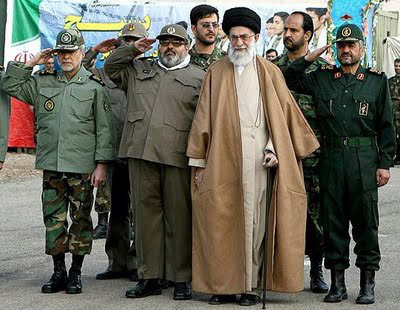
Neither Ahmadinejad nor state-run media have uncovered the names of the Iranian companies involved in the deal. But, some news outlet have revealed that the majority of the deal has been awarded to the regime’s Islamic Revolutionary Guard Corps (IRGC), which is tasked with domestic suppression.
The official website of Iranian state-run TV has indicated that the deal is worth over 21 billion dollars and the main party involved is the IRGC’s financial arm, Khatam al-Anbia Base. The fourth round of UN sanctions against the Iranian regime recently approved by the Security Council has banned all deals and links with the IRGC.
Two other companies standing to benefit from the deal are the “Industrial Development and Renewal Organization” and Petropars Company, which is an affiliate of the National Oil Company of Iran.
Previously, the British-Dutch Royal Shell company and Spain’s Repsol were supposed to jointly develop phases 13 and 14, but after the adoption of the more severe UN sanctions this month, international firms backed away from signing deals with the Iranian regime.
The Khatam al-Anbia company was formed during the eight-year Iran-Iraq war in the 1980s as a construction company and did not start out as a player in the oil sector. However, in recent years, and specially after the disputed presidential elections in Iran which brought Ahmadinejad to power for a second term, the IRGC’s financial arm has extended its reach into the highly profitable oil and gas sector.
Almost a year into Ahmadinejad’s first term in office, senior IRGC officials were awarded a 1.3 billion dollar contract for transferring gas. The deal cemented the IRGC’s place in the oil sector. The Ahmadinejad government awarded the development of the three phases of South Pars through an obscure process exclusively to Khatam Base in addition to two phases jointly with two other domestic companies.
Having been awarded 6 phases of the South Pars gas field, the IRGC-affiliated company has now become the de facto economic powerhouse in Iran.
International sanctions gave the Ahmadinejad government and his allies in the IRGC the opportunity to extend their influence in South Pars, which is the largest oil and gas project in Iran, filling the vacuum left by an exodus of large international firms.
But, even after the signing of the recent deals, experts continue to express doubt that Iranian companies possess sufficient management and technical expertise or resources to bring the projects to fruition. The operation involves more than 200 million square meters of gas.
It seems implausible for Khatam Base to complete such an enormous project in view of its deficiency of the required management expertise and technical experience, not to mention the multitude of financial challenges faced by the Iranian regime.