

 NCRI – Foreign ministers of the world’s most powerful countries were gathered in Berlin Thursday to demonstrate a united front over Iran’s disputed nuclear program after a breakthrough deal at the UN.
The talks bring together Britain, China, France, Russia and the United States — the United Nations Security Council’s five veto-wielding permanent members (P-5) — plus Germany, one of three European powers that have pursued nuclear talks with Tehran.
The 15-member Security Council on Wednesday unanimously approved a non-binding statement giving Iranian regime 30 days to abandon its uranium enrichment activities, ending a weeks-long impasse.
Germany called the talks in Berlin to map out a long-term strategy on how to contend with mullahs’ refusal to halt uranium enrichment, which could be used to build a nuclear bomb.
The working lunch in Berlin will bring together US Secretary of State Condoleezza Rice, German Foreign Minister Frank-Walter Steinmeier, Jack Straw of Britain, Philippe Douste-Blazy of France, Sergei Lavrov of Russia, Chinese deputy foreign minister Dai Bingguo and EU foreign policy chief Javier Solana.
The statement that finally prevailed is a watered-down version of a Franco-British statement that calls on Iranian regime to meet demands from the UN nuclear watchdog, the International Atomic Energy Agency (IAEA).
Rice greeted the Security Council statement as "unmistakeably clear". She added that the international community expects Iran to comply with the International Atomic Energy Agency’s call to suspend its uranium enrichment-related activities and to return to negotiations.
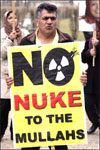
While world power foreign ministers met in Berlin supporters of the Iranian Resistance held a rally outside the German Foreign Ministry to call for tough measures against the Iranian regime. The participants also gave their support to Mrs. Maryam Rajavi’s plan for democratic change in Iran through people and their resistance.