

Three-minute read
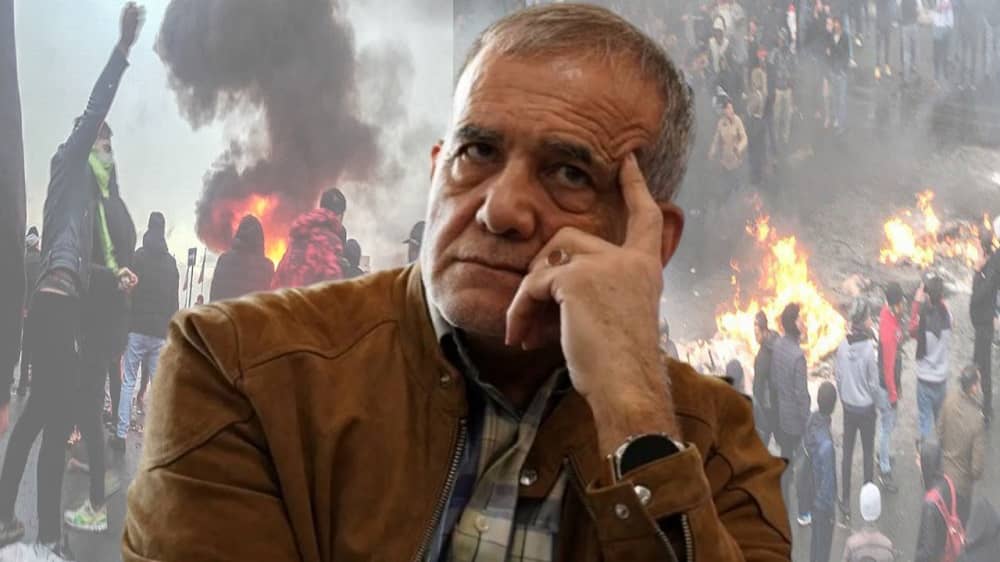
Masoud Pezeshkian, the Iranian regime’s newly appointed president, has made it clear that his administration will adhere strictly to the policies and directives of Supreme Leader Ali Khamenei. In a series of recent speeches and actions, Pezeshkian has signaled his commitment to carrying out Khamenei’s agenda, a strategy that, given Iran’s current political, social, and economic turmoil, will only serve to ignite further unrest and potential uprisings.
On August 27, 2024, Pezeshkian openly criticized the current economic situation, specifically targeting the subsidized fuel prices that have long been a point of contention in Iran. “There is no logic in buying gasoline at the free market price in dollars and selling it at a subsidized rate,” he stated, expressing frustration over the financial strain on the government, which he claims lacks the funds for essential commodities like wheat, medicine, and pensions.
Pezeshkian’s remarks signal a push towards raising fuel prices, a move that has already sparked considerable alarm among the public and within the regime itself.
Following Pezeshkian’s comments, the state-run newspaper Haft-e Sobh highlighted the immediate backlash, stating, “Everyone knew that Pezeshkian would eventually address the issue of gasoline, but not this soon. He finally touched on gasoline, and suddenly there was an uproar with opposition heard from all sides.” Reflecting on the potential consequences of such a policy, the newspaper added, “Even the proponents of price liberalization are afraid of the turmoil of 2019… No matter how much the government endures chaos and protests to increase gasoline prices, it will only temporarily cover the wound with official inflation at 80%.”
Watch and judge why this insider is warning that the regime is destined for a collapse or #IranRevolution pic.twitter.com/Ysu6LbOhnz
— NCRI-FAC (@iran_policy) January 1, 2024
The reference to the 2019 protests is particularly telling. In November of that year, the sudden tripling of gasoline prices under President Hassan Rouhani led to widespread protests that rocked the nation. The swift and brutal response by security forces, which resulted in over 1,500 deaths, failed to dampen but deepened the rage of an explosive society.
Farheekhtegan Daily, associated with Ali Akbar Velayati, a senior advisor to Khamenei, commented on August 29, “In the Rouhani administration, the gasoline price was subjected to shock therapy… Unlike the experience of the Ahmadinejad administration, the gasoline shock therapy in November 2019 (even with the added impact of COVID-19) failed to create a long-term reduction in gasoline consumption, and now gasoline consumption is back to its previous long-term trend.”
The state-run website Jamaran News wrote, “Making decisions about gasoline prices and addressing a deficit of over $4 billion in this sector is not something that can be done easily. Economic issues are interconnected like a chain, and one wrong move can create a domino effect of consecutive errors.”
Trying to walk back Pezeshkian’s statements, the Iran newspaper, the government’s mouthpiece, wrote on August 29, “Society is sensitive to any news about gasoline, especially if it is attributed to the president. In the current administration, there will be no shock therapy or surprises for the public in any area. If, in the future, a decision is made to address structural deficiencies, such as gasoline prices, and steps are taken accordingly, those steps will certainly be taken with the people’s support.”
Watch and judge how this insider is warning that #IranRevolution is at the regime's doorsteps. pic.twitter.com/C8ywVnrVJN
— NCRI-FAC (@iran_policy) November 3, 2023
Additionally, Pezeshkian has been vocal about his unwavering loyalty to Khamenei’s overall directives. While meeting with Khamenei on August 27, Pezeshkian emphasized the importance of unity and strict adherence to the Supreme Leader’s vision and policies. He stated, “If we adhere to the Constitution, the vision outlined by Your Excellency, and the policies and programs that have been announced, and if we move together in this direction, we should have a country that is inspirational.”
Furthermore, on August 28, Pezeshkian emphasized the need for tighter control over cyberspace, aligning with Khamenei’s recent concerns about the state of the internet in Iran. Pezeshkian instructed his ministers to take the Supreme Leader’s remarks seriously, saying, “Standing with the people never means being populist.”
During the August 27 meeting with the Pezeshkian government, Khamenei called for stricter regulation of the Internet. However, Pezeshkian’s stance on managing cyberspace sharply contrasts with his earlier criticisms of internet censorship during the presidential debates, where he had acknowledged the economic impact of such restrictions.
#MasoudPezeshkian’s Economic Policies: A Catalyst for Unrest and Uprising in #Iranhttps://t.co/8rJDXtdQSp
— NCRI-FAC (@iran_policy) August 29, 2024
Meanwhile, during the introduction ceremony of the new Minister of Interior, Masoud Pezeshkian heavily praised Ahmad Vahidi, the former Minister of Interior. He stated, “I thank our dear brother General Vahidi once again… We must help each other. We are all in the same boat, making efforts together.”
Pezeshkian’s praise comes even though Ahmad Vahidi is wanted by Interpol for his involvement in the 1994 bombing of a Jewish community center in Buenos Aires, Argentina, which resulted in the deaths of 85 people.
As Pezeshkian continues to implement Khamenei’s hardline agenda, it is clear that his policies are more likely to exacerbate public dissatisfaction rather than quell it. By pushing for fuel price hikes, intensifying internet censorship, and adhering strictly to Khamenei’s directives, Pezeshkian is practically refusing to address the economic and social needs. In his quest to execute Khamenei’s vision to preserve the regime, Pezeshkian is ironically steering Iran towards a new chapter of unrest and uprising.