

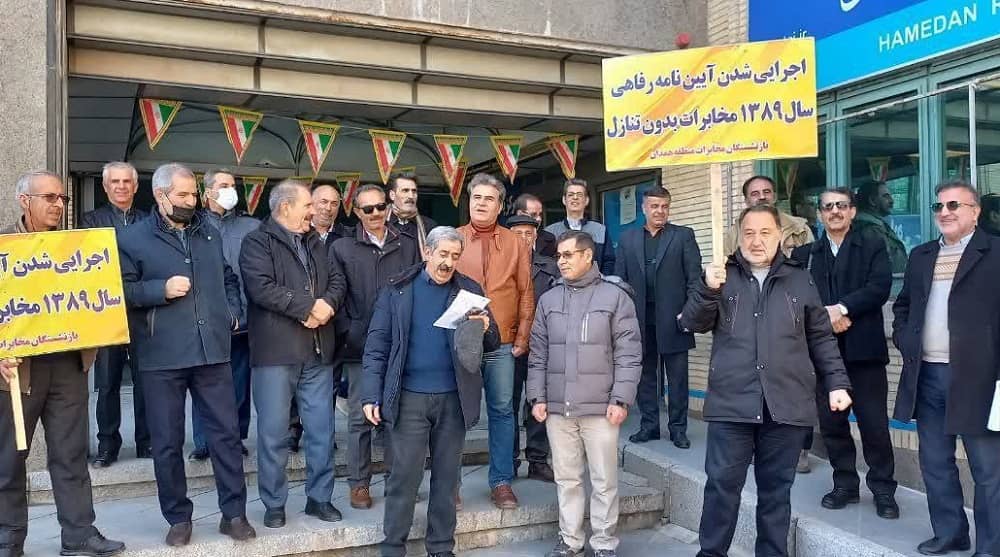
On Monday, February 3, 2025, retirees of Iran’s telecommunications sector staged widespread protests across multiple provinces, while industrial workers in Tabriz launched a strike, underscoring the growing unrest over economic grievances and government inaction. These demonstrations, which have become a recurring feature of Iran’s socio-economic crisis, took place in at least 14 cities, including Tehran, Tabriz, Ilam, Hamedan, Kermanshah, Bijar, Zanjan, Sanandaj, Shiraz, Ahvaz, Lorestan, Marivan, Hamedan, Chaharmahal and Bakhtiari, and Kurdistan.
The protests by telecom retirees were sparked by ongoing disputes over unpaid benefits, pension rights, and the privatization of Iran’s telecommunications industry, which they argue has stripped them of their rightful entitlements. Retirees gathered in front of telecom offices and government buildings, holding banners with messages such as:
- “Telecom Company, fulfill your promises!”
- “No compromise, no surrender—implement the regulations!”
- “Where is my right? Thirteen years have passed!”
- “We will keep coming every Monday until we get our rights!”
February 3—Hamedan, western Iran
Retirees of the Telecommunication Company of Iran (TCI) hold protest rally in front of TCI's provincial headquarters as authorities refrain from addressing their demands for higher pensions and basic services.#IranProtests pic.twitter.com/iA8BEhrvkt— People's Mojahedin Organization of Iran (PMOI/MEK) (@Mojahedineng) February 3, 2025
In Tehran, protestors chanted, “Our enemy is right here, they lie when they say it’s America!”—a direct rebuke to the regime’s narrative that blames external forces for Iran’s economic struggles. Demonstrators also condemned the role of regime-linked financial institutions in exacerbating their plight, specifically targeting Setad Ejraei Farman Imam (Execution of Imam Khomeini’s Order) and Bonyad Taavon Sepah (IRGC Cooperative Foundation), the two major stakeholders in the privatized telecom sector.
One of the most persistent demands has been the implementation of the Article 89 Pension Regulation, which mandates better benefits and pension adjustments. Protestors accuse telecom management of delaying payments while their financial burdens continue to rise.
More footage of the attack by the regime's criminal security forces against the impoverished people of towns in Sistan and Baluchestan.#Iranpic.twitter.com/X6MJFSMHkZ
— People's Mojahedin Organization of Iran (PMOI/MEK) (@Mojahedineng) February 3, 2025
In Tabriz, workers from the Charkheshgar Company, a manufacturer of industrial machinery, went on strike over low wages and deteriorating working conditions. Iran’s industrial sector has been plagued by economic mismanagement, inflation, and a lack of government support, leaving many workers unable to sustain their livelihoods.
The striking workers demand salary increases that align with inflation, improved benefits, and the settlement of outstanding payments. In past strikes, authorities have responded with intimidation tactics rather than addressing core labor grievances.
The wave of demonstrations highlights the worsening financial crisis in Iran. The ongoing economic turmoil, exacerbated by corruption and inflation, has deepened public frustration with the government.
February 3—Sanandaj, western Iran
Retirees of Telecommunication Company (TCI) of Iran resume weekly protest rallies, demanding higher pensions and other basic rights that the regime is supposed to provide according to its own laws.#IranProtests pic.twitter.com/P22imySDeu— People's Mojahedin Organization of Iran (PMOI/MEK) (@Mojahedineng) February 3, 2025
Authorities have so far ignored retirees’ demands, and despite repeated promises, pension reforms remain unimplemented. However, protesters have vowed to continue their weekly demonstrations, reinforcing the persistence of Iran’s growing labor and pensioner movement.
As economic pressures mount, Iran’s ruling establishment faces an increasingly mobilized opposition, where pensioners, workers, and other marginalized groups are becoming vocal agents of dissent against the regime’s economic policies and broader governance failures.