

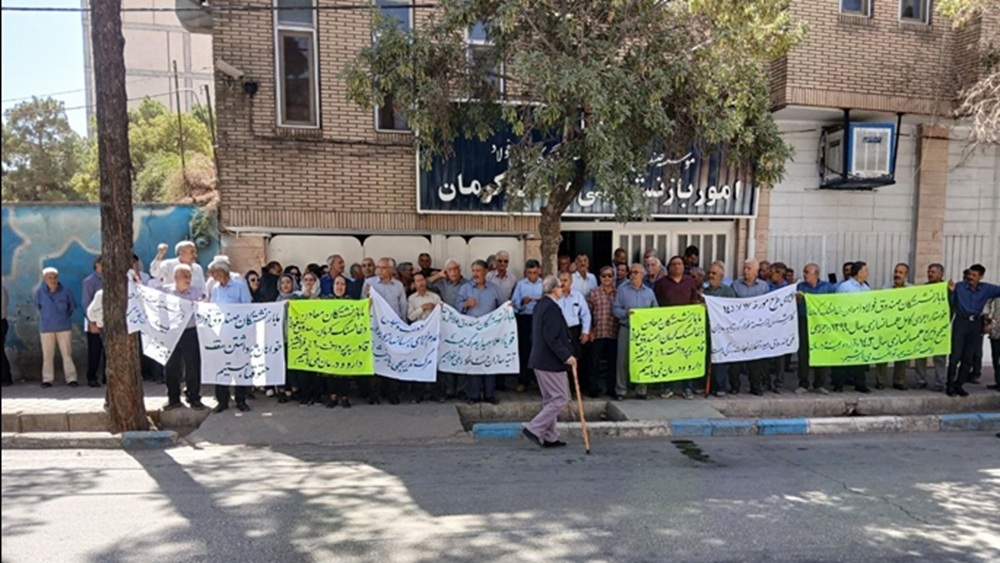
On August 31, 2025, a powerful wave of protests swept across Iran, revealing the profound depth of public fury and the utter failure of the clerical regime to address the nation’s compounding crises. From the industrial heartlands of the south to the agricultural centers and the capital itself, Iranians from every social stratum—retirees, oil workers, farmers, students, and professionals—took to the streets.
These demonstrations, erupting in cities like Tehran, Isfahan, Kerman, and Ahvaz, delivered a resounding verdict on the entirety of the regime. They proved that the Iranian people’s grievances are not with a single official but with the corrupt and incompetent system, led by Supreme Leader Ali Khamenei.
Retirees Flood the Streets Demanding Dignity
Nowhere was the outrage more palpable than among the nation’s retirees, the very generation that built Iran’s modern infrastructure. In a coordinated display of defiance, pensioners from the steel, mining, and social security sectors held major rallies in Isfahan, Kerman, Shush, Tehran, Ahvaz, and Rasht.
August 31—Shush, southwest Iran
Weekly protest rally by retirees of the Social Security Organization. Protesters demand higher pensions and basic services while the regime ignores their plight.#IranProtestspic.twitter.com/XFUAjOYmrK— People's Mojahedin Organization of Iran (PMOI/MEK) (@Mojahedineng) August 31, 2025
In Isfahan, their anger was aimed directly at the new administration, as they marched and chanted a slogan that encapsulates the nation’s disillusionment: “Hey Mr. President, you lied to the nation!” Their demands were not radical; they were cries for basic survival and dignity.
Protesters called for the full implementation of pension equalization laws, the removal of caps on their benefits, and access to adequate healthcare. In Shush and Ahvaz, retirees condemned the looting of their pension funds, asking how a “once-profitable” Social Security fund could be driven to bankruptcy, now delaying payments by as much as five months.
Widespread Labor Unrest
The protests extended deep into Iran’s economic core, exposing a state teetering on the brink of insolvency. In Gachsaran, contract workers in the vital oil and gas industry protested their meager wages and the corrupt system of intermediary companies that siphons off their earnings. Their central demand was the elimination of these contractors to ensure job security and fair pay.
More footage of protest rally by oil sector workers in Gachsaran.#IranProtestspic.twitter.com/wSOeNGZMte
— People's Mojahedin Organization of Iran (PMOI/MEK) (@Mojahedineng) August 31, 2025
This labor unrest was echoed across the country. In Hamedan, employees of the Refah department store chain rallied after not receiving their salaries for three months. Meanwhile, reports confirmed that municipal workers, despite their essential services, also remained unpaid, abandoned by unaccountable contractors. The regime’s inability to pay workers in its most critical sectors is a clear sign of systemic failure.
Farmers and Students Protest
The regime’s destructive policies have simultaneously crippled Iran’s present and mortgaged its future, a reality reflected in protests by farmers and students. In Isfahan and Zanjan, farmers took to the streets to protest catastrophic water mismanagement that has desiccated their lands. After an official in Isfahan offered more hollow promises, one farmer retorted with a sentiment hardened by experience: “We have been hearing these lies for 22 years… Do you think we are new to this?”
August 31—Isfahan, central Iran
Protest by farmers of western Isfahan province, demanding their water rights amidst severe shortages that have led to the destruction of ancient trees and agricultural lands. The farmers warn that if their water rights are not restored, agriculture… pic.twitter.com/rY9O8Oqa9b— People's Mojahedin Organization of Iran (PMOI/MEK) (@Mojahedineng) August 31, 2025
In Tehran, the nation’s youth voiced their own despair. Students at the Pars University of Art and Architecture gathered to protest a staggering 53% tuition hike, chanting, “Education is our right, not a commodity for sale!” Nearby, in a stark illustration of the regime’s squandering of human capital, medical, dental, and pharmacy graduates from foreign universities protested in front of the Health Ministry. They are being blocked from working in their own country or even taking the national qualifying exam, their skills and futures held hostage by a dysfunctional bureaucracy.
The nationwide protests of August 31, 2025, are more than just a collection of disparate grievances. They represent a unified national outcry against a totalitarian system that has failed on every front. From the retiree whose pension has been stolen to the farmer whose land has turned to dust and the student whose future has been foreclosed, the message is the same: the problem is the entire ruling clerical establishment.