

THIS PAGE WILL BE UPDATED WITH THE LATEST NEWS
UPDATE: 9:00 PM CET
Lebanon Army Arrests Drug Kingpin Nouh Zaiter

The Lebanese army on Thursday arrested the country’s most famous drug lord, Nouh Zaiter, during an operation in the country’s east, a military source told AFP.
Zaiter, who is under European and US sanctions, “was arrested during a security operation carried out by the army in the Bekaa”, the source said on condition of anonymity.
A statement from the army said it had arrested an individual identified as N.Z. in a roadside ambush, calling him one of the country’s “most dangerous wanted men”.
Zaiter — whose name is also written as Noah Zaitar — allegedly ran a veritable empire in Lebanon’s Bekaa Valley near the Syrian border, producing and exporting drugs including the stimulant captagon.
He has been on the run from Lebanese authorities for years, and has dozens of arrest warrants and criminal convictions to his name.
UN Atomic Agency Demands Iran Provide Full Information About Its Nuclear Stockpile
VIENNA (AP) — The U.N. atomic watchdog on Thursday demanded that Iran fully cooperate with the agency and provide “precise information” about its stockpile of near weapons-grade uranium, as well as grant its inspectors access to Iranian nuclear sites.
The development sets the stage for a likely further escalation between the U.N. nuclear agency and Iran, which has reacted strongly to similar moves by the watchdog in the past.
Nineteen countries on the International Atomic Energy Agency’s 35-member board of governors voted for the resolution at the IAEA’s headquarters in Vienna, according to diplomats who spoke on condition of anonymity to describe the outcome of the closed-doors vote.
UN Watchdog Says Iran’s Bombed Nuclear Sites Are Safe to Inspect

The United Nations atomic watchdog urged Iran to allow nuclear inspectors to resume their work, saying sites that were bombed by Israel and the US earlier this year are safe enough to visit.
International Atomic Energy Agency Director General Rafael Mariano Grossi said that chemical and radiological contamination at key nuclear sites in the Islamic Republic “is very, very limited” and can be dealt with using standard precautions.
“We know exactly what we need to do,” Grossi told a press conference in Vienna on Wednesday.
Grossi spoke as the IAEA board of governors prepares to pass a resolution ordering his monitors to report back on the state and location of Iran’s near-bomb-grade-uranium inventory. Inspectors lost track of the material — equivalent to the fuel needed for about a dozen warheads — after Israel triggered a 12-day war with Iran on June 13.
Satellite Imagery Shows Possible High-Explosives Containment Vessel at Taleghan 2, a Former AMAD Plan Nuclear Weapons Development Site

Recent satellite imagery of Taleghan 2, a former nuclear weapons development site established under the AMAD Plan shows ongoing construction and the presence of what appears to resemble a long, cylindrical chamber, maybe a high-explosives containment vessel, likely measuring approximately 36 meters long and 12 meters in diameter placed inside a building measuring roughly 40 meters long and 17 meters wide. High-explosive containment vessels are critical to the development of nuclear weapons but can also be used in many other conventional weapons development processes. There is no unequivocal evidence that the new site will be used in nuclear weaponization, however, its location and the site’s history raise significant questions. The site was previously destroyed during an Israeli bombing campaign on October 25th, 2024. Based on Axios reporting and the Institute’s understanding, it appears likely that just prior to the October 2024 bombing, Taleghan 2 most recently contained equipment used to make high purity PETN plastic explosives. These explosives, which are moldable, were used during the Amad Plan in the channels of the shock wave generators, a type of multipoint initiation system used to detonate the main high explosive charge in a nuclear weapon.
Stop Iran’s Execution Frenzy and Hold the Murderers to Account

The medieval tyranny ruling Iran has once again bared its fangs. The world is witnessing an execution frenzy so furious, so coldly systematic, that it can only be described as state-sponsored butchery. Day after day, the clerical dictatorship drags more innocent men and women to the gallows, desperate to crush the spirit of a nation that has already risen against it. And yet, the international community mutters only the mildest expressions of “concern,” as though these killings were tragic but inevitable acts of nature. They are not. They are deliberate crimes, calculated tools of terror wielded by a regime terrified of its own people. To remain silent is to become complicit.
Iran to Abandon Tehran?

For more than three hundred years, Tehran served as the capital of the Persian empire and its successor nation, Iran. For centuries prior, the city had grown and survived wars and dynastic struggles. Its prominence grew and its importance to Persian public life with it … until the mullahs seized power in 1979.
In forty-six years, their mismanagement and isolation has transformed a drought into an existential crisis. Today, the Iranian theocracy announced that the government would abandon Tehran and relocate to a proposed site in southeastern Iran.
Earlier in the year, the government had floated the idea, only to claim later that the trial balloon was intended only to underscore the seriousness of the water crisis. When Pezeshkian again raised the possibility a few weeks ago, the idea was laughed off as a joke. No one is joking now, however. Iranian authorities have imposed strict-unto-draconian water restrictions in the Tehran area, but with 10 million-plus residents, those measures have failed to address the failure of the mullahs to keep up with the demands of its key urban center.
UPDATE: 8:00 AM CET
Pezeshkian Admits to ‘Intentional’ Poverty as Iran’s Economic Crisis Deepens

More than a year into his presidency, Masoud Pezeshkian has openly admitted to the regime’s role in engineering the economic collapse that has engulfed Iran. On November 14, 2025, Pezeshkian acknowledged the “intentional cycle of poverty production,” stating, “A budget deficit means printing money, and printing money means inflation. Until we fix this, nothing will be fixed.” This admission follows a similarly shocking statement made just days earlier on November 5, where he remarked with startling brazenness: “When the government has a deficit, it is forced to print money. When they print money, high prices emerge, and the pressure of inflation falls on the necks of the deprived and the poor.”
Maryam Akbari Monfared Continues to Be Denied Medical Care in Qarchak Prison

Maryam Akbari Monfared, a political prisoner held in Qarchak Prison in Varamin, remains deprived of access to specialized medical treatment, despite confirmed medical necessity and even judicial authorization for her transfer to outside medical facilities. Maryam Akbari Monfared had previously submitted an official request for transfer to receive examinations as well as physiotherapy and chiropractic services. Although the presiding judge approved the request, the lack of medical resources inside Qarchak prison and the continued refusal of prison authorities to facilitate her transfer have effectively stripped her of this basic right.
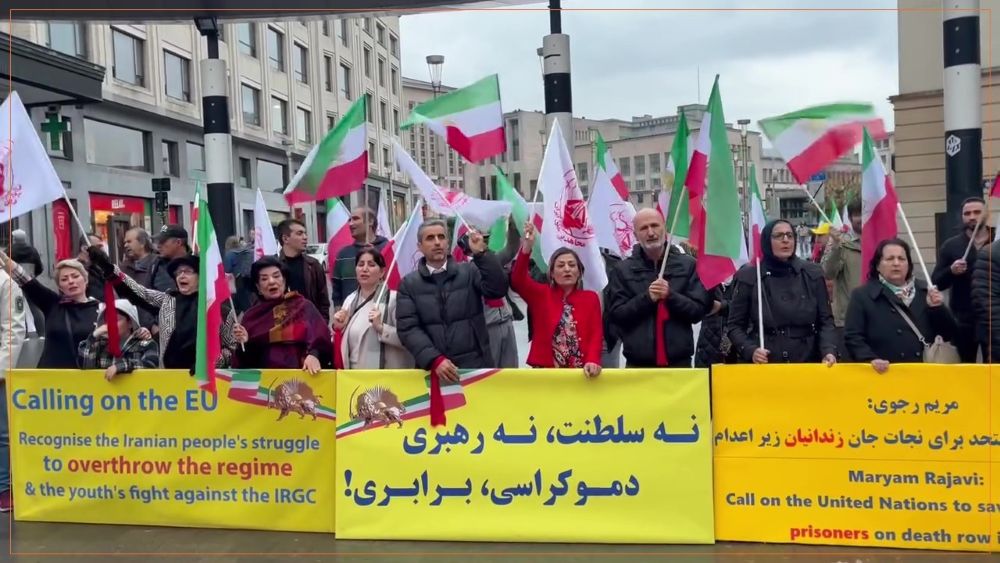
Iranians Rally in Brussels to Honor Iran’s November 2019 Uprising and Demand Regime Change

Brussels, Belgium — November 15, 2025: A rally and exhibition were held in Brussels by supporters of the People’s Mojahedin Organization of Iran (PMOI/MEK) to honor the 1500 martyrs of the nationwide Iranian uprisings in November 2019 (Aban 98), the 2022 protests, and political prisoners—especially those executed by the mullahs’ regime this year and those still at risk of execution.
Iranians Rally in Gothenburg to Honor Iran’s November 2019 Uprising and Demand Regime Change

Gothenburg, Sweden — November 15, 2025: A rally and exhibition were held in Gothenburg by supporters of the People’s Mojahedin Organization of Iran (PMOI/MEK) to honor the 1500 martyrs of the nationwide Iranian uprisings in November 2019 (Aban 98), the 2022 protests, and political prisoners—especially those executed by the mullahs’ regime this year and those still at risk of execution.
Iranians Rally in Berlin to Honor Iran’s November 2019 Uprising and Demand Regime Change

Berlin, Germany — November 15, 2025: A rally was held in Berlin by supporters of the People’s Mojahedin Organization of Iran (PMOI/MEK) to honor the 1500 martyrs of the nationwide Iranian uprisings in November 2019 (Aban 98), the 2022 protests, and political prisoners—especially those executed by the mullahs’ regime this year and those still at risk of execution.
Lost Childhoods in Iran
In many countries around the world, the International Day of the Child is an occasion for celebration, play, and hope for a brighter future; a day when schools and families emphasize children’s rights, joy, and safety. But in Iran under the mullahs’ regime, this day carries a different meaning. The reality of life for millions of Iranian children is entangled with poverty, insecurity, discrimination, structural violence, and the denial of fundamental rights; an undeniable truth that exposes the deep gap between global standards and the daily experiences of children. While the world celebrates, children in Iran remain trapped in cycles of execution, poverty, child marriage, and repression. Iran is the only country that continues to carry out executions of individuals who were under the age of 18 at the time of the alleged offense. Mai Sato, the UN Special Rapporteur on the situation of human rights in Iran, has called for the immediate halt of these executions, and Michelle Bachelet, the UN High Commissioner for Human Rights, has likewise urged Iran to stop implementing such sentences without delay.
Iranian Political Prisoner Sentenced to Death as Regime Authorities Force His Family into Silence

The death sentence for Mohammad-Mehdi Soleimani, one of those arrested during the nationwide protests of 2022, has been issued amid extensive ambiguities in his case, heavy security pressure on his family, and an absence of judicial transparency. These protests erupted across Iran after the killing of Mahsa Amini in morality-police custody. This young man, born in the 2000s, is now facing a finalized death sentence—issued through the same repeated pattern used against protesters: fabricating cases, extracting confessions under pressure, and threatening families. The incident dates back to September 21, 2022, when during protests in the Abkuh neighborhood of Mashhad, a security officer named Rasoul Doust-Mohammadi was killed. Only forty-eight hours later, the governor of Mashhad announced that “the assailant has been arrested,” but no name, photo, or details of the detained person were released.
Nationwide Aban Uprising Campaign Signals New Phase of Organized Resistance Inside Iran
A new wave of coordinated resistance activities across Iran—timed with the anniversary of the November 2019 (Aban) uprising—has marked a significant escalation in organized anti-regime operations carried out by the MEK’s network of Resistance Units (Kanoon-e Shureshi). This nationwide campaign not only honored the memory of the 1,500 martyrs of the Aban uprising, but also demonstrated that the spirit of November continues in a new phase of maximum pressure against the regime. What distinguishes this year’s Aban anniversary actions is the scale, precision, and synchronized organization behind them. According to the reports, Resistance Units executed six nationwide Aban Uprising campaigns, comprising 167 anti-repression operations and revolutionary activities across the country.