


THIS PAGE WILL BE UPDATED WITH THE LATEST NEWS
UPDATE: 08:00 AM CET
Iran Conference: Prospect for Change Featuring Distinguished Figures and Members of the Federal Parliament of Germany
On Sunday, 8 February, a conference was held in Berlin with the participation of Mrs. Maryam Rajavi, the President-elect of the Iranian Resistance, members of the German Bundestag, and political figures.
Iran Conference: Prospect for change
Featuring Distinguished Figures and Members of the Federal Parliament of Germany
At no time in Iran’s long history has the situation been as critical and turbulent as it is today.
Iran and the Middle East region stand at the heart of a… pic.twitter.com/1cei6BZOHy— Maryam Rajavi (@Maryam_Rajavi) February 8, 2026
In part of her speech, Mrs. Rajavi said: At no time in Iran’s long history has the situation been as critical and turbulent as it is today. Iran and the Middle East region stand at the heart of a profound transformation. This transformation is evident in the regime’s strategic failures across the region, in war, in the great January uprising, and most starkly in the regime’s nationwide mass killing of the Iranian people.
From Zahedan to Tehran: PMOI Resistance Units honor February 8 martyrs
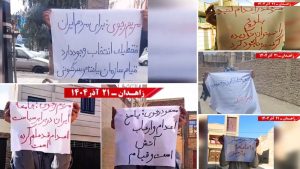
On February 6, PMOI Resistance Units in Zahedan, southeast Iran, resumed their anti-regime activities to commemorate a defining anniversary in the history of the Iranian Resistance. The brave youths of Zahedan organized these activities to honor the anniversary of February 8, 1982, the day the clerical regime attacked the headquarters of the People’s Mojahedin Organization of Iran (PMOI/MEK) in Tehran, killing key leaders Ashraf Rajavi and Moussa Khiabani along with 18 other members.
Holding placards in public places, the Resistance Units reiterated their commitment to the fight for freedom and the establishment of a democratic republic that rejects all forms of dictatorship. Their message was clear: the regime’s attempt to extinguish the flame of resistance four decades ago has failed. One placard read, “Today, Ashraf and Moussa have multiplied in thousands of Ashrafs in the young generation,” while another declared, “The blood of Ashraf and Moussa and their companions is a blazing torch lighting the path to the freedom of the nation and the people.”
Protests Continue for Sixth Day at Shiraz University of Medical Sciences
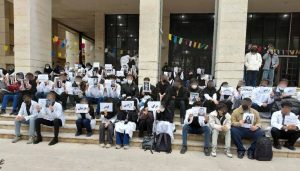
On the sixth consecutive day of protests, a group of students at Shiraz University of Medical Sciences held a demonstration and sit-in demanding the release of detained Medical Personnel on Saturday, February 7, 2026.
The protest comes amid growing dissatisfaction over security crackdowns on medical professionals and increasing restrictions imposed on activists in the healthcare sector. The protesting students strongly condemned the arrests and pressure exerted on doctors and Medical Personnel, calling for the immediate and unconditional release of those detained.
During the demonstration, students chanted protest slogans to express solidarity with Medical Personnel. Among the slogans heard were:
Why Political Boundary-Setting Is Essential to Prevent the Reproduction of Dictatorship in Iran

The January 2026 uprising and the chain of nationwide revolts that followed have brought the question of Iran’s future to the center of political debate. When the discussion turns to overthrowing the current system and shaping what comes next, a seemingly intuitive assumption emerges: that everyone opposed to the ruling theocracy must necessarily be on the same side and moving in the same direction. It is precisely at this point that deep political divergences—and conflicting strategies—begin to surface.
First, the monarchical dictatorship in Iran was decisively abolished in 1979 through the collective will of the Iranian people. The last Shah was expelled by popular consensus. Any political alliance with the son of that overthrown dictator therefore stands in direct contradiction to the explicit choice Iranians already made. Repackaging monarchy as an “option” is not neutrality; it is disregard for historical fact and popular sovereignty.
Indian Navy Seizes Three Oil Tankers Linked to Iranian Regime

Media outlets in Iran reported that the Indian Navy has seized three oil tankers linked to the Iranian regime for violating international sanctions.
According to these reports, the reason for the seizure of the three oil tankers was “illegal activities such as oil smuggling.”
Domestic media added that these tankers, which belonged to a single company, were placed on the United States sanctions list in 2025.
The Indian Coast Guard had earlier announced in a statement that on February 6, it had dismantled an international oil smuggling network in a precise and coordinated maritime-aerial operation.